Priorities before buying
Measure the space and the route to the room before comparing programmes. The door style, laundry volume and connections will often determine which format is genuinely practical.
| Priority |
What to check |
Your needs |
| Size and door clearance |
Compare the width, height and depth with the alcove, taking the hoses into account. Check the clearance needed for the door or the free space required above a top-loader. A slim model mainly reduces depth; a top-loader mainly reduces width. |
I want to install the machine without blocking a door, passageway or access to the drum. A narrow alcove may point towards a top-loader, while limited space behind the appliance may favour a slim front-loader. |
| Usable capacity |
Assess your everyday laundry, bedding, towels and washing frequency. UFC-Que Choisir generally places the needs of a one- to two-person household at between 5 and 7 kg, although this should be adjusted to your actual usage. |
I want a drum suited to my usual loads, without having to run multiple cycles or choose an appliance that is difficult to fill. Mini washing machines are better suited to small quantities than bulky laundry. |
| Connections and safety |
Check the water inlet, drainage and power supply before placing your order. In a bathroom, pay particular attention to earthing, 30 mA residual-current protection and the intended position of the appliance. |
I want to know whether the machine can be installed permanently in the chosen room. If the connections or the required space are not available, an external solution may be more realistic. |
| Noise and drying |
Check the energy label for the noise level, noise class, consumption and spin-drying efficiency. ADEME recommends choosing a good spin performance when laundry is dried indoors. |
I want to minimise disruption during the spin cycle and avoid laundry remaining very wet in a living area. Access to the filter is also important if the appliance is installed in a hard-to-reach space. |
Joybuy options for small spaces
These Joybuy options include a top-loader for a narrow alcove and a foldable mini washing machine for small supplementary loads.
 Image unavailable
Candy TCA464TM4-S ProWash 500 top-loader, 6 kg, 1 400 rpm
A top-loading option for a narrow alcove or where a front door cannot open outwards.
Listed width of 40.5 cm, 6 kg capacity, spin speed of 1 400 rpm and listed spin noise level of 79 dB(A), class C.
Its listed depth of 60 cm does not meet the needs of a shallow space. Also leave clearance above the lid and check the connections at the intended location.
Joybuy
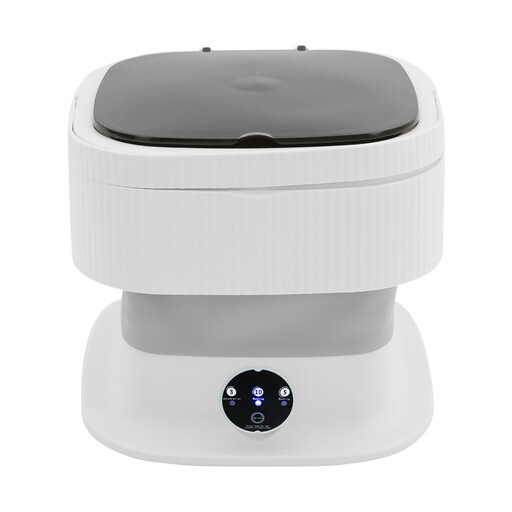 Image unavailable
10 L portable foldable mini washing machine, 40 W
A foldable supplementary solution for small loads in a dormitory, flat, campervan or while travelling.
The title states a capacity of 10 L, three durations of 2, 5 and 10 minutes, a 40 W motor, 320 rpm, a drainage basket and suction cups.
Check that the fabric load, filling, drainage and location suit your needs. For bedding, towels or regular laundry, a main appliance should still be considered separately.
Joybuy
Frequently asked questions
Does a slim washing machine solve every space problem in a studio flat?
No. It mainly reduces depth: slim models are generally still close to 60 cm wide, and their door needs clearance in front of the appliance. Measure the width, depth, hose route and door-opening radius before buying.
Is a top-loader better for a narrow bathroom?
It can be if width or front clearance is limited. According to UFC-Que Choisir, top-loaders are typically around 40 to 46 cm wide, but there must still be enough space above the machine to open the lid and load the drum.
What should you check before ordering a standard washing machine?
Check the water inlet, drainage and power supply in the intended room, as well as the space required for the appliance and its door or lid. Electrolux states that its installers connect an existing compliant installation, but do not necessarily carry out any required plumbing or electrical work.
Can you install a washing machine in a bathroom in France?
Yes, provided the safety requirements are met. According to Promotelec’s technical FAQ, the appliance must be earthed, protected by a 30 mA residual-current device and positioned beyond volume 2. Ask a qualified electrician to assess the project if you are unsure about the location or existing installation.
Can a mini washing machine replace a standard machine?
Not for most everyday needs. Mini washing machines designed for small spaces typically have a capacity of 2 to 3 kg, sometimes limited spin performance and may not be suitable for bulky items. Treat them as a supplementary solution.


