If you have a narrow space
If the machine needs to fit between two units or in a narrow bathroom, a top-loader is worth considering, as long as you can open the lid fully.


Choose a washing machine design based on the constraint that’s actually limiting your installation: a top-loader if width is tight, a slimline front-loader if there’s limited space in front of the machine, or a standard front-loader if the area in front of the door is clear. To conceal the machine behind a cupboard door, you’ll need an integrated model that’s compatible with the unit. To stack a tumble dryer on top, check that the stacking kit is designed for both models. In every case, measure the space available, including connections and room to open the door, then check the instructions for the exact model.
If the machine needs to fit between two units or in a narrow bathroom, a top-loader is worth considering, as long as you can open the lid fully.
If there’s enough width for a front-loader but the machine could stick out into a walkway, compare the overall depth of slimline models with the space you actually have.
Stacking requires a kit that’s compatible with both appliances. To conceal a machine in your kitchen, you’ll need an integrated model that fits the unit and its cupboard door. These are two different installation projects.
First, work out whether width, depth or the space needed to open the door is the main obstacle. According to Que Choisir, a top-loader may be a good solution when width is limited, while a slimline front-loader is generally the same width as a standard front-loader. Then consider capacity and any requirements for a kitchen cupboard door or a stacked installation.
| Criterion | What to check | Who this matters to |
|---|---|---|
| Size and access | Measure the width, height and depth of the space, check the connections and allow for the room the machine will take up once installed. | If the machine sticks out into a walkway, I need to be able to get past without moving anything else. Around 36% of consumers would put this space requirement first. |
| Access to the laundry | Check that the door or lid can open fully, and choose a capacity that suits your laundry loads. | If a unit gets in the way, I want to be able to load and unload the machine without a struggle. Around 29% of consumers would prioritise this access. |
| Fitting the machine in the room | For a cupboard door, check the unit and the integrated model. For a stacked set, check which kit is approved for both appliances. | If I’m planning a fitted kitchen or a stacked set, the installation needs to work with that layout. Around 21% of consumers would put this need first. |
| Everyday use | Compare the energy label, including energy consumption and spin noise, as well as the durability index that applies to the model. | If the machine is near a living area, I want to consider its noise and how it will work in everyday use. Around 14% of consumers would put these factors ahead of the others. |
A machine might fit in the measured space but leave too little room for the hoses or to open the door or lid.
Measure the width, height and depth, check the connections and test how the door or lid opens. Then compare your measurements with the product specifications and instructions.
According to Que Choisir, slimline front-loaders mainly save on depth and are generally around 60 cm wide.
If width is the issue, compare the width of a specific top-loader or compact model instead. If there isn’t enough room in front of the machine, compare overall depths.
The Electrolux STA8GW4 kit is for front-loading appliances with a depth of 47 to 60 cm, and compatibility must be checked using the PNC number. These conditions don’t apply to every kit.
Once you’ve chosen both appliances, check the relevant documentation to confirm which kit is approved for their exact model numbers.
Two models that fit the same space can also differ in spin noise and the information available about their durability.
Compare the details on the energy label and, for the washing machines covered in France, check the durability index and its breakdown. The DGCCRF says this information must also be provided for online sales.
Worth considering if limited width points you towards a top-loading machine.
A brand to explore if you’re comparing different top-loading washing machines.
A brand to consider if you want to conceal a washing machine in a fitted kitchen.
A useful option if you’re planning a stacked set of front-loading appliances.
These two models show different options for a tight space: a top-loader if width is the key factor, or a front-loader if you can keep the space in front of the door clear. Before deciding, check the installation dimensions in the documentation for each model.
 Image unavailable
Worth considering when width is the main constraint and you can keep the space above the machine clear.
Top-loading, with a stated capacity of 6 kg, a spin speed of 1,400 rpm, a B energy rating and 17 programmes.
Check the instructions for the space needed to open the lid, as well as the machine’s overall size with its connections.
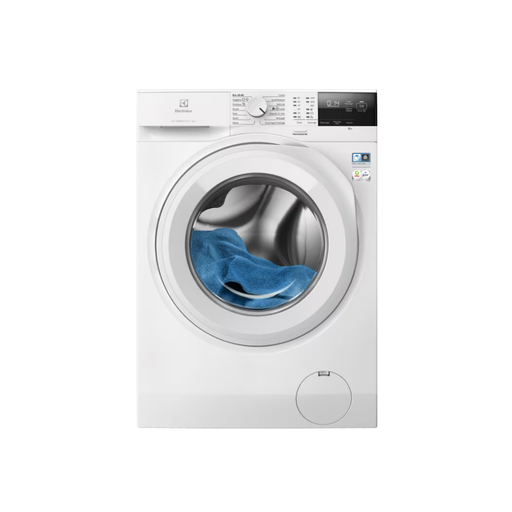 Image unavailable
Worth considering if a front-loader suits your layout and there’s enough room in front of the machine to open the door.
Stated capacity of 8 kg and a spin speed of 1,400 rpm.
Check the dimensions with the connections and allow for the door to swing open. If you’re planning to stack the machine or install it in a cupboard, check compatibility for the exact models separately.
Not necessarily. According to Que Choisir, slimline front-loaders are generally around 60 cm wide and mainly save on depth, which varies by model. If your space is too narrow, compare the exact dimensions of top-loaders or compact models.
No. Stacking requires a kit that’s compatible with both models. The Electrolux STA8GW4 kit, for example, is for front-loading appliances with a depth of 47 to 60 cm and requires a PNC number compatibility check. Don’t assume these conditions apply to a different kit.
Choose a capacity that suits the amount of laundry you do, rather than assuming the smallest model will be enough. ADEME says that a 7 kg washing machine is sufficient most of the time. However, Que Choisir notes that slimline front-loaders generally have capacities of around 4 to 6 kg, while compact models have capacities of under 5 kg.
Compare energy consumption, water use, capacity, the duration of the reference programme, noise and spin-drying efficiency for models that fit your space. ADEME recommends checking the label to assess these factors rather than focusing on the machine’s size alone.
Yes, for the front-loading and top-loading washing machines covered: the French Ministry of the Economy says the durability index has applied to these categories since 8 April 2025. The DGCCRF says the information must also be provided for products sold online. Check the index and its breakdown for the model you’re considering.