If depth is limited but width and space for the door to open aren’t an issue, consider a slimline front-loader. If space in front of the machine or its width is restricted, a top-loader may be a better fit, as long as there’s room above it. For one or two people, UFC-Que Choisir suggests 5 to 7 kg as a guide to capacity, which you can adjust to suit the laundry you actually wash. Before choosing, check the appliance’s dimensions, door clearance and connections against the space you have. A mini washing machine is best treated as a back-up option if a full-size model can’t be installed.
Which formats suit different needs?
If depth is limited
A width close to 60 cm may fit in your kitchen or utility room, but the machine shouldn’t stick out too far. A slimline front-loader is worth considering if you can also open its door fully. UFC-Que Choisir and Electrolux France describe this format as shallower, but not necessarily narrower.
If there isn’t much room in front of the machine
A narrow passage or an obstacle in front of the appliance can make it difficult to open a front-loader’s door. A top-loader may be a good option, as long as there’s nothing above it to obstruct the lid, as UFC-Que Choisir points out.
If you do smaller loads regularly
For one person or a couple, a drum that’s too small can mean running more wash cycles. UFC-Que Choisir suggests 5 to 7 kg as a starting point. Compare this guide with your bedding, towels and washing habits before settling on a capacity.
What should you check before buying?
To choose between a slimline front-loader and a top-loader, start by identifying the dimension that’s actually preventing installation. The former mainly reduces depth, while the latter avoids the need for door clearance in front of the appliance. UFC-Que Choisir and Electrolux France also point out that a top-loader needs room to open above it. In both cases, check the connections and capacity separately.
| Criteria |
What to check |
Who should consider it |
| Size and opening clearance |
Measure the space, the route for the hoses and the clearance needed to open the door or lid. Check the model’s full dimensions. |
If the machine might block the passage, I need to know which way it opens and how much room it takes up once installed. Around 36% of consumers would make the appliance’s footprint their top priority. |
| Connections and installation |
Locate the water inlet, drain, power socket and delivery route, then check these against the model’s manual. |
If the connection points are difficult to access, I want to know whether installation is feasible before choosing a format. Connections would be a priority for around 29% of consumers. |
| Capacity |
Think about your usual loads, especially bedding and towels. UFC-Que Choisir suggests 5 to 7 kg as a guide for one or two people. |
If my laundry often includes bulky items, I want a capacity that won’t mean running extra cycles. Around 21% of consumers would put laundry capacity first. |
| Noise and energy use |
Check the energy label for kWh per 100 cycles, water use per cycle, the Eco programme duration and noise levels, taking the capacity into account. |
If the machine is near the living area, I pay as much attention to the spin cycle and programme duration as I do to energy use. Around 14% of consumers would put this day-to-day comfort first. |
What mistakes should you avoid?
-
Measuring only the space where the machine will go
A slimline front-loader may still be close to 60 cm wide and needs room in front for its door to open. The hoses and the delivery route also affect whether installation is possible.
Measure the space in all three dimensions, the route to the room and the clearance needed. Then compare these with the specifications and manual for the exact model.
-
Choosing the smallest drum without considering what you wash
A small capacity can mean running more cycles if your usual loads won’t fit in the drum.
Use UFC-Que Choisir’s guide of 5 to 7 kg for one or two people as a starting point, then adjust it to suit your fabrics and how often you do laundry.
-
Expecting a mini washing machine to handle all your laundry
A mini washing machine is designed as a back-up, so it may not be able to handle a household’s everyday loads.
Only consider one if you have small loads and can’t install a full-size appliance. Check its capacity and water supply and drainage requirements.
-
Overlooking levelling and drainage
Bosch support guidance and Beko manuals highlight the need to take care with transit bolts, adjusting the feet and routing the drain hose during installation.
Follow your model’s manual to remove the transit bolts, adjust the feet and check that the drain hose isn’t kinked or blocked before the first cycle.
Brands to know when comparing formats
Electrolux
Electrolux France features slimline front-loaders and top-loaders in the ranges reviewed.
- These two formats let you consider limited depth and restricted front-door clearance separately.
- Check the dimensions and door clearance of the specific model: ‘slimline’ doesn’t necessarily mean narrower.
Beko
Beko France features front-loaders with reduced depth, including a selection of models listed as 45 cm deep.
- The LLFU3722 specifications provide model-specific details to help you assess installation and use.
- Don’t assume the LLFU3722’s features apply to other Beko models. Check the full external depth and the manual for the model you’re interested in.
Candy
Candy France offers 5 kg, slimline and top-loader washing machine ranges. The brand positions its 5 kg models for smaller loads.
- A 5 kg capacity gives you a useful point of comparison if your usual laundry fits into smaller loads.
- Being described as suitable for a studio flat doesn’t remove the need to check the specific model’s dimensions, noise levels and capacity.
Bosch
Bosch Home Appliances France offers front-loaders and support guidance on installation and drainage.
- This guidance helps you prepare checks for levelling, transit bolts and connections.
- One Bosch front-loader reviewed is 590 mm deep. Check the dimensions of the model you’re considering rather than assuming a front-loader will fit into a shallow space.
Washing machines to explore on Joybuy
These top-loaders and front-loaders let you consider two different constraints: the space in front of the machine and the available depth. Compare each model with your available space, connections and laundry loads.
 Image unavailable
Haier T Series 7 THASN276TM6-S, 7 kg top-loader
Worth considering if you’re short on space in front of the machine but can open its lid above.
The model name indicates a 7 kg capacity, a 1,200 rpm spin speed and an energy rating of A.
Check the manual for the required clearance and make sure the connections are compatible with your home.
View on Joybuy
 Image unavailable
Candy TCA464TM4-S ProWash 500, 6 kg top-loader
Top-loading means you don’t need to leave space in front of the appliance for a door to open, as long as the top is clear.
The model name indicates a 6 kg capacity, a 1,400 rpm spin speed and an energy rating of B.
Check the dimensions, hose route and connections against the manual before choosing this format.
View on Joybuy
 Image unavailable
Hisense WF5I8043BWF, 8 kg front-loader
Worth considering if depth is your main constraint and the width and door clearance work for your space.
The model name indicates an 8 kg capacity and a 1,400 rpm spin speed. This is above UFC-Que Choisir’s guide of 5 to 7 kg for one or two people, so compare it with your usual loads.
Check the installation dimensions, door clearance and connections in the manual.
View on Joybuy
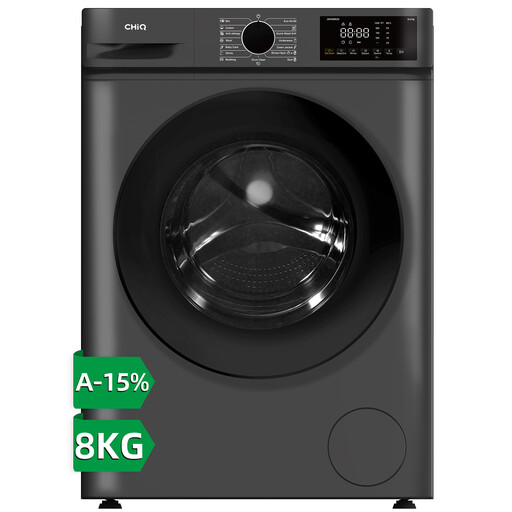 Image unavailable
CHiQ JW85883G, 8 kg front-loader
Only consider this front-loader if its full dimensions and door clearance suit the space you have.
The model name indicates an 8 kg capacity and a 1,400 rpm spin speed. Compare this capacity with your usual loads, not just the space available.
Check the energy label to compare energy use, Eco cycle duration and noise levels, then consult the manual for connection requirements.
View on Joybuy
Frequently asked questions
Does a slimline washing machine also take up less width?
Not necessarily. According to UFC-Que Choisir and Electrolux France, slimline front-loaders mainly reduce depth and are generally close to 60 cm wide. Also measure the space in front of the appliance to make sure the door can open.
What capacity should one person or a couple choose?
UFC-Que Choisir suggests 5 to 7 kg as a starting point for one or two people. Adjust your choice to how often you do laundry and how much space your bedding, towels and other bulky items take up.
Which connections should you check before ordering?
Check the water inlet, drain, power socket and possible hose route, then consult the model’s manual for installation requirements. Electrolux France’s pre-installation guide explains that its installation service doesn’t include plumbing, electrical or joinery work.
How can you stop a washing machine moving or draining poorly after installation?
Follow the model’s manual to remove the transit bolts, adjust the feet and check the route of the drain hose. Bosch support guidance and Beko manuals highlight the importance of levelling the machine and making sure the hose isn’t kinked or blocked.


