Start by choosing according to the amount of laundry actually combined, the available width and whether you need to dry clothes on site: a front-loading machine suits larger loads, a top-loading model works well in narrow spaces, while a washer-dryer makes sense when the lack of drying space justifies a lower drying capacity. Then compare the Eco 40-60 capacity, spin noise, water and energy consumption, and the durability index; the European Commission and ADEME state that this information complements the energy class alone.
Which households is it for?
Shared homes with a frequently full laundry basket
You share an appliance between several occupants and can combine loads of dry laundry. The usable capacity also depends on the programme: the maximum Eco 40-60 load does not automatically apply to synthetics, jeans or woollens.
Shared homes with limited space
You have a narrow space and need to balance capacity, access to the machine and spin noise. A compact top-loading model may be suitable, provided you compare the specifications for the exact reference.
Homes without dedicated drying space
You are considering a washer-dryer because using a clothes airer or installing a separate tumble dryer is not realistic. The decisive factor is the capacity that can actually be used for the wash-and-dry cycle, which is often lower than the washing-only capacity.
Buying priorities
Front-loading washing machine
Consider it: if the household regularly combines large loads, bedding or towels and has a standard-width installation space.
Watch out for: a large capacity must still be suitable for the programmes and loads you actually use.
Top-loading washing machine
Consider it: when installation width is the main constraint and a capacity of 6 to 7 kg is sufficient for the household.
Watch out for: check the clearance above the machine for opening, the spin noise and the available capacity.
Washer-dryer
Consider it: when drying clothes in the home or installing a separate appliance is impractical.
Watch out for: the wash-and-dry load is often smaller than the washing-only load.
| Priority |
What to check |
Your needs |
| Suitable capacity |
Compare the capacity in kg of dry laundry, programme-specific limits and installation dimensions. |
I want to combine laundry from several occupants without running underfilled cycles or doing more washes than necessary. |
| Noise and spin cycle |
Check the noise emissions in dB, the noise class and the spin speed on a like-for-like basis. |
The machine is close to living areas; I want to minimise disturbance during the spin cycle and reduce the moisture left in the laundry. |
| Water and energy |
Compare kWh per 100 cycles, litres per cycle, the Eco 40-60 duration and the noise level. |
We use the appliance frequently and want to compare usage data rather than focusing solely on the energy class letter. |
| Durability and maintenance |
Check the durability index displayed for the exact reference, along with the model data in EPREL. |
I want concrete information about durability and future maintenance, beyond a brand promise. |
Mistakes to avoid
-
Choosing a large drum assuming it will automatically save water and electricity
An unsuitable capacity can result in underfilled cycles or more frequent washing. The right reference point is the amount of dry laundry actually combined and the programmes used.
Estimate the combined loads of cottons, sheets and towels in the household, then check the limits specified for synthetics, jeans and woollens.
-
Comparing a washer-dryer based solely on its washing capacity
The capacity of the complete wash-and-dry cycle may be lower than the washing-only capacity. A full washing load may therefore require some of the laundry to be removed before drying.
Check the washing and wash-and-dry capacities separately, then make sure the load arrangement works for your household.
-
Looking only at the energy label letter
The energy class alone does not tell you how much water is used per cycle, the Eco 40-60 duration, spin noise, capacity or spin class.
Compare the figures on a like-for-like basis: kWh per 100 cycles, litres per cycle, duration, dB during the spin cycle, capacity and spin class.
-
Confusing a durability promise with the durability index and commercial warranty
A manufacturer’s promise or commercial warranty does not replace checking the durability index and the terms applicable to the specific model.
Check the durability index for the French market, the exact reference and the written warranty terms before comparing your options.
Brand guide
Bosch
Worth considering if your household is looking at a washer-dryer and needs to compare the washing capacity with that of the wash-and-dry cycle.
- For the WKD28260FR, Bosch states a capacity of 8 kg for washing and 5 kg for wash-and-dry.
- These specifications apply to this specific built-in model and do not apply to all Bosch washer-dryers.
Whirlpool
Worth considering for a top-loading installation where available width matters more than having a very large capacity.
- The TW6522FRESHCAREFR is an example of a 40 cm-wide top-loading model, with a stated capacity of 6.5 kg and a spin speed of 1,200 rpm.
- The capacity must remain suitable for the household’s combined laundry volume, and spin noise should be compared model by model.
Miele
Worth considering for an 8 kg front-loading washing machine when you want to compare label and product-sheet data for a specific reference.
- The WWA120 WCS 8kg Active product sheet states that it is front-loading, with an 8 kg capacity and a spin speed of 1,400 rpm.
- Miele makes a product claim that it is “tested for a 20-year lifespan”; this is a brand statement, while consumption, noise and dimensions must be checked for the exact reference.
Joybuy options
Joybuy options covering the three configurations considered for a shared home: front-loading for combined loads, top-loading for a narrow space and a washer-dryer for drying clothes at home.
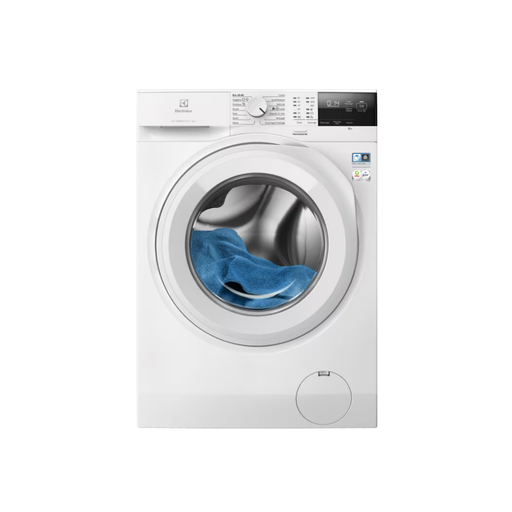 Image unavailable
Electrolux EW6FI4805AW, 8 kg front-loading washing machine
Worth considering for regularly combined household loads where there is room for a front-loading appliance.
Stated capacity of 8 kg, spin speed of up to 1,400 rpm, 43 L per cycle and 47 kWh per 100 cycles. Stated dimensions: 847 × 596 × 576 mm; also allow clearance for the door.
The stated noise level of 75 dB during the spin cycle should be compared with the machine’s actual location. Check the durability index and EPREL data for this reference before buying.
Joybuy
 Image unavailable
Candy TCA464TM4-S ProWash 500, 6 kg top-loading washing machine
Worth considering when available width is the priority and household loads are relatively small or variable.
Stated width of 40.5 cm, capacity of 6 kg, spin speed of up to 1,400 rpm, 41 L per cycle and 49 kWh per 100 cycles.
The 6 kg capacity may mean more cycles for sheets or towels belonging to several occupants. The stated spin noise is 79 dB(A); also check the clearance needed to open the machine.
Joybuy
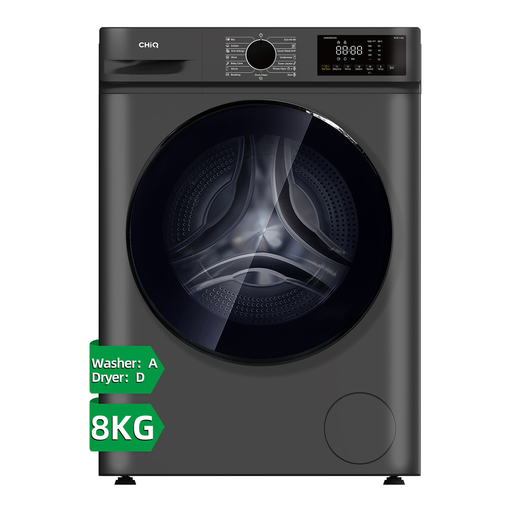 Image unavailable
CHiQ JW85882HG, 8 kg/5 kg washer-dryer
Worth considering when you need to wash and dry clothes at home without installing a separate drying appliance.
Stated capacity of 8 kg for washing and 5 kg for drying, with a spin speed of up to 1,400 rpm.
A full washing load may require some laundry to be removed before drying. Confirm the installation dimensions: the stated information gives both a width of 465 mm and dimensions of 600 × 520 × 847 mm.
Joybuy
Frequently asked questions
Which parts of the energy label should you compare for a washing machine?
Compare the class from A to G, energy use per 100 cycles, water use per cycle, cycle duration and noise emissions. The European Commission explains that these figures are used to compare models under regulatory conditions; they do not precisely predict the consumption of a shared household.
Must the durability index be displayed on a new washing machine in France?
Yes. ADEME states that displaying the durability index has been compulsory for washing machines since April 2025. Check that the index shown corresponds to the exact reference of the model on offer.
Why do you need to check two capacities on a washer-dryer?
The washing capacity may be higher than the capacity for the complete wash-and-dry cycle. For example, Bosch states that the WKD28260FR can wash 8 kg and wash and dry 5 kg: to dry continuously, you must follow the lower capacity.
Is the energy label QR code useful before buying?
Yes. It provides access to EPREL, the European public database, where you can view detailed data for the model placed on the European Union market. In particular, check the capacity, water and energy consumption, Eco 40-60 duration, spin cycle and noise level.


