Who is this choice for?

Households looking for a repairable machine

If you’re replacing a worn-out or faulty appliance, you’ll want to check the details of its durability index, which parts it covers and the warranties available. The Ministry of the Economy and the DGCCRF provide guidance on the durability index and information about spare parts.

Households with limited space

Check the width and depth, as well as the space needed to open the door or lid. UFC-Que Choisir identifies a narrow width as one of the factors to consider when choosing a top-loading model.

Households doing laundry frequently

Choose a capacity that suits your usual loads, and compare water and energy use, spin performance and noise levels. ADEME recommends matching capacity to your needs and checking the energy label.

What to compare

Front-loading washing machine

Consider this if: you have space for the door to open and may want to fit the appliance under a worktop.

Check: the depth, access for maintenance and the model’s detailed durability index. UFC-Que Choisir and the Ministry of the Economy outline these factors when comparing the appliances covered by the rules.

Top-loading washing machine

Consider this if: you have limited width and enough clear space above the machine.

Check: the clearance needed to open the lid and the model’s detailed durability index. With top loading, you can’t use the space directly above the machine as a worktop.

Washer-dryer

Consider this if: you need to dry your laundry but don’t have room for a second appliance.

Check: the drying capacity, which is lower than the washing capacity, and the figures for a complete cycle. The Ministry of the Economy specifies front-loading and top-loading washing machines as the appliances covered by the mandatory index; don’t assume this requirement automatically applies to washer-dryers.

What matters What to check before buying Who prioritises it most
Durability and repairability Check the details of the index for the model you’re considering, and find out which parts are covered, whether they’re available and what the warranty conditions are. The DGCCRF notes that the rules on spare parts don’t mean a repair will be free. When I replace a machine, I want to know what the index and warranties actually cover before relying on a repair. Around 36% of consumers put durability and repairability at the top of their list.
Size and access Measure the space and delivery route; compare the appliance’s dimensions and the clearance needed to open the door or lid. If the space is narrow or difficult to access, I check that I’ll still be able to load the machine and open it properly. Around 29% of consumers prioritise the appliance’s size and accessibility.
Capacity and consumption Match the capacity to your usual loads, then compare water and energy use, spin performance and noise levels on a like-for-like basis. ADEME says 7 kg is enough for most households, but this is only a guide and doesn’t replace an assessment of your needs. For regular laundry, I look for a capacity that suits my washing rather than choosing a drum size without considering my usual loads. Around 21% of consumers prioritise washing frequency and consumption.
Integrated drying Check the washing and drying capacities separately, along with the complete-cycle figures on the model’s label. If I don’t have room for a second appliance, I check that the drying capacity suits the loads I want to dry. Around 14% of consumers prioritise having washing and drying in one space.

Pitfalls to avoid

  • Confusing a durability index with a guaranteed lifespan

    The index combines repairability and reliability criteria, but it doesn’t guarantee how many years an appliance will work for. A commercial warranty that covers only the motor may not cover the other components.

    Check the details of the model’s index, find out which parts are covered and read the commercial warranty conditions separately before comparing offers.

    You may still have to pay for a repair if the fault or part isn’t covered by the applicable warranty.

  • Choosing the largest capacity without considering your usual laundry loads

    ADEME recommends matching capacity to your needs. A drum that’s too large for your usual loads may often be only partly filled or lead you to run more cycles.

    Start with the amount of laundry you actually wash, then compare the consumption figures for the models you’re considering.

  • Assuming a washer-dryer’s washing capacity is the same as its drying capacity

    Its drying load is smaller than its washing load. For the LG F964R33WR, LG lists a washing capacity of 9 kg and a drying capacity of 6 kg. These figures apply to this particular model, not to all washer-dryers.

    Compare both capacities and the figures for a wash-and-dry cycle before deciding whether the appliance suits your loads.

    If you need to split a load for drying, it may take longer to get through your laundry and require extra cycles.

Brands to consider

Bosch

The front-loading Series 6 range is worth considering if its capacity and dimensions suit your space.

  • For the WGG244FRFR, Bosch lists a 9 kg capacity, dimensions of 848 × 598 × 590 mm and a 10-year warranty on the motor.
  • This commercial warranty covers the motor and doesn’t, on its own, tell you about other parts or the model’s durability index.

Whirlpool

A top-loading model may be worth considering if you have limited width and can open the lid.

  • For the TDLR6261BFR, Whirlpool lists a width of 40 cm and a capacity of 6 kg.
  • These specifications apply to this particular model and don’t describe the brand’s entire range of top-loading machines.

LG

A washer-dryer is worth looking at if you need washing and drying to fit into one space.

  • For the F964R33WR, LG lists a washing capacity of 9 kg and a drying capacity of 6 kg.
  • The manufacturer’s claims about efficiency or reliability aren’t an independent measure of how long the appliance will last.

Miele

The brand’s stated spare-parts policy may be worth considering if repairability matters to you.

  • Miele says it keeps original spare parts in stock for at least 15 years after series production ends.
  • This policy doesn’t guarantee an appliance’s lifespan. Check the part number and cost for the model you choose.

Washing machines available on Joybuy

The models below include front-loading and top-loading washing machines, as well as washer-dryers. Compare their size and features with your home and laundry needs.

Samsung WD11DG6B85BEU3 washer-dryer

Samsung WD11DG6B85BEU3, 11/6 kg washer-dryer

Worth considering if you want to wash and dry in one space; the drying capacity is lower than the washing capacity.

Listed capacity: 11 kg for washing and 6 kg for drying. The product details list separate energy classes, consumption figures and cycle times for washing and the combined cycle.

View on Joybuy

Samsung WD10HG6U34BEU3 washer-dryer

Samsung WD10HG6U34BEU3, 10/6 kg washer-dryer

This style could suit you if you need washing and drying in one space; check that the drying capacity meets your needs.

Listed capacity: 10 kg for washing and 6 kg for drying. The energy class shown in the product name is D.

View on Joybuy

Candy TCA464TM4-S ProWash 500 top-loading washing machine

Candy TCA464TM4-S ProWash 500, 6 kg top-loading washing machine

Worth comparing if you’re looking for a top-loading machine; check that there’s enough clearance to open the lid in your home.

Capacity: 6 kg. Listed width: 40,5 cm; maximum spin speed: 1 400 rpm. The product details mention 17 programmes and an energy class of B.

View on Joybuy

Hisense WF5I8043BWF front-loading washing machine

Hisense WF5I8043BWF, 8 kg front-loading washing machine

Worth comparing if the depth of your space is a key consideration; also measure the clearance needed in front of the door.

Capacity: 8 kg; listed depth: 47 cm; energy class A. The product details list 33 kWh per 100 cycles and 38 litres per cycle.

View on Joybuy
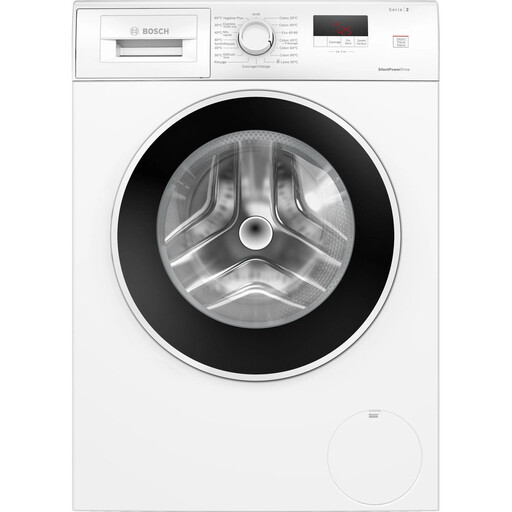
Bosch WGE02409FR front-loading washing machine

Bosch WGE02409FR, 7 kg front-loading washing machine

Worth comparing if a 7 kg capacity suits your usual loads; check the model’s detailed durability index.

Capacity: 7 kg; energy class A; maximum spin speed: 1 400 rpm. The product details list a 2-year product warranty and a separate 10-year commercial warranty on the motor.

View on Joybuy

Frequently asked questions

What should I look for in a durability index?

For a front-loading or top-loading washing machine covered by the rules, check the details of the index parameters for that model. The Ministry of the Economy says this information must be available at the point of sale and, for online purchases, on the page displaying the index. The index covers repairability and reliability; it doesn’t guarantee a particular lifespan.

Does a washer-dryer have to display the same index as a top-loading or front-loading model?

Don’t automatically assume that the requirement confirmed for front-loading and top-loading washing machines also applies to washer-dryers. The Ministry of the Economy specifies these two formats for the index. For a washer-dryer, also check the energy label and the information for that model, particularly for the complete cycle.

Does a 10-year motor warranty replace the statutory guarantee?

No. If you buy from a professional seller in France, the statutory guarantee of conformity is separate. Service Public says the fault must appear within two years of the goods being delivered. Check the terms of any advertised commercial warranty on the motor separately.

Can I look into a repair before replacing the appliance?

Yes, subject to certain conditions. Under the ecosystem scale in force since 1 January 2026, the repair bonus for a washing machine is 50 € if the appliance is no longer covered by a warranty, the fault is eligible and the repair is carried out by a QualiRépar-approved professional. Compare the quote with the cost of replacing the appliance, and don’t assume every repair is eligible.

Can my old washing machine be collected when my new one is delivered?

In France, under the conditions for « 1 for 1 » take-back, the retailer concerned must collect your old appliance free of charge if it’s the same type and you want to dispose of it. Service Public gives the example of an old washing machine being collected when a new one is delivered.