Before choosing a model, measure the delivery route, the space available and the room needed to load your laundry. If width is the main constraint, a top-loading washing machine is worth considering. If depth, the door or a worktop is the issue, compare front-loading models that suit your space and check their installation requirements. In every case, confirm the exact model, its connections and the clearance needed when the door is open.
Who is each configuration suited to?
If your space is particularly narrow
If the machine needs to fit between two units without obstructing the walkway, a top-loading model is worth considering. The French National Consumer Institute gives the usual width for this type of appliance as 40 to 45 cm. However, you’ll need enough clearance above it to open the lid, so it’s not a good choice for a space beneath a worktop.
If depth and the door are the main constraints
A front-loading machine may fit the available width, but its open door could block the bathroom or walkway. Measure the depth when the machine is ready to load, and allow for the hoses behind it too: the depth with the door closed doesn’t tell you whether there’s enough room to move around.
If you want to fit the machine into your units
If the machine is going beneath a worktop or inside a unit, look for a model explicitly designed for that installation rather than choosing a front-loader based on its height alone. Check that its capacity suits your household too. If the work involves altering a rented property or its fittings, get the landlord’s written permission first, as ANIL advises.
What should you check before choosing?
The main constraint can vary: the width of the route, the space in front of the door or fitting the machine beneath a worktop may all point to different configurations.
Top-loading
Worth considering: when width is the main obstacle and there’s enough clearance to open the lid fully.
The trade-off: the lid opens upwards, which generally rules out installing the machine beneath a worktop or stacking a tumble dryer on top.
Shallow front-loader
Worth considering: if a front-loader will fit widthways, but its depth when closed needs to leave enough room for the walkway or surrounding furniture.
The trade-off: a shallower machine doesn’t necessarily leave enough room to walk past when its door is open.
Built-under or integrated front-loader
Worth considering: if the machine needs to fit beneath a worktop or inside a unit designed for it.
The trade-off: compatibility depends on the exact model and its instructions; a cover panel or under-worktop accessory may be needed, depending on the model.
| What to consider |
What to check |
Who is it for? |
| Width and access |
Measure the clear width of the space and the access route the machine will take on delivery. For a top-loader, check the clearance needed to open the lid too. |
If the machine needs to fit between two units without blocking the walkway, width would be my first priority. Around 38% of consumers facing this issue would put it top of their list. |
| Depth and door clearance |
Compare the depth with the door closed against the space needed with the door open on the exact model, allowing for the connections as well. |
If an open door could block the walkway, I need to be able to load the laundry while keeping the route clear. This would be the top priority for around 31% of consumers facing this issue. |
| Installation and capacity |
Check in the instructions whether the machine is suitable for fitting beneath a worktop or inside your unit, then choose a capacity that suits your laundry needs. ADEME says that 7 kg is enough in most cases. |
If it’s going beneath a worktop, I want a machine that can be installed as intended and still has a suitable capacity for my household. Around 31% of consumers facing this issue would put this need first. |
Mistakes that can complicate installation
-
Measuring only with the door closed
A front-loader may fit into its space but block the walkway when the door is open. The Joybuy listing for the Bosch WAN28258FR gives a depth of 590 mm with the door closed, compared with 1 063 mm with the door open at 90°: these measurements apply to this specific model.
Mark out the loading space in front of the machine on your plan, then check the open-door measurement and which way the door opens on the model you’re considering.
-
Assuming “narrow” means “compact”
A top-loading washing machine may save width while still taking up plenty of depth. The French National Consumer Institute says that this type of machine is generally close to 60 cm deep, and can sometimes be 65 cm deep.
Measure the width, depth, access to the connections and clearance above the lid separately.
-
Planning to fit a machine beneath a worktop without checking the exact model
Having enough height doesn’t prove that an appliance can be built in or that its top panel can be removed. Bosch lists some built-under models with removable top panels, but this feature isn’t available across all front-loaders.
Read the installation instructions and check which accessories you’ll need before ordering. If the work involves altering a rented property or its fittings, get the landlord’s written permission first, as ANIL advises.
-
Assuming delivery includes installation
Getting the machine into your home and setting it up are separate services, so check exactly what’s included. The DGCCRF says that sellers must tell you the delivery timeframe they commit to.
Before ordering, confirm access to your floor, the delivery conditions, whether your old appliance can be taken away and exactly what the installation service includes.
Brands and ranges to consider
Bosch
The brand has front-loaders designed to fit beneath a worktop, with a removable top panel. The WOT24257FF also gives an example of a top-loading model, though this doesn’t indicate current availability.
- Bosch gives dimensions of 900 × 400 × 650 mm and a capacity of 7 kg for the WOT24257FF. These measurements help illustrate the balance between width and depth on this particular model.
- For a front-loader intended for use beneath a worktop, check the chosen model’s instructions for its dimensions, installation method and any accessories required.
Whirlpool
The range includes a built-in front-loader with published dimensions that can help you assess whether it will fit beneath your units.
- Whirlpool gives dimensions of 59,5 × 81,5 × 54,5 cm (W × H × D) and a capacity of 8 kg for the BI WMWG 8146 FR.
- Another front-loader from the brand, the freestanding W7X89ESILENCEFR, is listed as 60,7 cm deep. Don’t assume the built-in model’s dimensions apply to the whole range.
Electrolux
Electrolux offers top-loading washing machines for spaces where width is limited or a front-loader’s door would get in the way.
- With a top-loader, you don’t need to leave space in front of the machine for a door to open.
- Check the width, depth, capacity and clearance needed for the lid on the model you choose; the term “top-loader” doesn’t specify these dimensions.
Candy
Candy offers ranges of “slim” front-loaders and top-loading washing machines, giving you two ways to make the most of a smaller space.
- Candy describes its “slim” range as having a reduced depth, and its catalogue also includes top-loading models in different capacities.
- Check the depth of a “slim” model and the clearance needed for its door on the individual product listing, rather than relying on the range name.
A front-loading washing machine to consider on Joybuy
Consider this front-loader if you have enough room to install it and open its door. Its capacity and spin speed are listed, but whether it suits your laundry area depends on the dimensions and connections at your particular installation point.
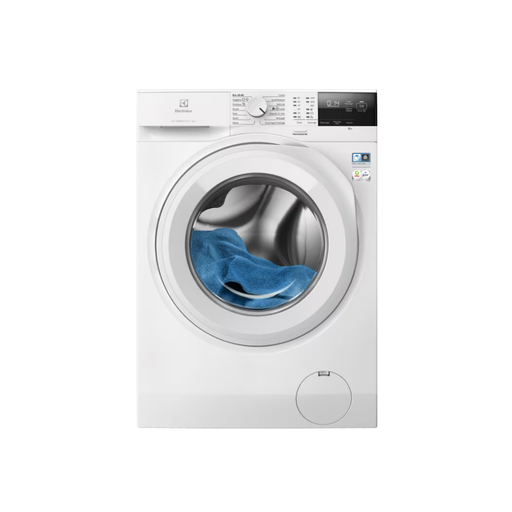 Image unavailable
Electrolux EW6FI4805AW, 8 kg front-loading washing machine
Worth considering if you’re looking for an 8 kg front-loader and can leave enough room in front of the door.
The product title lists a spin speed of 1 400 rpm. Before buying, check the instructions for this model’s dimensions, the space it takes up with the door open and the clearance needed for the connections.
View on Joybuy
Frequently asked questions
What should I measure before ordering a washing machine for a narrow space?
Measure the delivery route, then the width, height and depth of the space. Allow for the connections and the room needed to load the machine too. For a front-loader, check the depth with the door open; for a top-loader, check the clearance above the lid.
Is a top-loading washing machine always suitable for a small room?
No. It mainly helps when width is the issue and avoids the need for a door to open forwards. The French National Consumer Institute gives the usual width for this category as 40 to 45 cm, but you’ll still need enough depth and room to open the lid. For fitting beneath a worktop, a front-loader designed for that purpose is generally a better choice.
Can I alter the connections or a unit in a rented property?
If the work involves altering the rented property or its fittings, get the landlord’s written permission before starting. ANIL highlights this requirement for alterations; you should still check the installation instructions for your chosen washing machine separately.
Does delivery include setting up the washing machine?
Don’t assume that installation is included with delivery: check which services are covered by your order. Also confirm access to your home, whether your old appliance can be taken away and the stated delivery timeframe. The DGCCRF says that sellers must clearly tell you the timeframe they commit to.
What capacity should I choose if space is limited?
Choose a capacity that suits both your laundry habits and the space available. ADEME says that 7 kg is enough in most cases. Then compare the dimensions of models that meet your needs, rather than choosing a capacity that makes installation impossible.


