Households limited by width
If your doorway or alcove is narrow, a top-loading machine is worth considering. Que Choisir says top-loading washing machines are 40 to 46 cm wide; you’ll also need enough room to open the lid.


First, choose a format based on the dimension that limits your installation options: a top-loading washing machine suits a narrow space, while a slim front-loader is designed primarily for limited depth. If you’re planning to fit it under a worktop, behind a cabinet door or in a stack with a tumble dryer, check that the model and the appliances involved are suitable for that setup. Before ordering, compare the installation instructions and required clearances with the actual measurements of your room: the appliance dimensions alone aren’t enough.
If your doorway or alcove is narrow, a top-loading machine is worth considering. Que Choisir says top-loading washing machines are 40 to 46 cm wide; you’ll also need enough room to open the lid.
If there’s enough width for a front-loader but it would stick out too far into the room, a slim model could solve the depth problem. Remember to measure the space needed to open the door and accommodate the connections.
If you want to fit the machine under a worktop, behind a cabinet door or below a tumble dryer, your choice will depend on the type of appliance, the dimensions of the alcove and, for a stacked setup, whether the stacking kit is compatible with both models.
In a narrow room, first identify the dimension or layout feature that determines which format you need. Then check there’s enough space to use and connect the model you choose.
| Constraint | What to check | Who this affects |
|---|---|---|
| Available width | Measure the doorway and alcove; for a top-loader, also allow room to open the lid. Que Choisir puts the width of top-loaders at between 40 and 46 cm. | If the doorway is too narrow for the front-loader I’m considering, I’ll look for a narrower machine first. Around 25 % of consumers facing these constraints put width first. |
| Available depth | Compare the model’s depth with the alcove, remembering to allow for the door and connections. Electrolux describes its slim front-loaders as appliances with reduced depth. | In a small bathroom, I want to avoid a machine sticking out into the walkway; for around 31 % of consumers facing these constraints, depth is the main concern. |
| Fitting around furniture | Check the height under the worktop and, if you’re adding a cabinet door, follow the installation instructions for the integrated model. | If the machine needs to go under a worktop or behind a kitchen door, I need to make sure I can still access the drum. Around 19 % of consumers facing these constraints prioritise this type of installation. |
| Stacking | Check that the washing machine, tumble dryer and specific stacking kit are compatible; depth requirements vary by kit. | To save floor space, I want to put the tumble dryer on top of the washing machine. This is the main priority for around 13 % of consumers facing these constraints. |
| Compact format | Check the width, depth and capacity separately: a compact model won’t necessarily have the same dimensions as a slim one. | If even a slim front-loader is too wide, I could consider a smaller appliance and accept a lower capacity. Around 12 % of consumers facing these constraints prioritise this option. |
A machine might fit in its alcove but still leave too little room to open the door or lid, connect the hoses or access the appliance.
Measure the doorways in your home, the connections and the space needed to open the machine. Then compare these measurements with the installation diagram for the exact model.
A top-loader’s narrow width won’t solve a height restriction above the lid: you still need to be able to load it from the top.
If a worktop or cabinet prevents the lid from opening, consider a front-loader whose dimensions and installation type suit the alcove.
A slim front-loader mainly reduces depth and may still be too wide for a narrow doorway. According to Que Choisir, compact models address different size constraints, and the models covered in its guide have a capacity of under 5 kg.
If depth is the only issue, compare slim front-loaders. If width is a problem too, measure top-loaders and compact models, then check that their capacity will suit your laundry needs.
A stacking kit isn’t automatically compatible with every top-loading, slim or compact washing machine. Bosch specifies, for example, a depth of over 55 cm for one of its kits designed for full-size appliances.
Choose both appliances, then check their manuals and the manufacturer’s guidance to find a kit that works with the exact models.
A brand to consider if a top-loader is the best fit for your available width.
A brand to consider for an integrated washing machine or a stacked setup.
A brand to consider if limited depth points you towards a slim front-loader.
A brand to consider when comparing top-loading, slim front-loading and integrated formats.
These two appliances are worth considering for different constraints: a top-loader if width limits your options, and a front-loader whose dimensions you’ll need to check carefully if the depth of the space is the deciding factor.
 Image unavailable
Worth considering when width is your main constraint, as long as there’s room to open the lid above the machine.
The product name indicates a capacity of 6 kg, a spin speed of 1 400 tr/min, a class B rating, an Inverter motor, Wi-Fi and 17 programmes. Compare the installation dimensions and space for the connections with your available space.
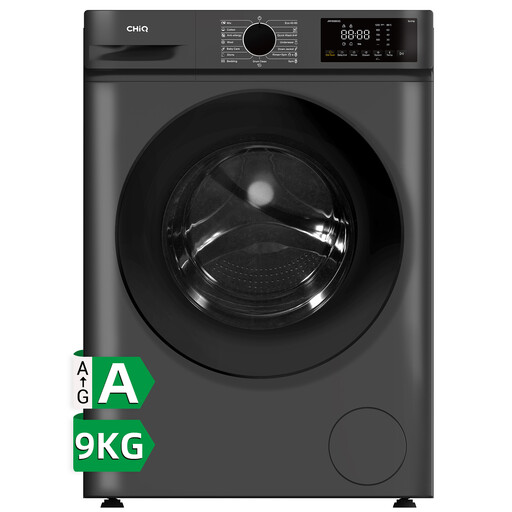 Image unavailable
Worth considering if you prefer front-loading and have enough space in front of the door; check the dimensions before choosing it for a shallow alcove.
The product name indicates a capacity of 9 kg, a spin speed of 1 400 tr/min and a BLDC motor. Check the width, depth, door clearance and connections in the technical specifications and manual for this model.
No. A slim model mainly reduces depth and won’t necessarily solve a width problem. Also measure the doorway, door clearance and connections, and check that the model’s capacity suits your needs.
No. Stacking depends on both appliances and the kit designed for them. For one of its kits, Bosch specifies a full-size washing machine with a depth of over 55 cm; check the requirements for the models you’re considering.
No. An integrated model is designed to take a cabinet door using a specific fitting method. If you simply want to put an appliance under a worktop, check its height, installation type, door clearance and manual. Don’t add a decorative door to a freestanding model unless it’s designed for that type of installation.