Households that quickly build up laundry
If your usual loads fill the drum quickly, look for a suitable capacity so you don’t have to run lots of underfilled cycles. ADEME recommends choosing a machine based on your household’s actual needs.


Choose a capacity based on how much laundry you usually build up, rather than automatically going for the largest drum. ADEME says a 7 kg washing machine is usually enough and advises against running cycles with too little in the drum. If you have the space, a front-loading model can handle larger loads; a top-loader can be a good choice when width is limited, while a washer-dryer calls for a closer look at its drying capacity, which is lower than its washing capacity on the models reviewed. Also compare water and energy use, spin performance and noise on the label for the model you’re considering.
If your usual loads fill the drum quickly, look for a suitable capacity so you don’t have to run lots of underfilled cycles. ADEME recommends choosing a machine based on your household’s actual needs.
If you use your machine often, the water and electricity figures on the label let you compare models on a like-for-like basis, rather than relying on a general promise of savings.
The available width may point you towards a top-loader. If one appliance also needs to dry your laundry, check the maximum load for washing and drying separately.
Worth considering: if your regular loads are large and you have enough space for an appliance dedicated to washing.
Bear in mind: it takes up more width than a 40 cm top-loader; you’ll also need to allow room for the door to open.
Worth considering: when width is a key constraint and the model’s capacity suits your usual loads.
Bear in mind: a narrow design won’t make up for a drum that’s too small if you build up laundry quickly.
Worth considering: if you need one space to serve for both washing and drying your laundry.
Bear in mind: the drying capacity is lower than the washing capacity on the models reviewed. UFC-Que Choisir also notes that drying programmes can take a long time.
To compare models in the same category, check the figures on their labels. The European Commission label includes energy use per 100 cycles, water use per cycle, cycle duration and noise levels.
| Feature | What to check | Who prioritises it |
|---|---|---|
| Capacity | Compare the stated capacity in kilograms with your usual loads of dry laundry, and leave enough room for the clothes to move around. | When laundry builds up between washes, I want to handle my usual loads without running several small cycles. Around 33% of consumers put capacity at the top of their list. |
| Water and electricity | Check the kWh per 100 cycles and litres per cycle on the labels of appliances in the same category. | When I wash frequently, I want to compare how much water and electricity each cycle uses. For around 27% of consumers, these running costs are the main priority. |
| Spin performance and noise | Check the spin-drying class, as well as the decibel level and noise class during the spin cycle. | If I dry laundry indoors or the machine is near living areas, I want to look at spin performance and noise. Around 20% of consumers put this comfort factor first. |
| Space and drying | Measure the space and access routes; for a washer-dryer, check washing and drying capacities separately. | I need the appliance to fit in a narrow space or to dry laundry in the same place, even if that limits how much I can dry in one go. Around 20% of consumers prioritise this installation or drying requirement. |
A large capacity won’t prevent underfilled cycles if it’s bigger than your usual loads. ADEME says a 7 kg model is usually enough, but that won’t necessarily be right for every household.
Estimate how much dry laundry you build up before each wash, and leave enough room in the drum for the clothes to move around without packing them in tightly.
When you wash frequently, the energy-rating letter alone doesn’t tell you everything. Check the consumption figures and cycle duration on the label too.
Compare kWh per 100 cycles, litres per cycle and the duration of the reference programme across models in the same category.
A washer-dryer may take a smaller load for drying than for washing. For example, the Bosch WNA144V0FR is rated for 9 kg when washing and 5 kg for a wash-and-dry cycle.
Check both capacities for the specific model and work out whether you’ll need to remove some of the load before drying.
Matching the available width isn’t enough if the depth, door opening or route into the room could cause a problem.
Measure the space and access routes, then compare them with the chosen model’s full dimensions and the clearance it needs.
The Bosch models reviewed offer two distinct options: the 9 kg WAN24209FR front-loader and the WNA144V0FR washer-dryer.
The TDLR7251FR top-loader is a 40 cm-wide option with a stated capacity of 7 kg.
The WWD380 WCS front-loader is aimed at households considering a 9 kg capacity, with SteamCare and QuickPowerWash functions.
The EW7IW4966BG and EW9W1165RB washer-dryers show why washing and drying capacities need to be checked separately.
This Joybuy selection includes two front-loaders to compare different washing capacities, plus a top-loader to consider if width is a key constraint. Compare each model with your usual loads and the space available.
 Image unavailable
Worth considering if the stated 8 kg capacity suits the amount of laundry you usually build up.
Stated spin speed of 1 400 rpm; Inverter motor and white finish. Check the full dimensions and the programme durations that matter for your routine.
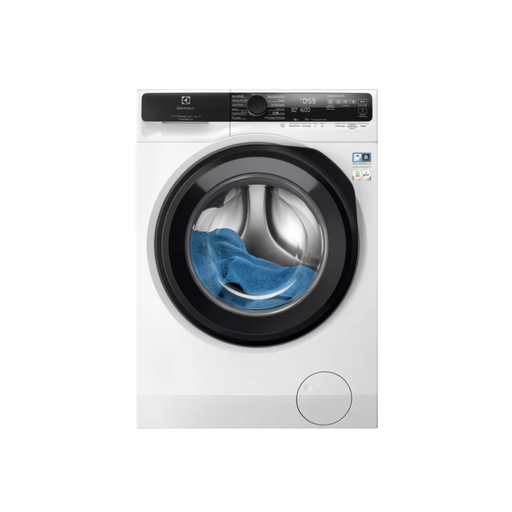 Image unavailable
Worth considering if your regular loads call for a stated 9 kg capacity and the appliance fits the space available.
Stated spin speed of 1 600 rpm; SteamCare, SmartSelect and connectivity features. If QuickCare is one of the reasons you’re considering it, check the duration of the specific cycle you’re interested in.
 Image unavailable
Worth considering if top-loading suits your setup and 6 kg is enough for your usual loads.
Stated spin speed of 1 400 rpm, B energy rating, Inverter motor, Wi-Fi and 17 stated programmes. Check the dimensions and noise level during the spin cycle before choosing where to put it.
Compare the figures on their labels for models in the same category, including kWh per 100 cycles and litres per cycle, rather than looking at the energy-rating letter alone. The European Commission label also shows the duration of the reference cycle, which is useful when you have several loads to get through.
No. An overfilled drum doesn’t leave enough room for the laundry to move around. ADEME advises waiting until you have enough laundry for a programme, while still leaving some space in the drum.
Not if the load is larger than its drying capacity. Bosch states a washing capacity of 9 kg but a wash-and-dry capacity of 5 kg for the WNA144V0FR; Electrolux states a washing capacity of 9 kg and a drying capacity of 6 kg for the EW7IW4966BG. Check both figures for the model you choose before planning a continuous cycle.