What should you check before buying?
Start with the space available in your home and your usual laundry loads. These will determine which type and capacity are worth comparing.
| Criteria | What to check | What you need |
|---|
| Space and type |
Measure the width, depth and height, as well as the delivery route and opening clearance. Check the water supply, drain and electrical connection. A top-loader opens upwards; a front-loader opens forwards. |
I’m short on width: a top-loader could work if the lid has enough room to open freely. If I want to fit a machine under a worktop, I need to check the dimensions and the model’s installation instructions. |
| Capacity |
Compare the stated capacity in kilograms with your laundry loads and how often you wash. Don’t assume a particular capacity is right just because of the size of your household. ADEME says that 7 kg is enough most of the time. |
I need to fit everyday laundry and larger items without running lots of cycles or regularly washing with a barely filled drum. |
| Energy, water and noise |
The European energy label includes the energy class, kWh per 100 cycles, litres per cycle, cycle duration and noise level. According to the European Commission, compare appliances of the same type using the same programme basis. |
If the machine is close to a living area, I also want to check its spin noise level, not just its energy class. |
| Washing and drying |
For a washer-dryer, check the washing and drying capacities separately, along with the figures for the relevant cycles. Make sure it can be installed in the same way as a washing machine. |
I need to dry laundry in the same appliance: the load I want to dry must be within its drying capacity, not just its washing capacity. |
| Durability |
Check the durability index for the exact model and its breakdown, if available. Treat this separately from the terms of any commercial warranty. |
I want to compare reliability and repairability before choosing, without treating a promise of long life as a measure that can be compared across models. |
A few models from well-known brands
These models highlight features to check against your installation requirements; they aren’t representative of every washing machine made by each brand.
Electrolux
Electrolux France lists the front-loading EWF1014A2 as having a 10 kg capacity, a depth of 658 mm and an A energy class.
- The product information also lists 51 kWh per 100 cycles and 52 L per cycle. Compare these figures on the same basis as the other models you’re considering.
- Check that the depth of 658 mm works with the required clearance and delivery route.
Miele
Miele France lists the front-loading WEA125 WCS Active as having an 8 kg capacity and a spin speed of 1 400 rpm.
- This capacity is worth considering if it suits your household’s usual laundry loads.
- To assess the durability of the model on sale, compare its durability index and warranty terms rather than relying on the brand’s claim about how long it will last.
Whirlpool
Whirlpool France lists the BI WMWG 9146 FR as a built-in front-loading model with a 9 kg capacity, measuring 59,5 cm wide, 81,5 cm high and 54,5 cm deep.
- Its built-in design makes it worth considering for a project involving a suitable cabinet.
- Check the cabinet, cabinet door, clearances and connections: the dimensions alone don’t guarantee a good fit.
Washing machines to explore on Joybuy
This selection includes a top-loader, front-loading models and a washer-dryer. Compare each model against the space available and your usual laundry loads. For the washer-dryer, also consider whether its integrated drying function meets your needs.
 Image unavailable
Candy TCA464TM4-S ProWash 500, 6 kg top-loading washing machine
Worth considering if limited width makes a top-loading model a better fit. The product information lists a 6 kg capacity, 1 400 rpm spin speed and B energy class. Check that the lid can open fully and that the capacity suits your laundry loads.
View on Joybuy
 Image unavailable
Haier X Series 11 HW100-BD14397PGU1, 10 kg washing machine
This 10 kg front-loader is worth comparing if your usual laundry loads call for this capacity. The product listing states a spin speed of 1 400 rpm and A energy class. Remember to measure the space and delivery route, too.
View on Joybuy
 Image unavailable
Samsung WD11DG6B85BEU3, 11 kg / 6 kg washer-dryer
Consider this model if you want to wash and dry in one appliance. It has a stated washing capacity of 11 kg and a drying capacity of 6 kg. Compare the figures for the cycle you plan to use and choose your loads accordingly.
View on Joybuy
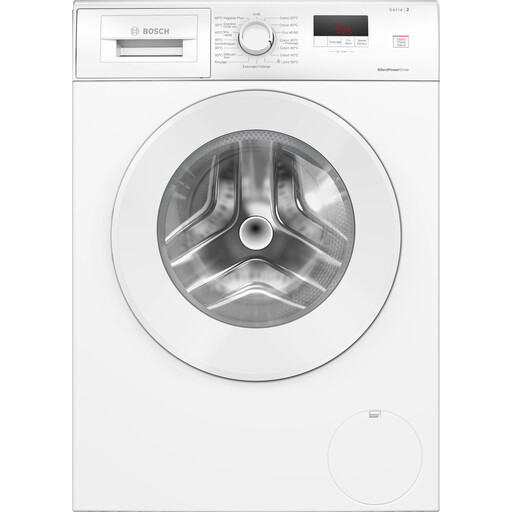 Image unavailable
Bosch WGE02407FR, 7 kg front-loading washing machine
Consider its 7 kg capacity in relation to your regular laundry loads. The product listing states a spin speed of 1 400 rpm and A energy class. Check the installation requirements in the manual and look up the durability index for the model on sale.
View on Joybuy
 Image unavailable
Electrolux EW7FI259160V, 9 kg front-loading washing machine
This 9 kg model is worth considering if the capacity suits your usual laundry loads. The product listing states a spin speed of 1 600 rpm. Before choosing, check the total depth, connections and clearance in front of the door.
View on Joybuy
Frequently asked questions
What should I check before comparing washing machine capacities?
First, check that the machine can be brought through to its intended position, will fit there and can be opened to load your laundry. Also check the water supply, drain and electrical connection. Electrolux’s pre-installation guide says its installers don’t carry out carpentry, plumbing or electrical work.
Is a top-loading washing machine suitable for every small space?
No: it’s mainly a solution when width is limited. The French National Consumer Institute says that top-loading models are usually 40 to 45 cm wide, but you’ll need room above for the lid to open and should check that the capacity suits your household’s laundry loads.
What should I compare on a washing machine’s energy label?
Look beyond the A to G rating: the European Commission says the label also shows information such as kWh per 100 cycles, litres per cycle, cycle duration and noise level. Compare appliances of the same type on the same basis.
How should I use the durability index in France?
Compare the index for the exact model and check the breakdown of its criteria, if available. Don’t confuse it with a commercial warranty. According to the French government departments responsible for ecological transition, the durability index has replaced the repairability index for the washing machines concerned since 8 April 2025.
Can you install a washing machine in a bathroom?
Yes, provided the location and electrical installation meet the applicable requirements. Promotelec specifies, among other things, installation beyond zone 2, earthing and a circuit protected by a 30 mA residual current device. Have the location checked before installation.


