Renters without a permanent space
You need to take the machine out and put it away after each load. Check how it’s filled and drained, as well as how much room you’ll need to store it.


If you need to put your washing machine away after every use, a portable mini model meets that requirement, but its small loads make it more of a stopgap. If you can have a permanent space and connections, choose a slim model if depth is limited, or a top-loading model if width is the issue. If you can’t install a machine safely, a launderette is a better option than improvising a connection.
You need to take the machine out and put it away after each load. Check how it’s filled and drained, as well as how much room you’ll need to store it.
You can leave a machine in place, but the available width or depth limits your options. Measure the space, allowing for the room needed to open the machine and accommodate the hoses.
If you do laundry regularly, consider washing capacity, spin performance and noise separately. A small drum or limited spin capacity can make your routine more difficult.
First, work out whether the machine can stay installed. This will help you rule out or shortlist fixed models before comparing their dimensions and capacity.
Consider this if: you need to put the machine away and mainly wash small loads.
Limitation: UFC-Que Choisir describes mini washing machines with a capacity of 2 to 3 kg as useful for occasional use; their spin capacity may also differ from their washing capacity.
Consider this if: depth is limited, but you can leave the machine connected in place.
Limitation: the slim front-loading models described by UFC-Que Choisir are 33–45 cm deep; you’ll also need space in front of the door.
Consider this if: width is your main constraint and a permanent installation is possible.
Limitation: you’ll need to leave enough space above the machine to open it and load your washing.
Keep this in mind: if your home isn’t suitable for running or connecting a machine safely.
Limitation: you’ll still need to travel to wash your clothes.
| Criteria | What to check | Consumers concerned |
|---|---|---|
| Storage and portability | Measure the machine and its storage space; check its weight and how it drains. | If there’s no permanent space for a machine, being able to move it and put it away is crucial; around 36% of consumers make this a priority. |
| Connections and capacity | Check the plug socket, water supply and waste outlet, then make sure the capacity suits your usual laundry loads. | To do your laundry regularly at home without running multiple cycles, you’ll need compatible connections and enough capacity; around 29% of consumers prioritise this. |
| Spin performance and noise | Compare spin capacity with washing capacity; for a model with an energy label, also check its noise class and dB rating. | If you dry your clothes in your living space, residual dampness and noise can be particularly bothersome; these are the main concerns for around 21% of consumers. |
| Energy use and durability | Check the energy label and, for washing machines covered by the scheme in France, the durability index for the exact model. | If you expect to use the machine for a long time, you may want to check its energy use and durability information before choosing a format; around 14% of consumers make this their priority. |
A slim or top-loading model is still designed for permanent installation. The space it takes up isn’t limited to the dimensions of its casing.
Mark out the space needed for the machine, hoses and opening. For a mini model, also make sure you can move and drain it easily after every cycle.
For a mini model listed by Darty, the stated capacities are 3 kg for washing and 1 kg for spinning. That means a full wash load would need to be spun in several batches.
Check the product details for both capacities and compare them with the amount of laundry you usually wash.
Having a free space isn’t enough if the water supply, waste outlet, plug socket or stability of the floor isn’t suitable.
Measure and take photos of the connections before you buy. If you’re unsure about the installation, ask a qualified professional for advice.
The energy rating doesn’t tell you everything about noise or whether the capacity suits your laundry. ADEME recommends choosing a capacity that matches your actual needs.
Also compare the dimensions, spin performance and noise information for the model. Check its durability index if it’s covered by the scheme in France.
Worth considering if you can leave a 6 kg top-loading washing machine in place.
Worth looking at if you want to compare top-loading models for a narrow space.
A brand to explore when comparing top-loading models with slim front-loading models.
This foldable mini washing machine is an option if you need to move your machine or put it away after use. Before choosing it for your studio flat, check that its filling and draining methods, as well as the amount of laundry it can wash, suit your home and your routine.
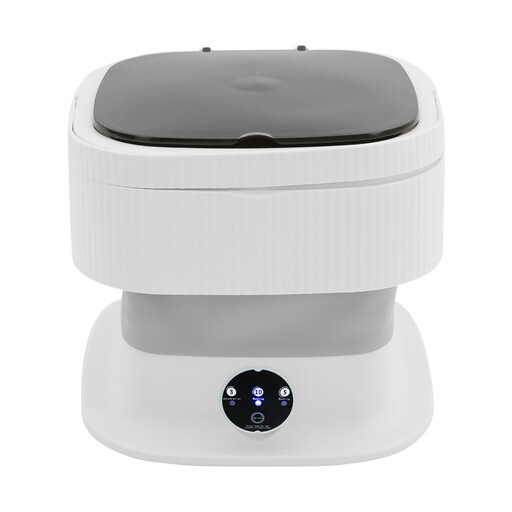 Image unavailable
Its portable, foldable design could suit you if you need to clear the space after every wash. The product title lists a 10 L volume, three cycle times of 2, 5 and 10 minutes, a 40 W motor rated at 320 rpm, a drain basket and suction cups. The volume in litres and stated spin speed don’t indicate the laundry load it can handle or its spin results. Before deciding whether it suits your needs, check the washing capacity in kg, its dimensions and weight, and how it’s filled and drained.
Not necessarily: UFC-Que Choisir describes mini washing machines with a capacity of 2 to 3 kg as useful for occasional use. If you want it to be your main machine, check the washing and spin capacities separately, as well as any limits for bulky items.
Make sure there’s a suitable plug socket, water supply and waste outlet near a stable space. Then measure the room needed for the hoses and to open the door or lid.
For models with an energy label, compare the noise class and the rating in dB, then check the spin specifications for the exact model. ADEME says that noise classes A and B indicate particularly quiet appliances. For a mini model, also check whether the spin capacity is lower than the washing capacity.
Yes, if the washing machine you’re considering is covered by the scheme. According to the French ministries responsible for the environment, the durability index has applied to eligible washing machines since 8 April 2025. Check whether it’s listed for the exact model, particularly if you’re looking at a portable mini machine.