If you mainly dry your laundry on an airer, start by choosing a capacity that suits your usual loads, then compare the spin efficiency class and noise level on the energy label: ADEME recommends a class A spin efficiency rating to speed up drying. If you want your laundry dried in the same appliance, consider a washer-dryer instead, checking its drying capacity separately from its washing capacity. The space available, ventilation and your building’s rules can then help you narrow down the options.
Who is this guide for ?
Households that mainly dry laundry on an airer
The capacity should suit the amount of laundry you usually wash, so you don’t have to run lots of small loads. To reduce the time your laundry spends on the airer, compare spin efficiency too; ADEME notes that drying laundry indoors adds moisture to the air in your home.
People who are mindful of noise
If you can hear the spin cycle from a bedroom or a neighbouring flat, check its noise class and dB level on the energy label. Also check your building’s rules when planning wash cycles; ANIL says that the co-ownership regulations and, where applicable, the building’s internal rules can be consulted.
People with limited space
Measure the route into your home and the space where the machine will go before choosing a format. A top-loading model may need less width, but you’ll need room to open the lid; a shallow front-loader may suit a different type of space constraint.
What should you look for ?
Front-loading washing machine
Consider this if : there’s room to open the door and you mainly dry your laundry on an airer.
Bear in mind : measure the depth, including connections, and allow space in front of the door; the front-loading format alone tells you nothing about noise or spin performance.
Top-loading washing machine
Consider this if : width is your main constraint; Whirlpool and Indesit, for example, offer top-loading models that are 40 cm wide.
Bear in mind : a top-loading machine needs vertical clearance, even if it fits the available floor space.
Washer-dryer
Consider this if : you regularly need to dry laundry in the same appliance and don’t want to keep an airer set up.
Bear in mind : the washing capacity may be greater than the drying capacity: Bosch lists 8 kg for washing and 5 kg for washing and drying for the WKD28260FR.
To narrow down the machines that will fit your home, start with your main priority: drying laundry faster on an airer, keeping noise down, making the most of a tight space or drying clothes in the machine.
| Feature |
What to check |
Who it matters to |
| Spin performance and capacity |
Compare the capacity with your usual loads and check the spin efficiency class on the energy label, rather than looking only at revolutions per minute. |
When I dry laundry on an airer, I want to avoid a load staying damp for longer than necessary without having to run extra cycles. Around 36 % of consumers make this their top priority. |
| Spin-cycle noise |
Check the noise class and dB level for the exact model; consult your building’s rules before setting a cycle to run. |
If the machine is near a bedroom or neighbours, my first priority is to minimise disruption during the spin cycle. This matters most to around 29 % of consumers. |
| Size and space |
Measure the width, depth and height, including connections, and allow enough room to open the door or lid. |
For a tight space, I need a machine I can install and load without anything getting in the way. Around 21 % of consumers prioritise this constraint. |
| Built-in drying |
For a washer-dryer, check the washing and drying capacities, the energy-label information for the combined cycle and how long it takes. |
Without room to leave an airer set up, I want to be able to finish drying in the machine regularly. This is a priority for around 14 % of consumers. |
Mistakes to avoid
-
Choosing a spin cycle based only on revolutions per minute
The maximum spin speed doesn’t tell you how much water will remain in your laundry or how noisy the cycle will be. If you dry clothes indoors, ADEME recommends checking the spin efficiency class on the energy label.
Compare this class, the capacity and the noise level of models that fit your space.
-
Confusing washing capacity with drying capacity
These capacities can differ on a washer-dryer: Electrolux lists 8 kg for washing and 4 kg for drying for the EW8W3816BI.
If you want to wash and dry in one go, size your load according to the drying capacity of the model you choose.
A larger wash load may need to be split before drying, which means handling the laundry again or running an extra cycle.
-
Measuring only the width of a top-loading model
Its smaller width may solve an access problem, but you still need to be able to open the lid and reach the drum.
Also check the available height, the depth and the space needed for connections.
-
Planning for an airer without considering ventilation
ADEME notes that air-drying laundry releases a lot of moisture into the air indoors.
If possible, choose a well-ventilated room or one with suitable extraction. Persistent damp in your home needs to be assessed separately from your choice of washing machine.
Brands to consider
Whirlpool
Worth considering if the available width points you towards a top-loading machine.
- Whirlpool lists a width of 40 cm for its TDLR6247FR/N top-loading model.
- This format needs access from above; check the dimensions, capacity and energy label for the model you choose.
Bosch
Worth considering if a built-in washer-dryer is an option for your installation.
- Bosch lists separate capacities of 8 kg for washing and 5 kg for washing and drying for the WKD28260FR.
- These capacities apply to this model; check the capacities and built-in dimensions of any other model you’re considering.
Electrolux
Worth considering when comparing built-in or freestanding washer-dryers.
- Electrolux lists capacities of 8/4 kg for the EW8W3816BI and 10/6 kg for the EW9W1166RA, for washing and drying respectively.
- Capacities vary by model; compare the energy-label information for both functions too.
LG
Worth considering if depth is a key factor for a washer-dryer.
- LG lists a depth of 47,5 cm and capacities of 8,5/5 kg for the F852SV52IRS.
- These specifications apply to this model; allow room for connections too, and check its energy label.
Washing machines to compare on Joybuy
These four models let you compare options for drying laundry indoors: two front-loaders for your usual loads, a top-loader if width is a concern, and a washer-dryer if you want to dry clothes in the machine. For each one, check the measurements of your available space and the energy-label details that matter most to you.
 Image unavailable
Hisense WF5I8043BWF, 8 kg front-loading washing machine
Worth considering if an 8 kg capacity suits your loads and you’re looking for a freestanding front-loader.
Listed spin speed: 1 400 rpm. If you dry laundry on an airer, also compare the model’s spin efficiency class and noise level on the energy label.
View on Joybuy
 Image unavailable
Electrolux EW7FI259160V, 9 kg front-loading washing machine
Worth considering if your usual loads call for a 9 kg capacity and your space can accommodate a front-loader.
Listed spin speed: 1 600 rpm. Before choosing this model for a flat, check the available depth, as well as the spin efficiency class and noise level on the energy label.
View on Joybuy
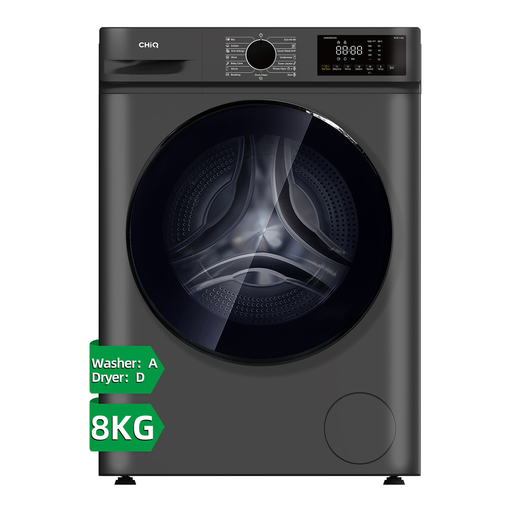 Image unavailable
CHiQ JW85882HG, 8/5 kg washer-dryer
Worth considering if you want to dry laundry in the same appliance without keeping an airer set up.
Listed capacity: 8 kg for washing and 5 kg for drying, so don’t assume a full wash load can be dried in one go. The stated width varies between product details; confirm the full dimensions before planning its installation.
View on Joybuy
 Image unavailable
Candy TCA464TM4-S ProWash 500, 6 kg top-loading washing machine
Worth considering if the width of your space points you towards a top-loader, provided there’s room to open the lid.
Listed capacity: 6 kg, with a spin speed of 1 400 rpm. If noise or faster drying is a priority, compare the noise and spin efficiency classes on the energy label.
View on Joybuy
Frequently asked questions
When should I run a washing machine to avoid disturbing the neighbours ?
Choose a time that complies with the rules for your building and keep spin-cycle noise to a minimum. In a block of flats, consult the co-ownership regulations and, where applicable, the building’s internal rules, as ANIL advises; check for any local requirements too before running a noisy cycle.
What should I check on the energy label if I dry laundry indoors ?
Check the spin efficiency class as well as the capacity and noise level. ADEME recommends a class A spin efficiency rating if you want to speed up indoor drying; the revolutions-per-minute figure is no substitute for this information.
Can a washer-dryer dry the whole load it has just washed ?
Only if the load is also within its drying capacity. Bosch, for example, lists 8 kg for washing but 5 kg for washing and drying for the WKD28260FR. Check both capacities for the model you’re considering before planning to run washing and drying back to back.
How can I manage damp when drying laundry on an airer ?
Choose a spot where the air can circulate: ADEME notes that air-drying laundry releases a lot of moisture into the air indoors. A large, well-ventilated room or one with suitable extraction is best; if damp persists regardless of the laundry, have the property assessed separately.


