How do the formats compare?
When choosing a machine for a tight space, work out whether your main concern is width, access to the drum, or height, depth and under-worktop installation. Then measure the space available for the appliance and for opening it.
| Criterion | What to check | Who it matters to |
|---|
| Alcove width |
The model’s overall width and the clearance above it if you’re considering a top-loader. |
If my alcove is too narrow for the front-loader I’m considering, I’ll first look for a machine that fits without compromising access for loading. Around 42% of consumers prioritise width for the same reason. |
| Access to the drum |
The direction of opening and the clearance required for the lid or porthole door. |
If there’s limited space in front of the appliance, or an obstruction above the alcove, I need to be able to load and unload the washing. Access to the drum is the main concern for around 33% of consumers. |
| Height, depth and under-worktop installation |
The model’s full dimensions and, for under-worktop installation, confirmation in its documentation that it’s suitable. |
If I’m fitting a machine under a kitchen worktop or into a shallow alcove, I need a format that fits the available space without overlooking washing capacity. Around 25% of consumers put these size constraints first. |
Examples published by Electrolux and Whirlpool show 6 kg top-loading machines measuring around 40 cm wide and 60 cm deep. Their narrower width won’t solve a depth restriction, and the lid needs clear space above it. By contrast, a front-loader’s porthole door needs room to open at the front, as the French National Consumer Institute points out.
A compact machine and a front-loader that can be installed under a worktop won’t necessarily solve the same problem. Haier states that its Mini Drum HW50-BP12307U1-S has a 5 kg capacity: check whether that’s enough for your usual washing load. Bosch lists front-loading machines for under-worktop installation with removable top panels, but neither the word ‘front-loading’ nor ‘slim’ is enough to confirm that a particular model will fit under a worktop.
Washing machines to explore on Joybuy
These models illustrate two options for a tight space: top-loaders when width is the priority, and a front-loader whose listed depth is worth considering. Whether they’ll fit your alcove depends on each model’s full dimensions and opening requirements.
 Image unavailable
Candy TCA464TM4-S ProWash 500, top-loading, 6 kg
Worth considering if alcove width is your priority and there’s enough space above the appliance for the lid to open freely.
The product description for this model lists dimensions of 86 × 40,5 × 60 cm, a 6 kg capacity and top loading. Check the instructions for the required clearances before comparing these measurements with your space.
View on Joybuy
 Image unavailable
Haier T Series 7 THASN276TM6-S, top-loading, 7 kg
Worth comparing for an alcove with limited width, provided there’s enough clear space above for access.
The product description for this model lists dimensions of 860 × 405 × 600 mm and a 7 kg capacity. Check the instructions for the lid clearance and consider whether the capacity suits the amount of washing you do.
View on Joybuy
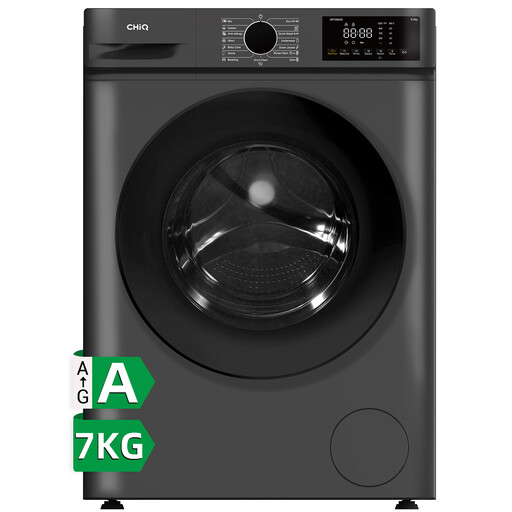 Image unavailable
CHiQ JW75883G, front-loading, 7 kg
Worth considering if depth is your main constraint and there’s enough space in front of the porthole door.
The product description lists a depth of 47 cm and a 7 kg capacity. Also check the width, height and installation and opening clearances specified for this model before deciding whether it will fit your alcove.
View on Joybuy
Frequently asked questions
How do I choose between a top-loading and a front-loading washing machine for a small room?
Measure the available width, depth and height, then check which way the door needs to open. A top-loader is loaded from above, while a front-loader opens at the front, as the French National Consumer Institute explains. Check the instructions for the specific model to find out how much clearance it needs.
Can you put a top-loading washing machine under a worktop?
Not if the fixed worktop prevents you from opening the lid and loading the drum. For an under-worktop installation, look instead for a front-loader specifically designed for this set-up, then check its instructions for the installation requirements. Bosch, for example, lists a category of under-worktop models with removable top panels.
Is a mini washing machine suitable for a whole household’s washing?
Compare its capacity with the amount of washing you usually do. Haier lists a 5 kg capacity for the Mini Drum HW50-BP12307U1-S. If that isn’t enough for your usual loads, you’ll need to split the washing across more cycles or choose a model with a larger capacity.
What should I check about the durability index when buying a new washing machine in France?
For the household washing machines covered, check the displayed index and the details of its criteria for the model you’re interested in. The ministries responsible for ecological transition state that this index has been gradually replacing the repairability index since 8 April 2025. However, it doesn’t confirm whether the appliance will fit in your alcove.


