For a home with a dedicated appliance space
If your kitchen or bathroom is already fitted out, measure the available width, depth and height. Also check access to the connections and whether there’s enough room to open the door or lid.


Measure the available space and the clearance needed to open the door before choosing a style: a front-loader needs room in front, while a top-loader opens upwards. A slim model usually keeps a width close to 60 cm, while an integrated model needs compatible cabinetry. Then choose a capacity that suits your usual laundry loads and compare water and energy use, spin performance and noise on the label for the model you’re considering.
If your kitchen or bathroom is already fitted out, measure the available width, depth and height. Also check access to the connections and whether there’s enough room to open the door or lid.
If width is limited, consider a top-loader; if depth is the issue, look at slim front-loaders. UFC-Que Choisir distinguishes between these two constraints: a slim model generally retains a width close to 60 cm.
A kitchen door requires an integrated model designed to fit the cabinet. If you want to stack a tumble dryer on top, check that both models and the stacking kit are compatible. Bosch notes that a similar width alone doesn’t guarantee compatibility.
Start with the constraint that could prevent the machine from fitting, then choose the capacity and compare the features that matter in everyday use.
| Consideration | What to check | Think about your needs |
|---|---|---|
| Size and opening clearance | Measure the space, access routes and clearances specified in the instructions. UFC-Que Choisir says top-loaders are generally 40 to 46 cm wide; slim front-loaders mainly reduce depth, typically to 33–45 cm, while retaining a width close to 60 cm. | If width is the issue, I’ll look at a top-loader, provided there’s room to open the lid. If depth is limited, I’ll check that a shallower front-loader still has enough clearance for its door. |
| Fitting into cabinetry | For an integrated appliance, compare the cabinet dimensions, door panel and connections with the diagram for the exact model. For an under-counter installation, also check the height and fitting requirements. | I want to hide the machine behind a kitchen door, so I need an appliance designed for this type of installation, not simply a washing machine that looks as though it will fit in the cabinet. |
| Capacity | ADEME gives 7 kg as a suitable capacity for most households. UFC-Que Choisir suggests 5 to 7 kg for one or two people; compare this with your usual loads and any bulky items. | I’d rather not run extra cycles because the drum is too small, but I also don’t want a large capacity that I regularly use half-empty. |
| Water, energy, spin performance and noise | ADEME recommends checking the energy label to compare water and energy consumption, spin performance and noise. Check the figures for the exact model rather than assuming how it will perform based on its type. | The machine will be near living areas, and I may need to dry laundry indoors, so noise and spin performance matter just as much as its size. |
| Stacking appliances | Check the instructions for both the washing machine and tumble dryer, as well as the kit’s compatibility. Bosch says its WTZ20410 kit is for a standard washing machine with a depth greater than 55 cm and must also be suitable for the tumble dryer. | If I might stack the appliances later, I’ll check the model numbers for both machines and the kit before relying on this option. |
A front-loader might fit in the space but still get in the way if its door blocks the route past it. A top-loader may be unusable beneath a shelf or enclosed worktop.
Measure the clear space in front of or above the appliance, then compare your measurements with the installation diagram for the model you’ve chosen.
UFC-Que Choisir warns that a drum that’s too small can mean running extra cycles. ADEME gives 7 kg as a generally suitable starting point, but this should be adjusted to suit your household’s loads.
Think about your usual loads and how much room bulky items take up before opting for a smaller capacity to save space.
Stacking depends on the model numbers and the kit. Bosch says you should check that the appliances can be stacked and that the kit is suitable for the tumble dryer in question.
Check the instructions for both appliances and the kit’s compatibility list before planning to stack them.
Bosch describes the WGE03207FR as an 8 kg front-loader measuring 848 × 598 × 588 mm. It’s an example of the space you may need for a freestanding appliance.
Electrolux says its YW7T3713DA top-loader has a 7 kg capacity and measures 890 × 400 × 600 mm.
Whirlpool describes the BI WMWG 9146 FR as an integrated 9 kg washing machine measuring 59,5 × 81,5 × 54,5 cm.
Candy lists the ProWash 550 BP 48SBL6-S as having an 8 kg capacity and measuring 595 × 488 × 880 mm.
These three front-loading models are suited to spaces where there’s room to open the door in front of the machine. Compare their dimensions with your kitchen or bathroom before choosing a capacity.
 Image unavailable
Its stated 7 kg capacity may suit everyday laundry if it matches your household’s usual loads. Its stated dimensions are 59,8 × 84,8 × 59 cm; compare these with your available space and check the door clearance and installation requirements.
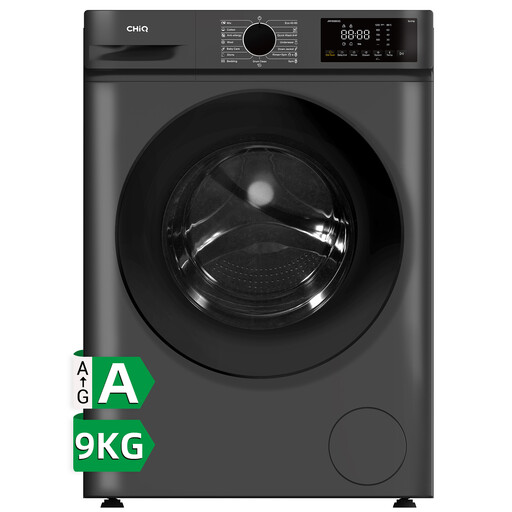 Image unavailable
Its stated 9 kg capacity is suited to households whose laundry loads call for it, and its spin speed is listed as up to 1 400 rpm. The product information gives conflicting depth measurements, so confirm the width, height, depth and door clearance on the product page or in the instructions before planning the installation.
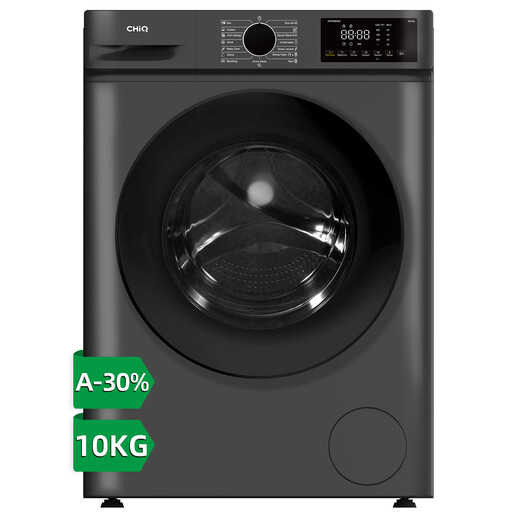 Image unavailable
Its stated 10 kg capacity may suit a household that regularly washes large loads, and its spin speed is listed as up to 1 400 rpm. Check its exact dimensions, installation clearances, and noise and water figures before deciding whether it’s suitable for a living area.
ADEME says a 7 kg washing machine is enough for most households, while UFC-Que Choisir suggests 5 to 7 kg for one or two people. Use this as a starting point and compare it with your usual loads, especially if you often wash bulky items.
No. It mainly reduces depth. UFC-Que Choisir describes slim front-loaders as 33 to 45 cm deep, while generally retaining a width close to 60 cm. You’ll also need to leave room to open the door and make sure the capacity suits your household’s laundry loads.
No. Bosch recommends checking that both models can be stacked and that the kit is suitable for the tumble dryer. Its WTZ20410 kit is listed for a standard washing machine with a depth greater than 55 cm. Check the instructions and the compatibility of the exact model numbers before buying.
Ask about collection before your new appliance is delivered. The French Ministry for Ecological Transition outlines a ‘one-for-one’ take-back scheme, whereby a retailer takes back an old appliance when a customer buys another product of the same type. Ask the retailer what arrangements apply to your purchase.