Households replacing a front loader
If a front loader suits your space, compare models by usable capacity, dimensions, energy label, noise level and the durability rating for each model, rather than choosing on brand alone.


When replacing a washing machine, first choose a type that fits the space and allows the door or lid to open: a front loader if there’s room, a top loader if width is limited, an integrated model for a compatible cabinet, or a shallow front loader if depth is restricted. Then compare the durability rating and its underlying criteria for the exact models that suit your needs, followed by capacity, the energy label and access to spare parts.
If a front loader suits your space, compare models by usable capacity, dimensions, energy label, noise level and the durability rating for each model, rather than choosing on brand alone.
If width is limited, consider top loaders, making sure there’s clear space above. If depth is the issue, measure the space needed for a shallow front loader, including the door and connections.
Check that the new washing machine is genuinely designed for integrated installation and is compatible with the cabinet, door panel, fitting method and connections. Similar dimensions to your old appliance aren’t enough.
Measure the space first, then compare durability and usage information for the models that will actually fit.
| Priority | What to check | What I need |
|---|---|---|
| Type and installation | Measure the width, height and depth, then allow for connections and the door or lid to open. Leave clear space above a top loader; for an integrated model, also check the cabinet, door panel and fitting method. | If width is limited, I’ll look at top loaders. If depth is the issue, I’ll compare shallow front loaders; a built-in cabinet requires a compatible model. |
| Durability rating | For the relevant front- and top-loading washing machines in France, check the rating and calculation criteria for the exact model. The DGCCRF states that this information must be available both in shops and online. | I want to compare the durability of models that already fit my space, without mistaking a brand’s claim for the official rating. |
| Capacity and performance | Compare capacity in kg with your usual laundry loads. Check the energy label for water and electricity consumption, spin performance and noise, as recommended by ADEME. | I’m looking for a capacity that suits my laundry loads, and I’ll take noise into account if the machine is near a living area. |
| Repairs and spare parts | Check the repairability criteria within the rating, then look up information on spare parts, the manual and servicing for the specific model. Check which parts are covered and when the stated availability period begins. | If a repair is needed, I want to be able to identify the parts and processes for my model, without assuming that every range from a brand is the same. |
A score won’t tell you whether the machine fits the space, whether you can open it easily or whether its capacity suits your household’s laundry loads.
Rule out models that won’t fit first, then check the score and detailed criteria for the remaining options.
Hoses, the cable, the door and access for maintenance all matter too. The word ‘slim’ doesn’t, on its own, confirm that a front loader will fit.
Compare your measurements with the dimensions and installation instructions for the model you’re considering.
Its narrower width may solve a space problem, but a cabinet above it could stop the lid from opening.
Make sure there’s clear access from above; otherwise, consider a front loader that fits the available space or a different layout.
A motor warranty won’t necessarily cover the rest of the washing machine. Nor are a manufacturer’s stated longevity test results the official rating.
Check the warranty coverage, spare-parts information and rating criteria for the exact model separately.
These examples of ranges and models can help you decide what to check. They don’t replace comparing models that suit your installation.
Bosch’s front-loading WGE03207FR is listed with an 8 kg capacity and a 1,200 rpm spin speed.
The W1 front-loader range includes the WCA120 WCS, which Miele lists with an 8 kg capacity and a 1,400 rpm spin speed.
The EWQ6412B is a 6 kg top-loading washing machine.
AEG lists the freestanding LTR8C7331A top loader with a 7 kg capacity and dimensions of 903 × 397 × 599 mm.
Whirlpool describes the BI WMWG 9146 FR as a 9 kg integrated front-loading washing machine.
These options include two front loaders and one top loader. Compare them based on the space available and access needed to open the door or lid, then check the durability rating for the model you’re interested in before making your choice.
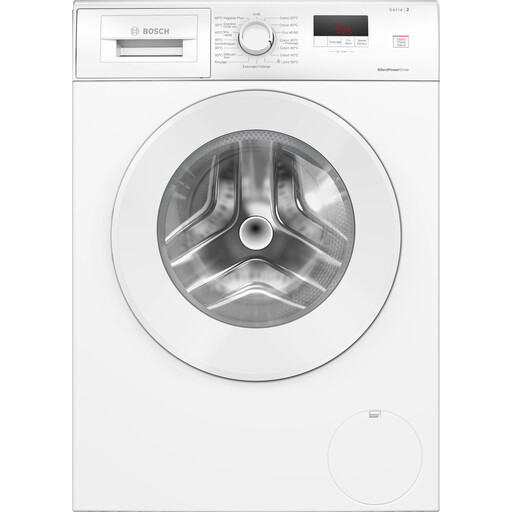 Image unavailable
Worth considering if you’re replacing a front loader and have enough room for the door to open. Listed with a 7 kg capacity, a 1,400 rpm spin speed and an A energy rating. Check the installation clearances and the durability rating for this model.
 Image unavailable
A top loader may be worth considering if width is your main constraint, provided there’s room to open the lid. Listed with a 7 kg capacity, a 1,200 rpm spin speed and an A energy rating. Check the dimensions, connections and the model’s durability rating.
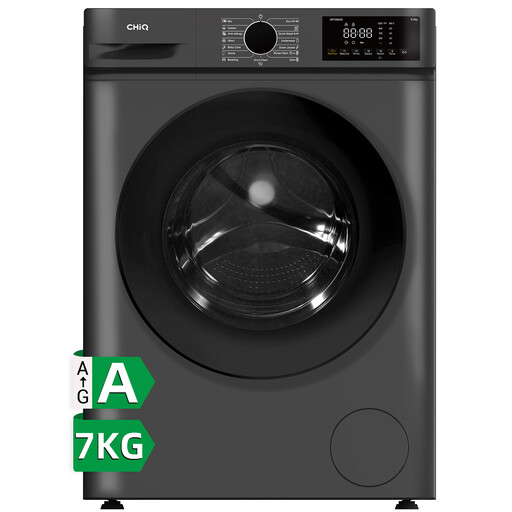 Image unavailable
Worth considering if you’re looking for a front loader and need to keep a close eye on the available depth. Listed with a 7 kg capacity, a 1,200 rpm spin speed and an A energy rating. Also measure the space needed for connections and to open the door, then check the durability rating for this model.
Yes. It applies to the relevant front- and top-loading washing machines covered by the scheme since 8 April 2025, according to the French ministries responsible for the environment. The DGCCRF states that consumers must be able to access the rating and the criteria used to calculate it, both in shops and on online retail sites and platforms.
Look at the detailed criteria for each model, especially those relating to repairability and reliability, rather than relying on the overall score alone. The guidance from the French ministries responsible for the environment includes a reliability test for washing machines, expressed as a number of cycles. Then compare capacity, dimensions and the energy label across machines suited to the same use.
No. It may work when width is limited, but you’ll need enough space above to open the lid. If depth is the main constraint, consider the dimensions of a shallow front loader instead. In either case, allow room for connections, opening the machine and maintenance.
Yes, provided the cabinet and connections are suitable for a genuinely integrated model. UFC-Que Choisir points out that built-in appliances have a specific fitting kit, so check the cabinet, door panel and installation instructions for the model you’re considering.
No. Check it for each model and for the parts you’re interested in. For example, Electrolux documentation states that a specified list of parts will be available for at least 10 years after the EWQ6412B is discontinued; this doesn’t apply to every range from the brand.