For everyday laundry, start with the amount of washing that actually builds up in your household. ADEME says that a 7 kg washing machine is usually sufficient, while a larger capacity makes sense if you regularly need to wash bigger loads. If width or easy access to the drum is your main concern, consider a top-loading machine. Then compare the water and energy use, programme duration and spin noise on the energy label of the models you’re considering.
Which households will find these criteria useful?
Households with regular, large laundry loads
If you’re choosing between 7, 8 and 9 kg, consider how much laundry you usually wash rather than your biggest-ever load. ADEME recommends matching capacity to your needs, so you don’t end up running extra cycles with a drum that isn’t full enough.
Households short on space
The available width and access to the drum may influence whether you choose a front-loading or top-loading machine. UFC-Que Choisir highlights the importance of available space when making this choice. Be sure to measure the clearance needed to use the machine, too.
Households mindful of noise and energy use
If your machine is close to living areas, spin noise is worth considering carefully. To compare day-to-day running, ADEME and the European Commission also recommend checking the energy and water use, as well as the programme duration shown on the label.
Which criteria should you prioritise?
First, work out the size of your usual laundry loads, then check the space available before comparing the energy label figures. For capacity, ADEME gives 7 kg as a typical guide, rather than a rule that applies to every household.
| Criteria |
What to check |
Who is it for? |
| Drum capacity |
Compare the stated capacity in kg with your usual loads and how often you wash; leave enough room for the laundry to move around. |
When laundry piles up, I want to avoid splitting loads without choosing a drum that’s usually underfilled; around 50% of consumers are said to make this their priority. |
| Space and loading |
Measure the width, height and depth, as well as the clearance needed; check that the capacity of the format you choose will be enough. |
If space is tight or bending down to load the laundry is difficult, I first look for a format that suits my home; this is said to be a priority for around 30% of consumers. |
| Noise, spin performance and energy use |
For comparable use, check the kWh per 100 cycles, litres per cycle, Eco 40-60 programme duration, and noise and spin performance ratings. |
If the machine is near living areas, I want to take spin noise into account while keeping an eye on water and electricity use; this is said to be the main concern for around 20% of consumers. |
Mistakes to avoid
-
Automatically choosing the largest capacity
A large drum is only useful if you regularly have enough laundry to fill it. ADEME says that 7 kg is usually sufficient and advises against packing the machine too tightly.
Consider the size of your usual loads before moving up to 8 or 9 kg, and leave enough room for the laundry to move around.
-
Looking only at the energy rating
The energy rating letter doesn’t tell you everything about water use, programme duration or spin noise. The European Commission shows these details separately on washing machine labels.
Compare the kWh per 100 cycles, litres per cycle, Eco 40-60 programme duration and spin performance figures for models suited to your laundry loads.
-
Assuming a top-loading machine suits every household
This format can be a good option when width is limited, but its capacity still needs to suit the amount of laundry you wash. UFC-Que Choisir notes that the top-loading models it has observed tend to have a maximum capacity of 8 kg.
Measure the space and compare the capacity of the model you’re considering with your regular loads.
If the capacity is too small for your usual loads, you may need to split your laundry across more cycles.
-
Forgetting about spin noise
Noise levels can matter particularly if the machine is near living areas or runs at times when noise may be disruptive.
Check the decibel level and spin noise rating on the label for the exact model.
Brands and models to consider
The specifications below apply to the models listed, not to each brand’s entire range.
Bosch
The WAN2827TFR is an example of a front-loading washing machine with a mid-range capacity.
- Bosch Electroménager France lists an 8 kg capacity and a 1,400 rpm spin speed for this model.
- Check its dimensions and spin noise to make sure it suits the space you have.
Miele
The WWD380 WCS is a front-loading option to consider if your regular loads call for a 9 kg capacity.
- Miele France lists a 9 kg capacity, a 1,400 rpm spin speed, SteamCare and QuickPowerWash for this model.
- Make sure you’ll use the capacity and features on offer, rather than choosing them by default.
Electrolux
The EW6T3465DA is an example of a top-loading machine to consider when width is a priority.
- Electrolux France lists a width of 400 mm and a capacity of 6 kg for this model.
- Check that 6 kg is enough for your usual loads, and measure the space needed around the machine.
Whirlpool
The TDLR6242SFR/N is another example of a 6 kg top-loading washing machine.
- Whirlpool France lists an energy rating of C and a noise level of 76 dB for this model.
- Compare its label with those of other machines suited to your laundry loads; these figures don’t represent the brand as a whole.
Washing machines for different household needs
This Joybuy selection includes front-loading and top-loading models with capacities from 6 to 8 kg. Start by choosing a machine to suit your usual loads and the space available, then check the label for the model you’re interested in.
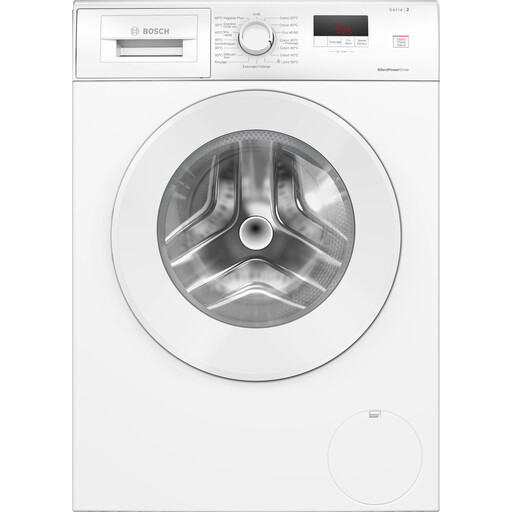 Image unavailable
Bosch WGE02407FR, 7 kg
Worth considering for everyday laundry loads close to ADEME’s 7 kg guide, if a front-loading machine suits your space.
- Capacity: 7 kg; stated spin speed: 1,400 rpm; energy rating: A.
- Before choosing this model, measure the depth you’ll need with the door open and allow space to move around.
View on Joybuy
 Image unavailable
Haier T Series 7 THASN276TM6-S, 7 kg
A top-loading machine is worth considering if easy access to the drum or limited width is a key factor in your choice.
- Capacity: 7 kg; stated spin speed: 1,200 rpm; energy rating: A.
- Check the space needed to open the lid and the spin noise on the label.
View on Joybuy
 Image unavailable
Hisense WF5I8043BWF, 8 kg
Worth considering if you regularly have enough laundry to fill an 8 kg drum and a front-loading machine fits your home.
- Capacity: 8 kg; stated spin speed: 1,400 rpm.
- Check the full dimensions, Eco 40-60 programme duration and energy and water use in the model specifications.
View on Joybuy
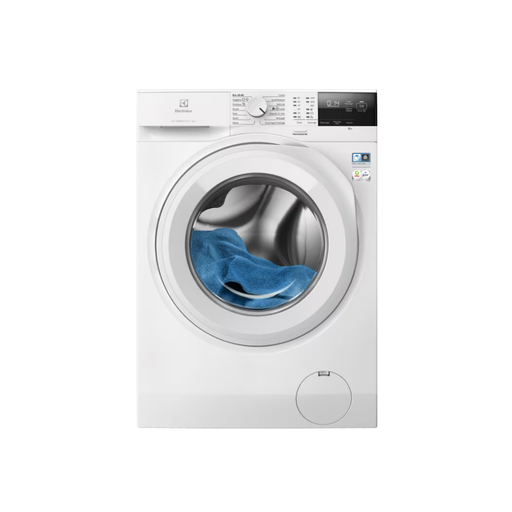 Image unavailable
Electrolux EW6FI4805AW, 8 kg
This front-loading model is designed for households whose usual loads call for an 8 kg capacity rather than a smaller drum.
- Capacity: 8 kg; stated spin speed: 1,400 rpm; SensiCare feature mentioned in the product name.
- Check the label for the exact model’s Eco 40-60 programme duration and spin noise.
View on Joybuy
 Image unavailable
Candy TCA464TM4-S ProWash 500, 6 kg
Worth considering if you prefer a top-loading machine and 6 kg is enough for your usual loads without having to run extra cycles.
- Capacity: 6 kg; stated spin speed: 1,400 rpm; energy rating: B.
- Measure the space and check the spin noise if the machine will be close to living areas.
View on Joybuy
Frequently asked questions
What does the kg figure on a washing machine mean?
It refers to the maximum weight of dry textiles specified by the supplier for the relevant programme conditions, according to the European Commission. It doesn’t mean you should pack the laundry in tightly: ADEME recommends leaving room in the drum.
What should you compare on the energy label?
For machines suited to similar loads, compare the energy rating, kWh per 100 cycles, litres per cycle and Eco 40-60 programme duration. The European Commission also lists spin noise and its rating. Check spin efficiency separately if you’ll be drying your laundry at home.
Is a top-loading machine always right for a small home?
No. It may suit a narrow space or make the drum easier to access, but its full dimensions and capacity still need to work for your household. UFC-Que Choisir notes that available space often influences this choice; remember to measure the clearance needed to open the lid, too.


