First, choose a machine that will fit through to its intended spot, with enough room to open the door or lid. Then pick a capacity that suits the amount of laundry your household actually washes. A front-loader needs space in front for its door, a top-loader is a good option when width is limited, and a slim front-loader can help when depth is an issue. A drum that’s too small could mean more wash cycles. To narrow down your options, also compare spin performance, noise levels, the energy-label consumption figures and, in France, the durability rating for the specific model.
Who are these options for?
Households with limited installation space
In a narrow room, you’ll need to balance the machine’s width and depth with access to it and the space needed to open the door or lid. Que Choisir highlights the different space constraints that top-loaders and slim models can help address.
Households with lots of laundry
If sheets, towels and clothes regularly fill your laundry basket, a larger capacity can help you avoid splitting loads. However, ADEME recommends choosing a capacity that suits your usual loads rather than automatically opting for a large drum.
Households that dry clothes indoors or are mindful of noise
Spin performance matters when you’re drying clothes after washing, while noise is especially worth considering if the machine is near your living space. Compare these features across models that suit your space and household laundry needs.
What sets washing machines apart?
Your available space will guide your choice of machine, but its capacity should still suit your household’s laundry needs. The dimensions given by Que Choisir are typical guide measurements for each type of machine. Measure the route to the room, then check the specifications for the exact model.
Front-loader
Consider one if: there’s enough width for a front-loader, which is generally around 60 cm wide according to Que Choisir.
Bear in mind: you’ll need enough room in front of the machine to open the door and load the drum.
Top-loader
Consider one if: width is your main constraint; Que Choisir gives a typical width of 40 to 46 cm for this style.
Bear in mind: you’ll need room above the lid, and a capacity that suits your usual loads.
Slim or compact front-loader
Consider one if: depth is your main constraint; Que Choisir gives a typical depth of 33 to 45 cm for slim front-loaders.
Bear in mind: capacity is often lower, so make sure it can handle the amount of laundry you actually wash.
| Criterion |
What to check |
Who it matters to |
| Size and access |
Measure the width, depth and height, the delivery route and the clearance needed to open the exact model you’re considering. |
If the room or access route is narrow, I want to be able to install and open the machine without blocking the way. Of consumers who put one need above all others, around 42% would prioritise size and access. |
| Capacity and frequency |
Compare the capacity in kg of dry laundry with your usual loads, including household linen, and don’t assume the stated capacity applies to every programme. |
If my laundry basket fills up quickly, I want to wash my usual loads without having to split them regularly. Capacity and frequency would be the top priority for around 33% of consumers. |
| Drying and ease of use |
For suitable models, compare spin performance, noise, water and energy use on the label. Also check the durability rating for the specific model. |
If I dry my laundry indoors or the machine is near a living space, spin performance and noise have a greater bearing on my choice. Around 25% of consumers would prioritise drying, noise levels or consumption figures. |
Mistakes to avoid before buying
-
Choosing the smallest drum just to save space
A small capacity could mean more wash cycles or make it harder to wash household linen. Que Choisir describes mini washing machines with a capacity of 2 to 3 kg as occasional-use solutions rather than direct replacements for machines that handle larger loads.
Measure the space and consider a few typical laundry baskets. If you’re only short on depth, compare slim front-loaders before settling on a mini model.
-
Buying a large-capacity machine without planning to fill it
A bigger drum may take up space unnecessarily if you usually wash small loads. ADEME recommends choosing a capacity that suits your household’s needs.
Think about how much dry laundry you typically accumulate between washes, rather than focusing on the maximum capacity available.
-
Checking the energy rating but overlooking noise and spin performance
These features affect different aspects of everyday use: noise matters if the machine is near your living space, while spin performance is especially worth considering if you dry clothes indoors. In a survey of 4,350 newsletter subscribers published in February 2026, Que Choisir reported more mixed views on noise during the spin cycle.
Once you’ve chosen the right size and capacity, compare the noise, spin, water and energy information on the labels of the models you’re considering.
-
Treating the durability rating as a guarantee of lifespan
The rating provides information on the criteria assessed for the specific model; it doesn’t guarantee that the machine won’t break down or that it will suit your home.
For the household washing machines covered by the rules and sold in France, check the rating out of 10 and its breakdown after you’ve confirmed the dimensions, capacity and features that matter for everyday use.
Brands to know
There are no brands to feature in this section.
Washing machines for different needs
These front-loaders and top-loaders offer a range of capacities to suit different available widths and typical laundry loads. Check the dimensions and clearance for your chosen model before making a decision.
 Image unavailable
Haier T Series 7 THASN276TM6-S, 7 kg top-loader
Worth considering if width is limited and a 7 kg capacity suits your usual loads. Make sure there’s room above the machine to open the lid.
Stated maximum spin speed: 1,200 rpm. Energy rating A; steam and Wi-Fi features are mentioned in the product name.
If the machine is near a living space, compare its noise level during the spin cycle with those of other models you’re considering.
View on Joybuy
 Image unavailable
Bosch WGE02407FR, 7 kg front-loader
Worth considering for typical loads of around 7 kg if you have enough room to open the door easily.
Stated maximum spin speed: 1,400 rpm. Energy rating A.
The stated depth, including the door, is 63.2 cm, so measure the space and access route. Also check the durability rating for the specific model; a repairability rating is not a substitute.
View on Joybuy
 Image unavailable
Electrolux EW7FI259160V SteamCare SmartSelect, 9 kg front-loader
Worth considering if you regularly have loads that call for a 9 kg capacity; it may be more than you need if you often wash small loads.
Stated maximum spin speed: 1,600 rpm. The product name mentions a connected feature.
The stated depth is 66 cm. Measure the route to the room and the space in front of the door, too.
View on Joybuy
 Image unavailable
Candy TCA464TM4-S ProWash 500, 6 kg top-loader
Worth considering when width is limited and 6 kg is usually enough for your loads. Regularly washing larger loads may mean you need to run more cycles.
Stated maximum spin speed: 1,400 rpm. Energy rating B; the product name mentions Wi-Fi and 17 programmes.
Allow enough clearance to open the lid. If noise matters to you, compare the noise level during the spin cycle before choosing.
View on Joybuy
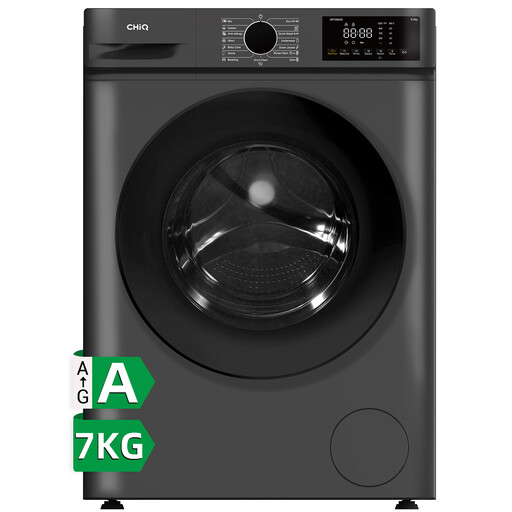 Image unavailable
CHiQ JW75883G, 7 kg dark grey front-loader
Worth considering if you’re looking for a 7 kg front-loader, especially when depth is limited. Check its exact dimensions before choosing it for a narrow space.
Stated maximum spin speed: 1,200 rpm. Energy rating A; the product name mentions 16 programmes and a steam function.
Check the width and depth in the specifications for the exact model, then measure the route to the room and the clearance needed to open the door.
View on Joybuy
Frequently asked questions
Is a 7 kg washing machine suitable for every household?
No. 7 kg is a guide, not a one-size-fits-all capacity. ADEME says this capacity is usually enough, while Que Choisir suggests 5 to 7 kg for one or two people and 7 to 8 kg for an average-sized family. Compare these guide figures with the sheets, towels and other loads you actually wash.
What should I measure before choosing a front-loader, top-loader or slim model?
Measure the space where the machine will go, the route to the room and the clearance needed to open it. Que Choisir gives typical dimensions of around 60 cm wide for a standard front-loader, 40 to 46 cm wide for a top-loader and 33 to 45 cm deep for a slim front-loader. Then check the exact dimensions and door clearance for the model you’re considering.
What should I compare if I dry my laundry indoors?
First compare the spin-drying class of machines that suit your loads and available space, then check their noise levels and consumption figures on the energy label. ADEME recommends choosing spin-drying class A if getting laundry dry after washing is a priority.
Do washing machines sold in France have to display a durability rating?
Yes, for household washing machines covered by French regulations. According to the government departments responsible for ecological transition, the durability rating has applied to these appliances since 8 April 2025. The score is shown out of 10. Check the rating and the criteria behind it for the specific model; it is not a guarantee of the machine’s lifespan.


