What do different households need?
The size of your household matters, but how often you do laundry, how you sort your clothes and the space available can all affect your choice.
Households that often wash bulky items
If you regularly wash large loads of sheets, towels or duvets, a capacity of 8 to 10 kg may be suitable, as UFC-Que Choisir suggests for families with children. A larger capacity is less useful if these loads are only occasional or the drum is rarely filled properly.
Households with limited space in width
If the space available is narrow, a top-loading machine may be easier to fit: UFC-Que Choisir gives a width of 40 to 46 cm for top-loading washing machines. You’ll also need to leave enough room to open the lid.
Households that often sort laundry by fabric
If you wash cotton, synthetics, wool and delicate items separately, the load limits for each programme matter more than the single capacity figure shown on the product page. Check the programme table for the model you’re considering before deciding on a machine size.
What should you check before choosing?
Start with your laundry loads and the space available, then compare the performance information for models that meet both requirements.
| Criteria |
What to check |
To suit my needs |
| Usable capacity |
Compare the capacity in kg with your usual laundry loads. Check the manual for the limits on synthetic, wool and delicate programmes: the stated capacity may not apply to every fabric. |
I mainly wash everyday loads: according to ADEME, 7 kg is often enough. If sheets, towels or duvets regularly fill the machine, it’s worth considering the 8 to 10 kg range suggested by UFC-Que Choisir for families with children. |
| Style and installation |
Measure the height, width and depth, then check the connections and the space needed to open the machine. UFC-Que Choisir gives a width of 40 to 46 cm for top-loading models; check the exact dimensions of each front-loading model. |
A narrow space points me towards a top-loading machine, provided there’s room to lift the lid. If I have space for a front-loader, I’ll also check access to the door and the depth required. |
| Water, energy and noise |
On the EU energy label, compare the class, kWh per 100 cycles, litres per cycle and spin noise. Also check the duration of the reference programme and the spin-drying efficiency class. |
If the machine is near a living area, spin noise matters to me. If I often dry laundry indoors, I’ll also check the spin-drying efficiency rather than judging it by the maximum spin speed alone. |
| Durability and support |
Check the durability index for the exact model and the details behind its rating. Make sure you distinguish the terms of any commercial warranty from the statutory guarantee that applies to your purchase. |
I want to be able to compare durability information and know who to contact if something goes wrong. In France, the Ministry of the Economy explains that the statutory guarantee of conformity applies to new, second-hand and refurbished goods sold by a business to a private individual. |
A few brands and models to consider
These models illustrate different styles and capacities for comparison; their features don’t represent every machine from their respective brands.
Bosch
The Bosch WAN24209FR is an example of a 9 kg front-loader. Its French product listing gives dimensions of 845 × 598 × 590 mm.
- Its width of 598 mm gives you a useful reference when checking the space available.
- You’ll still need to check the depth, connections and clearance for the door in your chosen location.
Electrolux
According to the manufacturer’s product listing, the Electrolux YW7T3713DA top-loader has a 7 kg capacity and measures 890 × 400 × 600 mm.
- Its stated width of 400 mm makes it worth considering where every centimetre of width counts.
- There must be room to open the lid, and its features don’t apply to every top-loading washing machine from the brand.
Miele
According to Miele France, the WEA125 WCS front-loader has an 8 kg capacity, a maximum spin speed of 1 400 tr/min and AddLoad and CapDosing functions.
- This model offers a useful comparison between 7 kg machines and models with a 9 to 10 kg capacity.
- The listed functions alone don’t tell you how well it washes or how durable it is. Compare information for the exact model against your priorities.
9–10 kg washing machines on Joybuy
These 9 or 10 kg front-loading models are best suited to households that regularly wash large loads. Their inclusion here doesn’t replace the need to compare their overall dimensions and the load limits for the programmes you use most.
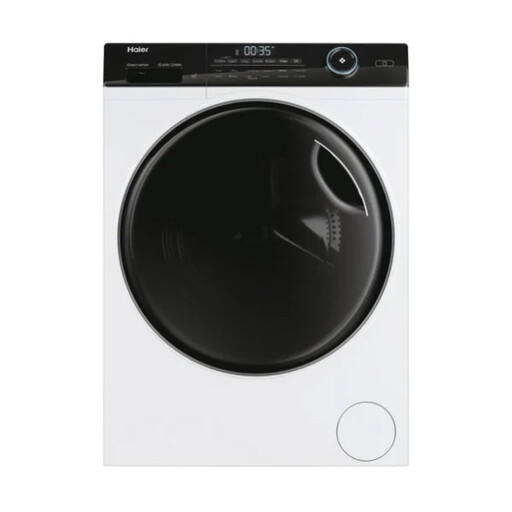 Image unavailable
Haier HW90-B14959U1 I-Pro Series 5, 9 kg
Worth considering if your household regularly washes large loads of bedding and towels that call for a 9 kg capacity. The model name lists 1 400 tr/min, an A energy class, a Direct Motion motor, steam and Wi-Fi.
Check the depth required, including connections, and the load limits for the programmes you’ll use.
View on Joybuy
 Image unavailable
Haier X Series 11 HW100-BD14397PGU1, 10 kg
Its 10 kg capacity is worth comparing if large loads are a regular feature of your household laundry. The product name lists 1 400 tr/min, an A energy class, Direct Motion, AutoDose, steam and Wi-Fi.
Pay particular attention to the available depth, connections and load limits for each programme.
View on Joybuy
 Image unavailable
Electrolux EWF1410N2, 10 kg
This 10 kg front-loader is worth considering if your bulky laundry loads genuinely fill a machine of this capacity. The product name lists TimeSave and an Inverter motor.
Measure the depth of the space available, including the connections, before choosing this model.
View on Joybuy
 Image unavailable
Electrolux EW7FI259160V SteamCare SmartSelect, 9 kg
The 9 kg capacity may suit households that regularly wash large loads of bedding and towels. The model name lists a maximum spin speed of 1 600 tr/min and connected features. If drying time matters to you, compare the spin-drying efficiency class too.
Check the depth required and the clearance needed to open the door carefully.
View on Joybuy
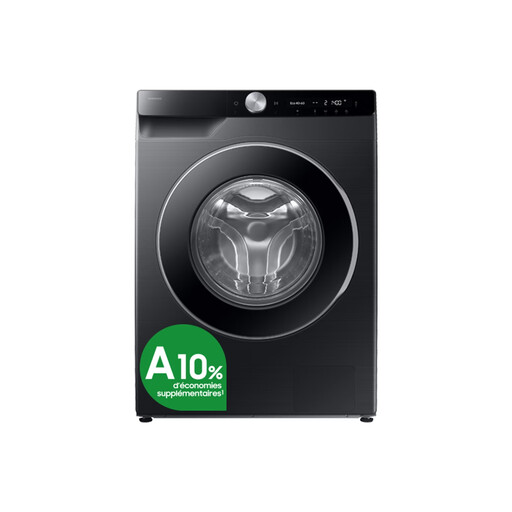 Image unavailable
Samsung WW90DG6U85LBU3 AI Wash 6000 Series, 9 kg, black
Compare its 9 kg capacity with the size of your usual loads, particularly sheets and towels. The product name lists an A energy class.
Before choosing, check the installation dimensions and the maximum loads for programmes other than cotton.
View on Joybuy
Frequently asked questions
Does the stated capacity apply to every programme?
No. Maximum loads can vary by fabric and programme. UFC-Que Choisir’s testing protocol, for example, distinguishes the capacity of the synthetic programme from that of the cotton programme. Check the load table in the manual for the model you’re considering.
Top-loader or front-loader: which should you choose if space is tight?
If width is your main constraint, consider top-loading models: UFC-Que Choisir says they are generally 40 to 46 cm wide. However, check their height and the space needed to open the lid. For a front-loader, measure the depth and the clearance needed for the door too.
What should you compare on a washing machine’s energy label?
Compare the energy class, consumption in kWh per 100 cycles, water use per cycle, the duration of the reference programme and spin noise. The European Commission confirms that these details appear on the label. Use the same basis of measurement when comparing two models.
Can you check a washing machine’s durability index in France?
Yes. The French ministry responsible for ecology says that, from 8 April 2025, the durability index is gradually replacing the repairability index for washing machines. Check the score and its breakdown for the specific model rather than judging an entire range by a single machine.
Does a commercial warranty replace the statutory guarantee?
No. In France, the statutory guarantee of conformity is compulsory for new, second-hand and refurbished goods sold by a business to a private individual, as the Ministry of the Economy explains. Read the terms of any commercial warranty offered with the washing machine separately.


