Households with regular, large loads
If you often have to split your laundry across several cycles, compare the capacity with the loads you actually wash together. ADEME recommends avoiding a large drum if you rarely use its full capacity.


Choose a capacity that suits the loads you actually wash, then check that the machine will fit in your home and that the spin noise is suitable for the times you plan to use it. A larger capacity can save you splitting some loads, but it may not be much use if your regular washes rarely fill the drum. ADEME says that 7 kg is usually enough.
If you often have to split your laundry across several cycles, compare the capacity with the loads you actually wash together. ADEME recommends avoiding a large drum if you rarely use its full capacity.
The available width and depth, the space needed to open the lid or door, and whether you can comfortably bend down may help you decide between a top-loading and a front-loading machine.
If the machine is near living areas or you need to use it at certain times, compare its stated spin noise. The spin-drying efficiency class also matters if you dry your laundry indoors.
Start with your usual loads and the dimensions of the space available. Then compare suitable models using their energy labels and spin performance data.
Consider it if: there’s room to access the door and you need a capacity suited to regular large loads, an under-counter installation or a compatible stacking set-up.
Bear in mind: you’ll need to bend down to load it, and it needs more depth than the cabinet dimensions alone suggest.
Consider it if: width is limited or you’d rather load your laundry without bending down.
Bear in mind: UFC-Que Choisir puts the maximum capacity of top-loading models at between 5 and 8 kg, so check that it’s enough for your most frequent loads.
| Criteria | What to check | Who is it for? |
|---|---|---|
| Usable capacity | Compare the capacity in kg of dry laundry with your usual and larger loads. To compare models, also check the kWh per 100 cycles and litres per cycle for the Eco 40-60 programme. | When laundry piles up, I want to avoid splitting large loads without running my regular washes in a half-empty drum. Around 42% of consumers put usable capacity first. |
| Size and loading style | Measure the width, height and depth, then allow room to open the door or lid, move around and connect the machine. | In a tight space, I need to be able to install and load the machine without blocking the way. For around 33% of consumers, limited space or ease of use is the priority. |
| Noise and spin performance | Compare the stated spin noise, noise class and spin-drying efficiency class for the exact model on its energy label. | If the machine is near living areas or I dry laundry indoors, I focus first on noise and how damp the laundry is after spinning. These needs come first for around 25% of consumers. |
A larger capacity can mean fewer split loads, but ADEME recommends choosing one that matches your actual needs to avoid running a drum that isn’t full enough.
Take note of the loads that build up over a week and compare them with the machine’s capacity, then check its energy use and the length of the Eco 40-60 programme.
Its slim design may solve a space problem without handling larger loads: UFC-Que Choisir says top-loading washing machines have a maximum capacity of 5 to 8 kg.
Also measure the clearance needed to open the lid and check that the capacity suits the loads you want to wash together. If space allows, compare it with a front-loader too.
The stated noise level helps you choose before you buy, but AEG also lists transport bolts left in place, incorrect levelling and an unbalanced load as possible causes of shaking during the spin cycle.
After installation, follow the instructions for removing the transport bolts and levelling the machine, then follow the loading guidance.
The WGE03207FR front-loader featured by Bosch France has a stated capacity of 8 kg and a spin speed of 1,200 rpm.
Miele France’s W1 range of front-loaders includes models with stated capacities of 8, 9 and 10 kg.
For a tight space, the EWQ6412B top-loader featured by Electrolux France has a stated width of 40 cm and a capacity of 6 kg.
The LTR8C7331A top-loader featured by AEG France has a stated capacity of 7 kg and a width of 397 mm.
This selection includes 7 or 8 kg front-loaders and a 7 kg top-loader. Compare their capacity with your loads, then check the space each model needs and its spin performance data.
 Image unavailable
Worth considering if your loads call for 8 kg and you prefer a front-loader. The product name states a spin speed of 1,400 rpm. Measure the space needed in front of the door and behind the machine.
 Image unavailable
Worth comparing if 7 kg suits your loads, rather than paying for extra capacity you’re unlikely to use. The product name states a spin speed of 1,400 rpm and an A energy class. Check the total depth needed, including the door and connections.
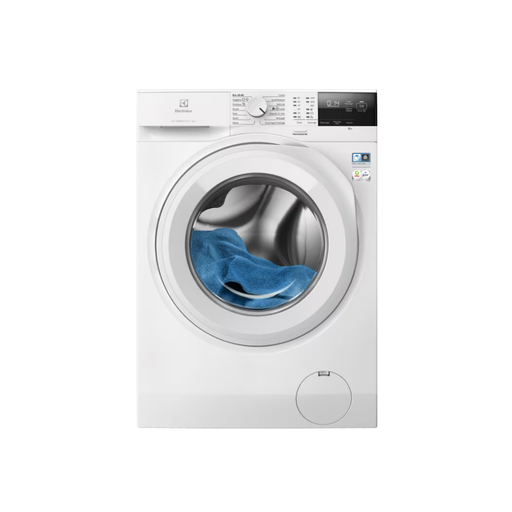 Image unavailable
Worth considering if you regularly wash loads that add up to 8 kg. The product name mentions 1,400 rpm, steam and SensiCare. If the machine is near living areas, also compare its stated spin noise.
 Image unavailable
Worth considering if a top-loader suits your space and 7 kg is enough for your loads. The product name states a spin speed of 1,200 rpm and an A energy class. Allow enough headroom to open the lid and compare the spin noise.
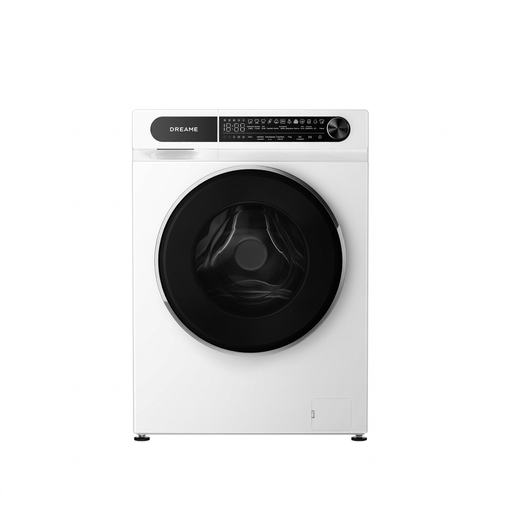 Image unavailable
Worth comparing if your loads call for 8 kg and you need to pay particular attention to depth. Check the total space needed, including connections, and the model’s spin-drying efficiency class if you dry laundry indoors.
Start with the dry laundry you actually put in each wash, rather than the size of your household alone. ADEME says that 7 kg is usually enough; a larger capacity is most worth considering if you regularly wash large loads.
Compare the kWh per 100 cycles, litres per cycle and duration of the Eco 40-60 programme, as well as the energy class. The European label also shows spin-drying efficiency and noise, so check these figures for the exact model rather than looking at capacity alone.
Check the durability rating for the specific model, scored out of 10. According to the French Ministry of the Economy, it has replaced the repairability rating for front- and top-loading washing machines since 8 April 2025. Don’t mistake an old repairability rating for the durability rating.
Check the installation and loading against the instructions for your model. AEG support lists transport bolts left in place, incorrect levelling, an unbalanced load and overloading among the possible causes of noise and shaking.