What should you look for?
Start with your usual loads, then check the space available before comparing the energy label figures. ADEME recommends choosing a capacity to suit your needs, while the European Commission sets out the standardised information shown on washing machine labels.
Front-loading
Consider this if: you have around 60 cm of width and would like to install the machine under a worktop, for example.
Bear in mind: measure the depth and the space needed in front for the door to open. A large drum is only worthwhile if your laundry loads call for it.
Top-loading
Consider this if: width is your main constraint, or you’d rather load the laundry without bending down. UFC-Que Choisir says top-loaders are usually 40 to 46 cm wide.
Bear in mind: check that the capacity suits your loads and that the lid can open freely above the machine.
| Feature |
What to check |
Who it matters to |
| Drum capacity |
Compare the capacity in kg with the loads you usually build up and any larger items you wash occasionally. |
If I often run a wash with only a small amount of laundry, I want a drum that suits my usual loads rather than the largest capacity, which I’d rarely use. Around 36% of consumers would put this at the top of their list. |
| Water, energy and cycle duration |
For a similar capacity, compare kWh per 100 cycles, litres per cycle and the duration of the Eco 40-60 programme. |
When I run repeated cycles, I want to compare their energy and water use without overlooking how long they take. This would be the top priority for around 29% of consumers. |
| Size and loading |
Measure the width, depth and clearance needed to open the door or lid. |
In a tight space, I need to be able to install the machine and get to the laundry easily day to day. Around 21% of consumers would put this first. |
| Noise and spin performance |
Compare noise emissions during spinning, the noise class and the spin-drying efficiency class. |
If the machine runs near living areas or I dry laundry indoors, noise and the amount of moisture left in clothes matter especially. Around 14% of consumers would make these their priority. |
Washing machines to consider on Joybuy
These top- and front-loading models let you compare capacities of 7, 8 and 10 kg for regular laundry. Match each capacity to your usual loads, then check the dimensions and energy label figures for the model you choose.
 Image unavailable
Haier T Series 7 THASN276TM6-S, 7 kg top-loader
Worth considering if the available width points you towards a top-loader and 7 kg suits your loads.
Advertised spin speed of 1,200 rpm; energy rating A. Check there’s enough clearance above the machine to open the lid.
View on Joybuy
 Image unavailable
Bosch WGE02407FR, 7 kg front-loader
Worth considering if your usual loads suit a 7 kg capacity and you have space for a front-loader.
Advertised spin speed of 1,400 rpm; energy rating A. Also measure the depth needed, including space for the door to open.
View on Joybuy
 Image unavailable
Haier X Series 11 HW100-BD14397PGU1, 10 kg front-loader
A 10 kg capacity is worth considering if you regularly build up large loads; it may be more than you need if you often wash small loads.
Advertised spin speed of 1,400 rpm; energy rating A. Check the dimensions and installation clearances.
View on Joybuy
 Image unavailable
Hisense WF5I8043BWF, 8 kg front-loader
Worth considering if your loads need an 8 kg capacity rather than 7 kg and a front-loader suits your space.
Advertised spin speed of 1,400 rpm. Check the full dimensions, connections and clearance needed for the door.
View on Joybuy
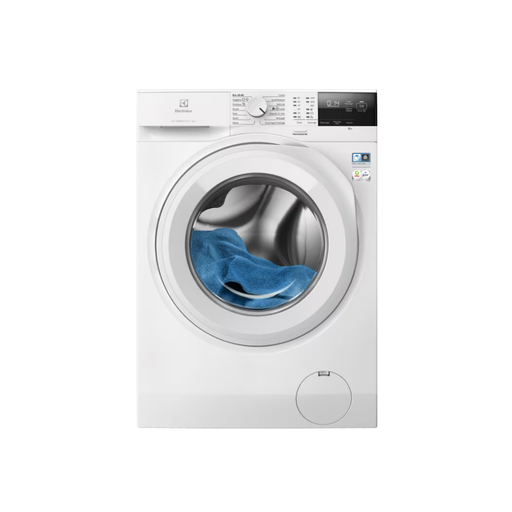 Image unavailable
Electrolux EW6FI4805AW SensiCare, 8 kg front-loader
Worth considering if an 8 kg capacity suits your routine and you’d like to compare features designed for loads of different sizes.
Advertised spin speed of 1,400 rpm. If cycle times matter to your routine, check the Eco 40-60 programme duration on the model’s label.
View on Joybuy
Frequently asked questions
Which energy label figures should I compare?
Compare the energy rating, kWh per 100 cycles, litres per cycle, Eco 40-60 programme duration, spin efficiency and noise during spinning. ADEME and the European Commission highlight these as factors to consider; also weigh them against the capacity and dimensions you need at home.
Is a top-loader always better for a small bathroom?
No. A top-loader is mainly useful when width is limited. UFC-Que Choisir says this type is usually 40 to 46 cm wide, but you’ll need room to open the lid and a capacity that suits your needs. A front-loader may fit under a worktop if the dimensions allow.
Should I fill the drum completely before every wash?
Aim for a good-sized load without cramming the laundry in: it needs room to move around. ADEME advises against half-loads, which may use less water but the same amount of electricity. Also follow the programme instructions and take the fabrics you’re washing into account.
What should I check during installation to reduce vibration?
Follow the instructions for your chosen model and check that it is stable and level. Electrolux’s guidance for its appliances calls for a flat, hard floor and feet that are firmly in contact with it; the exact instructions depend on the washing machine you install.
Does a commercial warranty replace the statutory guarantee?
No. In France, the Ministry of the Economy explains that the statutory guarantee of conformity applies to goods sold by a business to an individual, including when a product does not match its description. A commercial warranty is separate: check what it covers, how long it lasts and any exclusions, without confusing it with your statutory rights.


