Households with baskets that are often full
You regularly have large loads to wash and want to avoid running several cycles, without choosing a drum that’s too big for your usual laundry.


Choose a capacity based on how often you do large loads, rather than simply on the size of your household. According to Que Choisir, 8 to 9 kg is generally enough for a household of three to four people, while 10 to 12 kg is a better fit if you regularly have full loads to wash. If you alternate between large and small loads, also compare the stated energy and water consumption, the limits for each programme and the dimensions of the appliance.
You regularly have large loads to wash and want to avoid running several cycles, without choosing a drum that’s too big for your usual laundry.
Bedding, thick towels, throws or duvets regularly find their way into your laundry. Drum capacity matters, but so does having enough room to install the appliance.
You alternate between full baskets and smaller loads sorted by fabric or programme. Your choice also depends on energy and water consumption, and the load limits for the cycles you use.
To choose between a mid-size capacity and a larger drum, start with the loads you actually wash. According to Que Choisir, the rated capacity is the weight of dry laundry the machine can take for cotton or Eco 40-60 programmes. It doesn’t automatically apply to every programme.
Worth considering: if you do laundry regularly but large loads don’t make up most of your washing; Que Choisir generally considers this range sufficient for three to four people.
The trade-off: bulky items may still need to be washed in separate cycles.
Worth considering: if you regularly have full baskets, bedding and thick towels to wash, and will make good use of the extra capacity.
The trade-off: if the drum is often only half full, its larger capacity won’t guarantee lower consumption. You’ll also need to allow enough space for the appliance.
| Feature | What to check before buying | Who is it for? |
|---|---|---|
| Usable capacity | Compare how often you have full loads with the machine’s capacity in kg of dry laundry. Also check the limits for programmes other than cotton and Eco 40-60. | When bedding and towels often fill the basket, I want to wash them together without having to run another cycle straight away; around 36% of consumers put capacity first. |
| Varying load sizes | Compare the kWh per 100 cycles and litres per cycle on the energy label. If the machine claims to adjust consumption to the load, check how this works for the model you’re considering. | I alternate between large loads and smaller sorted washes, and don’t want to choose a large drum just for the days when it’s full; this is a priority for around 29% of consumers. |
| Space required | Measure the space, the route to the room, the connections and the clearance needed to open the door. Compare these measurements with the model’s dimensions. | If access or space is limited, being able to install and open the appliance matters more than a few extra kilograms of capacity; around 21% of consumers prioritise this. |
| Frequent use | Check the spin and noise specifications, how easy the filter is to access and, if you’re buying in France, the durability index shown. | When I run frequent cycles, I want noise, maintenance and drying to remain manageable day to day; these factors are a priority for around 14% of consumers. |
A larger capacity is most useful if you regularly wash large loads. According to Que Choisir, an XL model may be less efficient when it’s only half full.
Count how often you actually have full loads and compare the figures on the energy label before choosing a larger capacity.
The stated weight applies to dry laundry on cotton or Eco 40-60 programmes; the limits may be lower for wool, synthetics and delicate fabrics.
Check the maximum load for the programmes you’ll use most often in the instruction manual.
A washing machine that suits your laundry needs must also fit through to its installation space, connect properly and open without obstruction.
Measure the access route and the space available, then check the model’s dimensions and the clearance it needs.
Que Choisir reports more mixed feedback on cycle length, filter access and spin noise. These factors matter in a household where the washing machine is used often.
Alongside capacity, compare the noise and spin specifications, maintenance requirements and durability index.
These models suit two different needs: regular large loads with 10 kg drums, or smaller loads with a 7 kg top-loading machine. Check the dimensions and the load limits for each programme before choosing a model.
 Image unavailable
Worth considering if you regularly have large loads that will fill a 10 kg drum.
Spin speed listed as 1,400 rpm; energy class A stated in the product title. Check the permitted loads for the programmes you usually use and the space needed for installation.
 Image unavailable
Worth considering if your usual loads are fairly small and a top-loading machine suits your space.
Spin speed listed as 1,200 rpm; energy class A stated in the product title. Its 7 kg capacity may mean more cycles when large loads come one after another. Also check the clearance above the appliance.
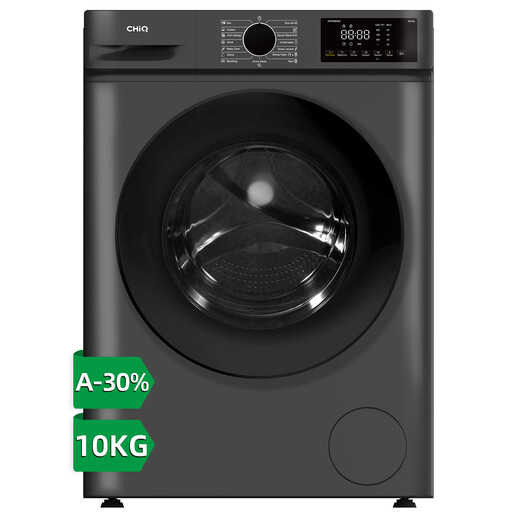 Image unavailable
Worth considering for frequent, large loads, provided its capacity suits the programmes you use.
Spin speed listed as 1,400 rpm. To compare its consumption with another appliance, check the kWh per 100 cycles and litres per cycle on its energy label. Also measure the installation space.
According to Que Choisir, 8 to 9 kg is generally enough for a household of three to four people, while 10 to 12 kg is a better fit if you regularly have full loads to wash. Choose based on how often you wash large loads and bulky items, not just the number of people in your home.
No. A large capacity that’s rarely used to the full won’t guarantee lower consumption. Que Choisir notes that XL models may use more energy when half full. Compare the kWh per 100 cycles and litres per cycle on the energy label, bearing in mind that these are reference figures.
No. According to Que Choisir, the rated capacity applies to dry laundry on cotton or Eco 40-60 programmes, while other programmes have lower load limits. Check the instruction manual for the limits for the fabrics you wash regularly.
Make sure the appliance can be moved through to the room, connected and opened in its intended position. Measure the access route, width, height, depth and required clearances, then compare them with the dimensions of the model you’ve chosen.
Not necessarily, but the installation must follow safety guidance and the manufacturer’s instructions. Que Choisir advises against installing it yourself if you’re unsure; check the available connections before delivery.