Choose a capacity based on the loads you wash regularly, rather than an occasional duvet. According to UFC-Que Choisir, 8 to 9 kg is generally enough for a household of 3 to 4 people, while 10 to 12 kg is a better fit when you regularly wash large loads. If you alternate between large and small loads, check how the specific model adapts its cycle to the load, then compare its energy label and dimensions.
Which households are these capacities suitable for?
The number of people in your household is a useful guide, but how often you wash large loads is the main factor when choosing a capacity.
Households that regularly wash large loads
If you often have large loads to wash, look at 10 to 12 kg models. UFC-Que Choisir considers these capacities a better fit in this situation; however, ADEME recommends choosing a drum capacity that matches the loads you actually wash.
Households that alternate between large and small loads
A 10 kg capacity can handle large loads, but that alone doesn’t guarantee that the machine will adjust for smaller ones. Check whether the model’s documentation explains how it adapts water, energy or cycle duration to the amount of laundry.
Households that often wash bulky items
If duvets and thick throws regularly end up in your washing machine, a larger capacity may be worth considering. Also check the care instructions for each item and the appliance’s dimensions: the stated capacity in kg alone doesn’t confirm that a particular duvet will fit.
What should you compare before choosing?
Start with the size of the loads you wash regularly, then check how the model handles a small load and compare the standardised information on its energy label.
| Factor | What to check | Think about your needs |
|---|
| Typical load size |
Estimate the size of the loads you wash most often, rather than choosing a machine just for an occasional item. According to UFC-Que Choisir, 8 to 9 kg is generally enough for 3 or 4 people; 10 to 12 kg is a better fit if you regularly wash large loads. |
Would my regular loads often fill a large-capacity drum, or would I mostly be washing smaller loads? |
| Bulky items |
Check how often you wash duvets and throws, their care instructions and whether they will fit in the drum of the model you’re considering. |
I often wash these items at home, so their size matters when I choose. If I only wash them occasionally, my regular loads are still the main thing to consider. |
| Small loads |
Look for a clear explanation in the model’s specifications of how it adapts to the amount of laundry. Don’t assume that it adjusts water, energy or cycle duration based on its capacity in kg alone. |
I alternate between large loads and smaller washes, particularly for sportswear or delicates. I want to know what the machine adjusts in each case. |
| Energy label |
The European Commission says the label includes information such as the energy class, kWh per 100 cycles, litres per cycle, duration and noise. Compare figures measured using the Eco 40-60 programme. |
To choose between two similar capacities, I want to compare figures measured on the same basis, without treating the energy class alone as a summary of all the programmes I use. |
| Installation |
Check the model’s full dimensions and measure the space, as well as the route it will need to take for delivery and installation. |
A larger drum won’t help if the appliance won’t fit through the doors or in the space I’ve planned for it. |
| Durability |
For a front-loading or top-loading washing machine sold in France, check the model’s durability index. According to the French Ministry of the Economy, this replaced the repairability index for these appliances on 8 April 2025. |
My washing machine will be used frequently, so I want to factor this information into my choice alongside capacity and consumption. |
Which pitfalls should you avoid?
-
Choosing 12 kg or more for an occasional duvet wash
A large drum that is rarely full isn’t well suited to your usual loads. ADEME recommends matching the capacity to your actual needs rather than running cycles with a barely filled drum.
Before choosing a capacity, note the size of your regular loads and how often you really wash bulky items.
-
Assuming a large capacity means the machine adapts to small loads
The kg figure indicates the rated capacity, not the adjustments the machine makes when you wash less laundry.
Check the specifications for the exact model to see what its load-management feature adjusts: cycle duration, water, energy, or only some of these.
-
Looking only at the energy class
The energy class doesn’t replace the figures on the label. The European Commission also provides consumption, duration and noise information, standardised for the Eco 40-60 programme.
Compare kWh per 100 cycles, litres per cycle, duration and noise on the same basis, then consider which programmes you’ll use.
-
Forgetting about dimensions and durability
The right capacity won’t solve a problem with access or installation. In France, the Ministry of the Economy says that the durability index replaced the repairability index for front-loading and top-loading washing machines on 8 April 2025.
Measure the space and access route, then check the index for the model you’re considering before ordering.
Which brands and features should you look at?
The features below apply to the models mentioned, not to every model in each brand’s range.
AEG
The LFR62E114S has a stated capacity of 10 kg and includes ProSense®.
- According to AEG, ProSense® adjusts the cycle duration, water and energy to the amount of laundry in this model.
- This manufacturer’s description doesn’t prove that it uses less energy than another model: compare their energy labels too.
Electrolux
The EW6FI4130SA is a 10 kg model sold in France with SensiCare.
- Electrolux says SensiCare adjusts the cycle duration and water and energy consumption to the weight of the load.
- Check the dimensions and energy label for the exact model before deciding whether it suits your space and laundry needs.
Haier
The HW100-B14959S8U1 and HW120-BD14397PGU1 are listed with capacities of 10 and 12 kg respectively.
- Haier says the HW100-B14959S8U1 adjusts cycle duration, water and energy to the weight of the laundry.
- Don’t assume another model has this feature without checking its specifications. For the 12 kg model, also check its overall dimensions.
Bosch
ActiveWater Plus is a feature worth looking at if you often wash small loads.
- Bosch describes this feature on the WGG04209FR product page as being designed to reduce water use for small loads.
- Bosch says the WGG04209FR is no longer available. If you’re buying a washing machine, check the model on offer and its specific features.
10 kg washing machines available on Joybuy
These four 10 kg models are for households considering a machine for regular large loads. If you often wash smaller loads, check the load-adaptation features of each model separately.
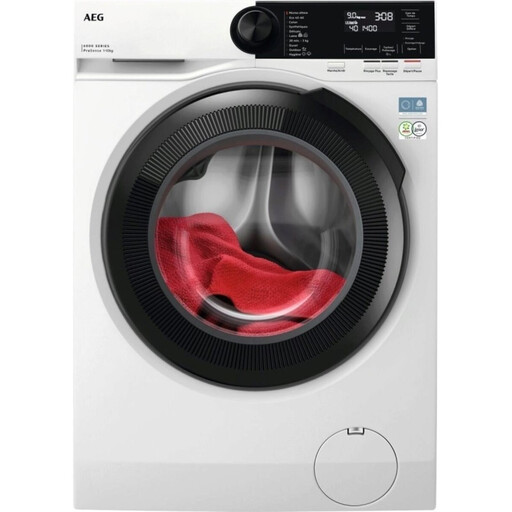 Image unavailable
AEG LFR62E114S — 10 kg, 1 400 tr/min
If you regularly wash large loads but also do smaller washes, AEG says this model’s ProSense® feature adjusts the cycle duration, water and energy to the amount of laundry.
A freestanding front-loading model with a stated energy class of A. Check its dimensions for your installation and compare the figures on its energy label with those of other models you’re considering.
View on Joybuy
 Image unavailable
Haier X Series 11 HW100-BD14397PGU1 — 10 kg
Its stated capacity of 10 kg is worth considering if you regularly wash large loads. If you often wash smaller loads too, check the specifications for this model to see whether it adjusts cycle duration, water or energy to the amount of laundry.
The product name mentions AutoDose, Steam and Wi-Fi. Check its dimensions and energy label before comparing its figures with those of another washing machine.
View on Joybuy
 Image unavailable
Electrolux EWF1410N2 — 10 kg
This 10 kg front-loading model is worth considering if you regularly wash large loads. If you also often wash smaller amounts, check exactly what its load-management feature adjusts.
The product name mentions TimeSave and an Inverter motor. Check its dimensions and energy label figures to compare it against the factors that matter to your household.
View on Joybuy
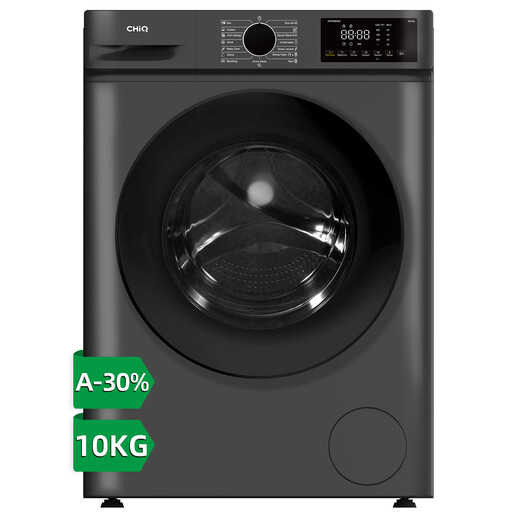 Image unavailable
CHiQ JW105883G — 10 kg, dark grey
Its stated capacity of 10 kg is suited to households that regularly wash large loads. If you often do smaller washes, check the model’s specifications for any adjustments to cycle duration, water and energy.
The product name states 1 400 tr/min and 16 programmes. Measure the available space and compare the figures on its energy label before choosing.
View on Joybuy
Frequently asked questions
Does a large household necessarily need a 12 kg washing machine?
No. According to UFC-Que Choisir, 8 to 9 kg is generally enough for a household of 3 to 4 people; 10 to 12 kg is a better fit if you regularly wash large loads. If you’re considering 12 kg, make sure your usual loads or the bulky items you wash regularly justify that capacity.
How can you tell if a model is suitable for small loads?
Check the feature description for the exact model. It should say whether the machine adjusts cycle duration, water or energy to the amount of laundry. AEG describes ProSense® this way on the LFR62E114S, and Electrolux describes SensiCare on the EW6FI4130SA. These manufacturers’ claims don’t replace comparing energy labels.
What should you compare on a washing machine’s energy label?
Compare the energy class, kWh per 100 cycles, litres per cycle, duration and noise. The European Commission presents this information on a standardised basis linked to the Eco 40-60 programme. It helps you compare appliances, but doesn’t by itself describe every programme you’ll use.
Which index should you check for a washing machine sold in France?
Check the model’s durability index. According to the French Ministry of the Economy, it replaced the repairability index for front-loading and top-loading washing machines on 8 April 2025. Consider it alongside capacity, dimensions and the energy label.


