Which criteria should you check first?
Start with your usual dry laundry load, then compare the machines that suit it based on your available space and how you dry your laundry. The energy and water figures on the label help you compare models for the stated usage, but they don’t describe every cycle you might run.
Front-loading washing machine
Worth considering: if there’s enough room to open the door and you want to choose a capacity that suits your usual loads.
Keep in mind: check the width, depth and clearance needed for your chosen appliance, rather than relying on the capacity figure alone.
Top-loading washing machine
Worth considering: if width is limited or you prefer loading from the top; the Electrolux EW7T3733BA is one example of this style, with a stated width of 400 mm.
Keep in mind: you’ll need clear space above the machine to open the lid. According to UFC-Que Choisir, the top-loading models in its review have a maximum capacity of 8 kg.
Washer-dryer
Worth considering: if you’d also like to dry your laundry in the same appliance and its drying capacity suits your loads.
Keep in mind: compare the capacity and label figures for washing alone and for the full wash-and-dry cycle separately; they aren’t interchangeable.
| Criterion |
What to check |
Who is it for? |
| Capacity and loading |
Compare the rated capacity, expressed in kg of dry laundry, with your usual loads and the larger loads you wash from time to time. |
If my laundry basket takes a while to fill, I want to avoid lightly loaded cycles without having to split my larger washes. Around 42% of consumers would prioritise this balance of capacity. |
| Spin performance and drying |
Check the spin-drying efficiency class and the noise level in dB, not just the maximum speed in rpm. |
When I dry laundry indoors, the amount of moisture left after spinning matters more to me, but I can’t ignore the noise. This would be a priority for around 33% of consumers. |
| Dimensions and access |
Measure the available width, depth and height, then allow for the space needed to open the machine. |
In a tight space, I need to be able to install the machine and access the laundry while still having a useful capacity. Around 25% of consumers would put this space constraint first. |
Washing machines for your needs
This Joybuy selection includes front-loading models with different capacities, a top-loader and a washer-dryer. For each one, start with your usual load, then check the label for the exact model and the dimensions needed for installation.
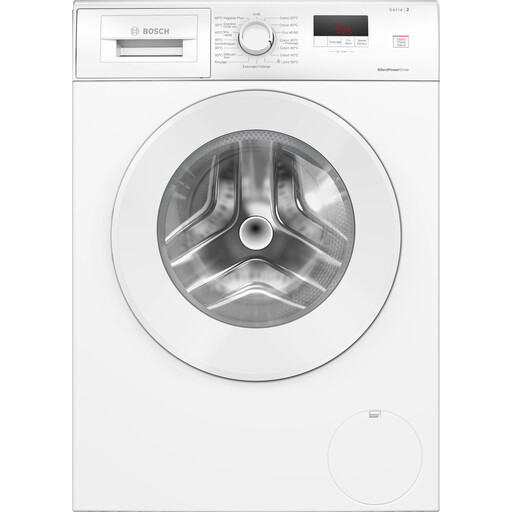 Image unavailable
Bosch WGE02407FR, 7 kg front-loading washing machine
Worth considering if your usual washes suit a 7 kg capacity.
The product listing states a maximum spin speed of 1 400 rpm and an A energy rating; also check the spin-drying efficiency class on the model’s label.
Check the depth and allow clearance for the door before installation.
View on Joybuy
 Image unavailable
Candy TCA464TM4-S ProWash 500, 6 kg top-loading washing machine
Top loading may be a good option if a front-loading door is difficult to access. Make sure 6 kg is also enough for your larger washes.
The product listing states a maximum spin speed of 1 400 rpm. If the machine will be near a living area, compare its spin-drying efficiency class and noise level on the label.
Allow enough space to open the appliance’s lid.
View on Joybuy
 Image unavailable
Samsung WD11DG6B85BEU3, 11 kg / 6 kg washer-dryer
Worth considering if you’d like to wash and dry in the same appliance, provided your loads suit its separate capacities.
The listing states 11 kg for washing and 6 kg for drying, so a full-capacity wash load won’t fit within the stated drying capacity.
Compare the label figures for washing alone and for the complete cycle separately, then check the space needed for installation.
View on Joybuy
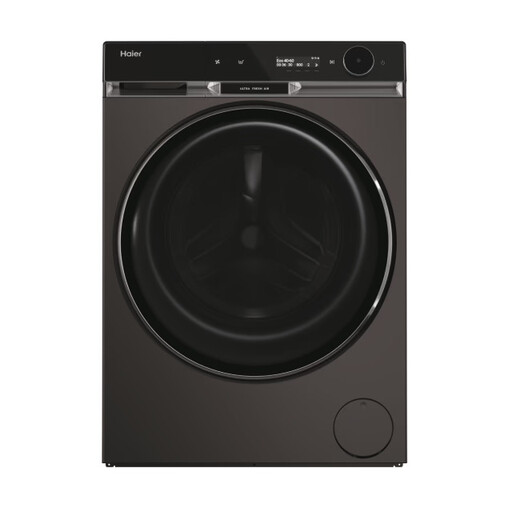 Image unavailable
Haier X Series 11 HW100-BD14397PGU1, 10 kg washing machine
This capacity may suit you if you regularly have larger loads or leave longer between washes. Compare it with your usual laundry basket to avoid having a drum that’s often only partly full.
The product listing states a maximum spin speed of 1 400 rpm and an A energy rating. If you plan to tumble-dry your laundry afterwards, also check the spin-drying efficiency class.
Measure the available depth and allow for clearance before installation.
View on Joybuy
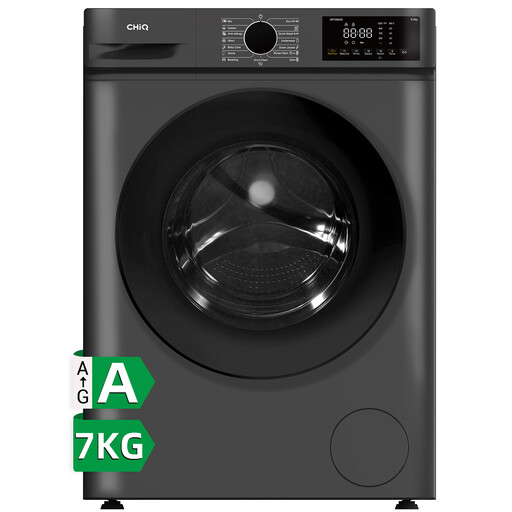 Image unavailable
CHiQ JW75883G, 7 kg dark grey front-loading washing machine
Worth considering if a 7 kg capacity suits the loads you build up before each wash.
The product listing states an A energy rating and a maximum spin speed of 1 200 rpm. To compare energy and spin performance, check the energy and water figures as well as the spin-drying efficiency class on the exact model’s label.
Check the dimensions needed to install it in your chosen space.
View on Joybuy
Frequently asked questions
Does the capacity in kilograms refer to wet laundry?
No. The rated capacity refers to the weight of dry textiles, in line with the manufacturer’s instructions and the European labelling framework. Compare it with the laundry in your basket before washing, not its weight after the cycle.
Should you fill the drum right to the top to avoid a half-load?
No. Put enough laundry in the drum, but leave room for it to move around. ADEME advises against half-loads, which use less water but the same amount of electricity.
Is a high spin speed enough if I dry laundry indoors?
No. Also check the spin-drying efficiency class, which is based on residual moisture under the European labelling framework. The noise level in dB also matters if the appliance will be used near living areas.
How do you compare a washer-dryer with a standard washing machine?
First compare their washing capacities, then check the figures for the complete cycle separately if you plan to use the built-in dryer. The European EPREL register lists these two uses separately. For the Siemens WN54G2A8NL listed there, the stated capacity is 10,5 kg for washing and 6 kg for the complete cycle; these figures don’t apply to other models.
What should you check on the label besides the energy rating?
Check the kWh per 100 cycles, litres per cycle, capacity, Eco 40-60 programme duration, spin-drying efficiency class and noise level, as listed under the European labelling requirements. Scan the label’s QR code to find the information for that model in EPREL.


