What should you compare before buying?
First, check that the capacity and dimensions suit your laundry needs and available space. ADEME recommends choosing a capacity that meets your needs. Then compare the energy-label figures, which are based on a reference cycle defined by the European Commission.
| What matters |
What to check |
Who it matters most to |
| Getting the capacity right |
Estimate the size of your usual loads and check the load limits for the programmes you plan to use. |
I want to combine my laundry without regularly leaving a large drum half empty. Around 33% of consumers prioritise a capacity that suits the amount of laundry they actually wash. |
| Dimensions and installation |
Measure the space and delivery route; check the clearance needed for the lid or door and for the connections. |
If space is tight, I need to know whether the machine will fit and whether its door or lid can open without obstruction. Around 27% of consumers prioritise being able to install the machine. |
| Water and electricity use |
Compare kWh per 100 cycles and litres per cycle using the same energy-label basis. |
Once I’ve found models that suit my household, I want to compare water and electricity use on a like-for-like basis. Around 20% of consumers put these figures first. |
| Spin performance and noise |
Check the spin-drying efficiency class and noise level during spinning; check whether spin speeds are restricted on certain programmes. |
If the machine is near a room in use, I check the noise and spin-drying efficiency rather than relying on the maximum revolutions per minute alone. Around 20% of consumers make this their priority. |
Washing machines for different needs
This selection features front-loading washing machines with capacities from 7 to 12 kg, so you can compare capacities and stated energy and water use against your household’s laundry needs.
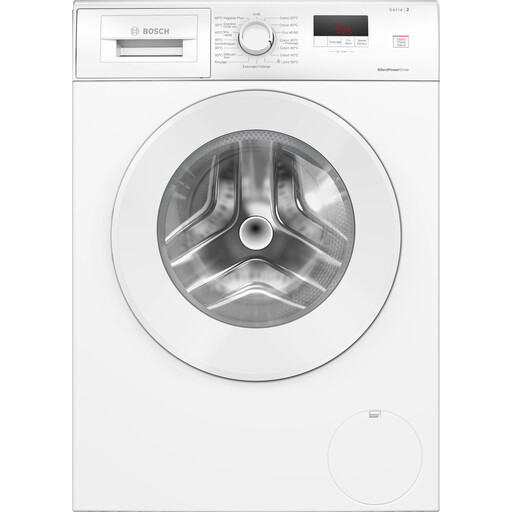 Image unavailable
Bosch WGE02407FR, 7 kg front-loading washing machine
For everyday laundry loads of up to 7 kg, this capacity is in line with ADEME’s general guidance, though it isn’t a rule for every household.
The Joybuy product listing gives it an A energy rating, a maximum spin speed of 1,400 rpm, a B spin-drying efficiency class, 40 kWh per 100 cycles, 44 L per cycle and 72 dB during spinning. Listed dimensions: 59.8 × 84.8 × 59 cm.
Joybuy
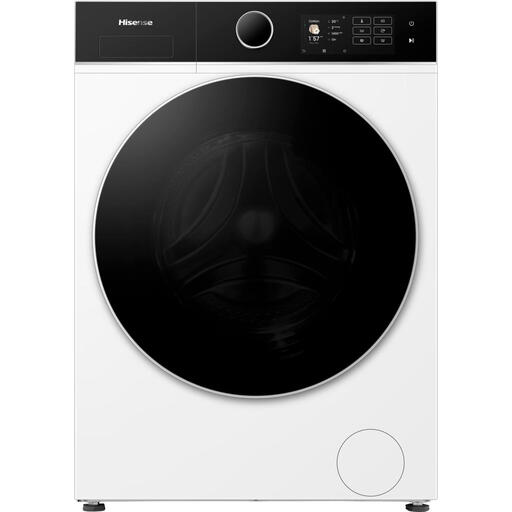 Image unavailable
Hisense WF5I8043BWF, 8 kg front-loading washing machine
Consider this model if an 8 kg capacity suits your usual loads and you have enough depth for it.
The Joybuy product listing gives it an A energy rating, a maximum spin speed of 1,400 rpm, a B spin-drying efficiency class, 33 kWh per 100 cycles, 38 L per cycle and 72 dB during spinning. Listed depth: 470 mm.
Joybuy
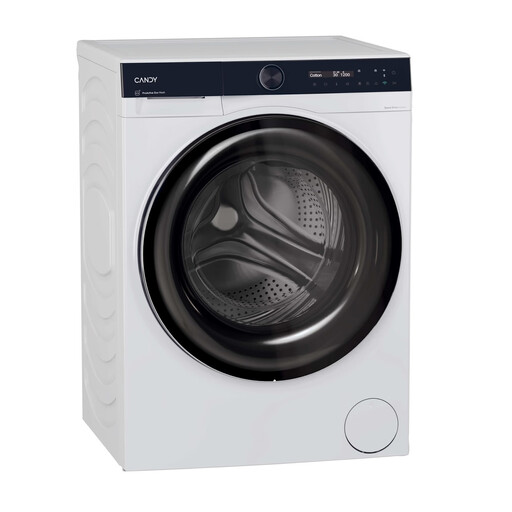 Image unavailable
Candy ProWash 700 BS 412B8-S, 12 kg
A 12 kg capacity is worth considering if you regularly wash large or frequent loads of this size. ADEME recommends avoiding drums that are regularly underfilled.
The Joybuy product listing gives it an A energy rating, a maximum spin speed of 1,400 rpm, a B spin-drying efficiency class, 44 kWh per 100 cycles, 45 L per cycle and 72 dB during spinning.
Joybuy
 Image unavailable
Electrolux EW7FI259160V, 9 kg front-loading washing machine
A 9 kg capacity may suit you if it matches the amount of laundry you actually wash. Check that you have enough depth for this model, too.
The Joybuy product listing gives it an A energy rating, a maximum spin speed of 1,600 rpm, an A spin-drying efficiency class, 44 kWh per 100 cycles, 48 L per cycle and 72 dB during spinning. Listed dimensions: 84.7 × 59.7 × 66 cm.
Joybuy
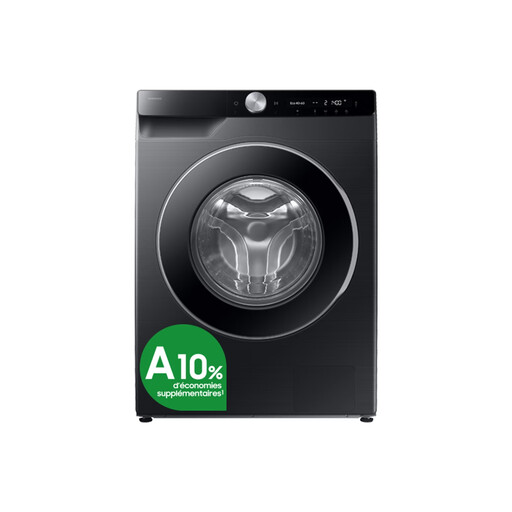 Image unavailable
Samsung WW90DG6U85LBU3, 9 kg washing machine
Worth comparing if a 9 kg capacity suits your usual loads and the machine’s dimensions fit your space.
The Joybuy product listing gives it an A energy rating, a maximum spin speed of 1,400 rpm, a B spin-drying efficiency class, 44 kWh per 100 cycles, 50 L per cycle and 72 dB during spinning. The Eco 40–60 programme is listed at 3 h 48; dimensions: 60 × 85 × 55 cm.
Joybuy
Frequently asked questions
Do babies, pets or shared accommodation mean you need a particular capacity?
No. These circumstances alone don’t determine how many kilograms of capacity you need. Count the loads you separate and actually wash each week, as well as any bulky items, then check the load limits for the programmes you’re considering. ADEME’s guideline that 7 kg is enough “most of the time” isn’t a rule for every household.
What should you check before delivery and connecting the machine?
Measure the space, the route the machine will take, the clearance needed to open the door or lid, and the room available for the water and waste connections. Check the installation instructions for the exact model for details on connecting it, levelling it and preparing it for first use. The dimensions of a different model aren’t enough.
Does the energy label show how much every programme will use?
No. The energy-label comparison figures are based on the Eco 40–60 programme and won’t exactly predict the consumption of every programme or load. The European Commission gives electricity and water consumption figures on this basis; compare the models you’re considering using the same data.
What protection and durability indicator should you look for in France?
When you buy from a professional seller, the legal guarantee of conformity is provided by the seller under the conditions set out by law. The DGCCRF states that it applies for two years from the date the goods are delivered. The French Ministry for the Ecological Transition says that the durability index has applied to washing machines since 8 April 2025. It covers criteria such as parts availability and repairability, but doesn’t guarantee the lifespan of any particular appliance.
How should you maintain your machine without assuming every model works the same way?
Follow the instructions for your model when cleaning the filter, carrying out general cleaning and running maintenance cycles. For the F94N14SLS, LG recommends cleaning the drum monthly. This guidance is specific to that model’s documentation and doesn’t automatically apply to every washing machine.


