Which features should you compare?
Start with your usual laundry loads and the space available, then compare usage figures for models with similar capacities. If installing a machine at home is not an option, or you only need one temporarily, consider the costs and arrangements for a launderette or local service too.
| Feature | What to check | My needs |
|---|
| Capacity |
Compare the capacity in kg with your usual loads, how often you wash and any larger items you need to clean. ADEME says that 7 kg is usually enough. |
I want to wash the laundry that has built up without choosing a drum that is too large for my usual loads. |
| Size |
Check the dimensions of the exact model, the space needed to open it and the clearances specified in its manual. According to Whirlpool, the Whirlpool TDLR 62667 FR is 40 cm wide and 60 cm deep; Electrolux slim front-loaders are designed to reduce depth. |
Is my space limited in width, depth or height? I also need to be able to open the door or lid. |
| Water and energy |
On the energy label, compare the class, kWh per 100 cycles and litres of water per cycle, preferably between models with similar capacities. These figures are based on the Eco 40-60 reference programme, not every programme. |
For my regular laundry, I want to compare consumption figures measured on the same basis, rather than looking at the energy class alone. |
| Noise and spin efficiency |
Check the spin noise level and spin-drying efficiency class shown on the label. Treat the maximum speed in rpm as a model specification, not a promise of results for every load. |
If the machine is near a living area, spin noise matters to me, as does spin-drying efficiency. |
| Durability |
For eligible washing machines put on sale in France since 8 April 2025, compare the durability index out of 10 for the exact model. According to the French Ministries responsible for the ecological transition, it takes account of factors including parts, maintenance, ease of disassembly and resistance. |
I want to compare maintenance and repair options without treating a score as a guarantee of how long the machine will last. |
Brands and models at a glance
These manufacturer specifications illustrate particular formats and capacities; they do not apply to every model from each brand.
Bosch
The WGE02201FR is an example of a 7 kg front-loader: Bosch lists a spin speed of 1 200 rpm and dimensions of 848 × 598 × 588 mm.
- Published capacity and dimensions make it easier to compare the model with your laundry loads and available space.
- Check the clearances and connections in the manual for the model you buy.
Whirlpool
According to Whirlpool, the TDLR 62667 FR is a 6 kg top-loader that is 40 cm wide and 60 cm deep.
- Its published width makes it worth considering for a narrow space.
- Check that 6 kg is enough for your loads, and compare its stated spin noise of 79 dB with other models on the same basis.
Electrolux
Electrolux offers slim front-loaders that are generally 33 to 45 cm deep, with capacities ranging from 4 to 6 kg. The EW6S3626XA is listed with a 6 kg capacity and a depth of 411 mm.
- You can compare the depth of the EW6S3626XA directly with the space you have available.
- Make sure the capacity is sufficient for the laundry that builds up, and check the full dimensions of the model you choose.
Miele
Miele’s range includes the WEA125 WCS 8kg Active front-loader, listed with an 8 kg capacity and a spin speed of 1 400 rpm.
- This model offers a point of comparison if your laundry loads call for more than ADEME’s usual guide of 7 kg.
- Compare the energy label, durability index and dimensions of the exact model; a higher capacity is not automatically an advantage for every household.
Front-loading washing machines on Joybuy
These three front-loaders suit different household laundry routines: two have a 7 kg capacity and one has a 9 kg capacity. Choose according to your loads first, then check the installation requirements and label information for the model you select.
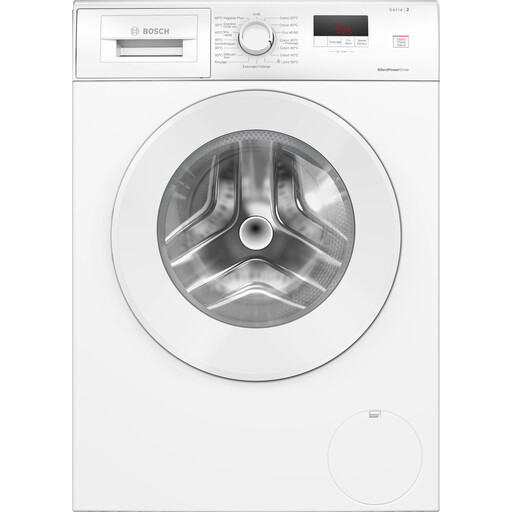 Image unavailable
Bosch WGE02407FR, 7 kg, 1 400 rpm
Worth considering if your usual loads match ADEME’s 7 kg guide. The model name indicates an A energy class; compare the detailed figures on its energy label too. Check the dimensions, opening and connections in the manual before deciding where to put it.
View on Joybuy
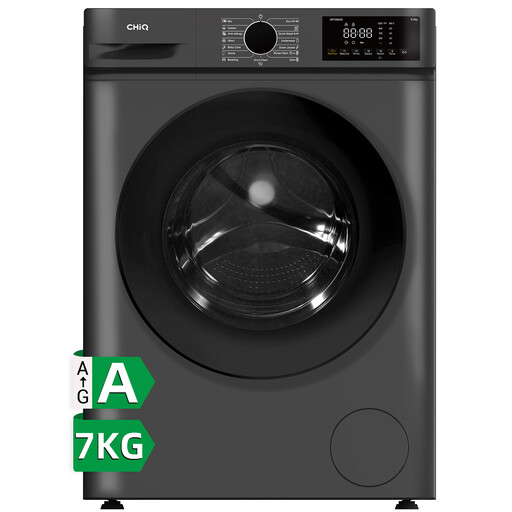 Image unavailable
CHiQ JW75883G, 7 kg, 1 200 rpm
This 7 kg front-loader is worth comparing if you regularly wash loads of this size. Its model name indicates an A energy class and 16 programmes. Before installation, check its full dimensions, connections and instructions for removing the transit bolts.
View on Joybuy
 Image unavailable
Electrolux EW7FI259160V, 9 kg, 1 600 rpm
Consider its 9 kg capacity if your usual loads call for it: ADEME says that 7 kg is usually enough. The model name mentions SteamCare, SmartSelect and a connected feature; check which functions will be useful to you, along with the energy label, dimensions and connections for the exact model.
View on Joybuy
Frequently asked questions
Is a 7 kg washing machine big enough for a household?
According to ADEME, 7 kg is usually enough. However, compare this guide with the size of your loads and any larger items you wash regularly, rather than automatically choosing a bigger capacity.
What should you look for on the energy label?
Compare the energy class, kWh per 100 cycles, litres of water per cycle, spin-drying efficiency, noise level and duration of the Eco 40-60 programme. For a useful comparison, try to compare washing machines with similar capacities and formats.
What is a washing machine’s durability index for?
It lets you compare repairability and reliability factors on a scale of 10, but it does not guarantee how long a particular machine will last. According to the French Ministries responsible for the ecological transition, it applies to eligible washing machines put on sale in France since 8 April 2025; check the score for the exact model.
Do you need permission before changing the installation in a rented home?
If installing a washing machine means altering the property or its fittings, ANIL says you must get the landlord’s written permission before carrying out the work. Check what changes are needed and the terms of your tenancy before you begin; a space that is already set up may not raise the same issue.
What maintenance should you plan for after buying?
Always follow the manual for your model first. ADEME recommends descaling the machine, cleaning the filters and seals, and checking the hoses and cables.


