You only have room for one appliance
When floor space or the area beneath a worktop is limited, consider the overall depth and door clearance as well as how much laundry can be dried in one go.


If you only have room for one appliance to wash and dry your laundry, a washer-dryer could be the answer, provided you size your loads according to its drying capacity, which is lower than its washing capacity. If you often dry large loads and have room for two appliances, a separate tumble dryer may be worth considering. Check the available space, connections and whether the appliances can be safely stacked.
When floor space or the area beneath a worktop is limited, consider the overall depth and door clearance as well as how much laundry can be dried in one go.
A continuous wash-and-dry cycle saves you from moving laundry between two appliances, as long as you stay within the drying capacity. Otherwise, you’ll need to remove some of the load after washing.
If you have space for a second appliance or can safely stack compatible models, consider the capacity of a separate tumble dryer before choosing an all-in-one appliance. You’ll also need to make sure the installation is suitable for your home.
Your choice comes down first to the space you actually have, then to how much laundry you want to come out dry without any intervention.
Consider it: if one space needs to accommodate both washing and drying.
Bear in mind: according to UFC-Que Choisir, drying capacity is lower than washing capacity. A large wash load may therefore need to be reduced before drying.
Consider it: if you often dry large loads and can fit a second appliance, including alongside an existing washing machine.
Plan for: a suitable space or, for a stacked installation, a stacking kit that is compatible with both appliances, as well as the necessary connections.
| Consideration | What to check | Who should consider it |
|---|---|---|
| Overall dimensions | Measure the overall depth, door clearance and route to the installation space. | I only have a narrow recess and need to open the door without blocking the room; around 33% of consumers prioritise the appliance’s size. |
| Drying capacity | Compare the wash-and-dry cycle capacity, in kg, with your usual load. | I want all my laundry to come out dry without removing damp items; this is the top priority for around 27% of consumers. |
| Cycle time and energy use | Check the figures for the combined cycle, which differ from those for washing alone, using comparable programmes and loads. | If I often run a complete cycle, its duration and energy use matter to my choice; around 20% of consumers say this is their main concern. |
| Installation | Check the model’s instructions for the required connections and make sure the necessary power supply is available. | Before choosing an appliance, I need to know whether my home can accommodate and connect it; this is the priority for around 20% of consumers. |
A washer-dryer rated at 9 kg for washing and 6 kg for drying cannot wash and then dry a 9 kg load in one continuous cycle. UFC-Que Choisir highlights this difference in capacity.
Start with the amount of laundry you want to come out dry in one go, then check the limit for the combined programme on your chosen model.
The depth of the appliance’s body doesn’t necessarily include protruding parts or the space taken up by the open door. For example, LG lists the F964V72WRHT as 565 mm deep, but gives an overall depth of 620 mm.
Measure the usable space, door clearance and delivery route before placing your order.
The duration and energy information for the combined cycle relate to a different type of use. For the LG F964V72WRHT, the product information gives an A rating for washing and an E rating for washing and drying.
If you expect to regularly collect dry laundry, compare the figures for the combined cycle using comparable load sizes and programmes.
Suitable drying capacity is not enough if you can’t install or connect the second appliance in the space available.
Check its dimensions and installation instructions. For a stacked setup, confirm that the stacking kit is compatible with both models.
Bosch offers freestanding and integrated washer-dryers. Its product information for the Series 6 WNG24402FR lists a 9 kg washing capacity and a 6 kg capacity for the wash-and-dry cycle.
The LG F964V72WRHT is a 9/6 kg washer-dryer. Its product information gives separate figures for the appliance’s depth and overall depth.
AEG offers both the LWR98B166X heat pump washer-dryer, rated at 10/6 kg, and the TR939I4OBCE separate condenser and heat pump tumble dryer, rated at 9 kg.
The Samsung WD90DG5B15BE washer-dryer is listed with a 9/6 kg capacity and dimensions of 600 × 850 × 600 mm.
These appliances combine washing and drying in one machine. Both Samsung models have a 6 kg drying capacity; the Roborock Marshmallow Zeo Mini is better suited to very small loads. Compare this capacity with your usual load before choosing.
 Image unavailable
Worth considering if you want to wash and then dry your laundry in one appliance. It has a listed capacity of 10 kg for washing and 6 kg for drying, so limit the load to 6 kg for a continuous cycle. Check the usable dimensions, the duration and energy use of the combined cycle, and the model’s installation instructions.
 Image unavailable
This model combines both functions in one appliance, making it suitable when you only have space for one. It is listed at 11 kg for washing and 6 kg for drying, so a full wash load will need to be reduced before drying. Check the product information and instructions for the exact WD11DG6B85BEU3 model to confirm its dimensions, combined cycle and installation requirements.
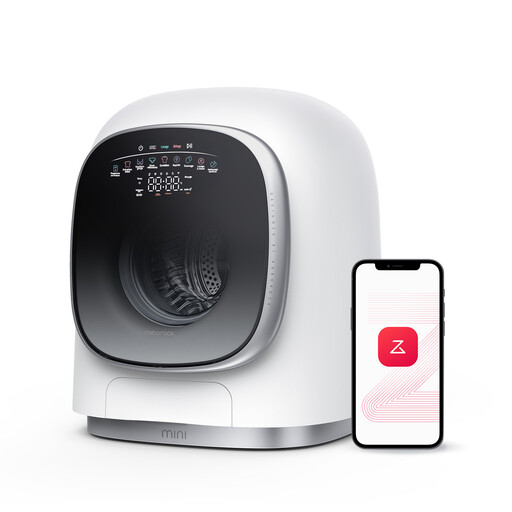 Image unavailable
Best considered for very small loads rather than drying a full, typical wash load. It has a listed capacity of 1 kg for washing and 0,5 kg for drying. Check its dimensions, cycle information and installation requirements before choosing this format.
Yes, as long as the load does not exceed the capacity for the wash-and-dry cycle. According to UFC-Que Choisir, this capacity is lower than the washing capacity on its own. For a 9/6 kg model, limit the load to 6 kg to run both stages in sequence, or remove some laundry before drying.
Check the installation instructions for the exact model, then make sure your home has a water supply, a drain, enough room for the hoses and a suitable power supply. If you’re adding a separate tumble dryer, check its own installation requirements rather than assuming they’re the same as those for the washing machine.
The presence of a socket alone is not enough to determine whether your installation is suitable for both appliances. Promotelec describes dedicated circuits for washing machines and tumble dryers in the electrical installations it covers. If you’re unsure about your home’s wiring, have it checked before planning to connect both appliances.