If you can keep an indoor airer in your home, start by comparing washing machines’ spin efficiency. Bear in mind, though, that you’ll still need to hang your washing out to dry. If you often dry large loads and have a suitable space, a separate tumble dryer meets a different need. And if there’s no room for two appliances, a washer-dryer combines both functions, although its drying capacity is generally lower than its washing capacity. Whichever option you choose, check the dimensions, energy and water consumption, and installation requirements of the model.
Who is each option best for?
People short on space
If there’s no room for two appliances in your kitchen, bathroom or utility room, a washer-dryer means you don’t need to make space for a second machine. You’ll still need to plan your laundry loads around its drying capacity, which is often lower than its washing capacity, as UFC-Que Choisir points out.
Households that often dry large loads
If you regularly wash towels, bedding or frequent loads of laundry, a separate tumble dryer gives you dedicated drying capacity. You’ll need to find space for the appliance and check its installation requirements, including how condensate is handled.
People who are happy to use an indoor airer
If you don’t mind hanging your washing out to dry, focus on a suitable washing capacity, spin efficiency and noise levels. ADEME recommends checking the spin efficiency class when laundry needs to dry indoors. A washing machine alone does not dry your clothes.
Which criteria should you compare?
If you don’t have outdoor space, first check what you can install, then consider how much laundry you need to dry in each cycle. Next, compare the energy consumption and spin efficiency figures for models that meet both requirements.
| Criteria |
What to check |
Best for which shoppers? |
| Available space |
Measure the space and allow for the required clearance. With a washer-dryer, compare the washing and drying capacities separately. |
I want to wash and dry without finding room for a second appliance, even if that means reducing the load before drying. Around 30% of consumers would put saving space first. |
| How often you dry laundry |
Compare the tumble dryer’s capacity with your usual loads, then check its dimensions and how it handles condensate. |
When bedding or towels start to pile up, I want to dry one load while the next wash is running. Around 40% of consumers would prioritise this flexibility. |
| Consumption and durability |
Compare energy and water figures using the same cycle basis. In France, also check the durability index for applicable front-loading and top-loading washing machines. |
If I use the appliance regularly, I’d rather compare energy, water and durability figures than choose based on format alone. Around 20% of consumers would make this a priority. |
| Indoor drying |
Check the spin efficiency class, noise levels and a capacity suited to your laundry. ADEME recommends choosing spin efficiency class A for indoor drying. |
I can keep using an airer, but I’d like my laundry to dry faster without adding a tumble dryer. Around 10% of consumers would make this their top priority. |
What to look out for
-
Looking only at a washer-dryer’s washing capacity
Its drying capacity is generally lower. UFC-Que Choisir points out that you may need to reduce a washed load before drying it, which can change how you plan your laundry.
Compare the washing and drying capacities in kilograms on the product specifications, and start with the amount you actually want to dry in one go.
-
Planning for a tumble dryer without checking all the installation requirements
The appliance’s depth isn’t the only thing to consider: clearances, door opening, condensate handling and stacking requirements all depend on the model and its instructions.
Measure the space and check the instructions for both appliances before planning a stacked installation. Also make sure any accessories are compatible.
Depending on the setup, installation may require a stacking kit or a suitable drainage accessory.
-
Relying on the energy class alone
An energy class doesn’t tell you everything. Check the energy, water, programme duration and noise figures for the reference programmes. Your choice should reflect the cycles you’ll actually use.
Compare figures measured on the same basis, and look at washing and drying data separately if the appliance does both.
-
Overlooking the durability index for an eligible washing machine
According to the French Ministry of the Economy, the durability index replaced the repairability index for eligible front-loading and top-loading washing machines sold in France from 8 April 2025. Its score out of 10 doesn’t show the full detail of the criteria on its own.
Check the score and its breakdown when comparing eligible models. The index does not apply to tumble dryers.
Brands to compare
Bosch
Worth looking at if you’re considering a separate heat pump tumble dryer and want to compare capacity, dimensions and drainage requirements across models.
- Bosch lists the WTH85V02FF with an 8 kg capacity, dimensions of 842 × 598 × 613 mm and a water drainage hose.
- These specifications apply to this particular model. Bosch’s claim that heat pump dryers use less energy than traditional condenser dryers is a statement about its own appliances, not a conclusion that applies to every brand.
LG
Worth considering if you’re looking for a washer-dryer and both the available depth and the amount you can dry in one cycle matter.
- LG’s specifications for the F742212WR list a 7 kg washing capacity, a 4 kg drying capacity and a depth of 45 cm. These capacities suit different uses.
- Check the figures and clearances for the version you’re considering. This example does not represent the entire LG range.
Electrolux
Worth a look if you’re planning to buy a separate tumble dryer, need to drain condensate or want to stack your appliances.
- Electrolux offers condensate drainage accessories and stacking kits for specific configurations, as detailed for each product.
- An Electrolux stacking kit listed for front-loading appliances with a depth of 47 to 60 cm may not suit other dimensions or models. Check which models are compatible.
Samsung
Worth comparing if you plan to dry laundry indoors and want a washing machine with a capacity and spin performance that suits your laundry.
- Joybuy’s listing for the Samsung WW90DG6U25LK specifies a 9 kg capacity and a spin speed of 1 400 tr/min.
- A spin speed in tr/min doesn’t replace the spin efficiency class or a comparison of the model’s noise levels and consumption.
Appliances to suit your routine
These appliances suit three ways of managing laundry without outdoor space: adding a separate tumble dryer, combining washing and drying in a washer-dryer, or using an airer after washing your clothes. Compare each appliance’s capacity with your usual load, and check the instructions before settling on a setup.
 Image unavailable
Hotpoint CHD84MWBSEE, 8 kg heat pump tumble dryer
Worth considering if you have space for a separate drying appliance and want to dry regular loads.
Listed capacity of 8 kg; energy class C. Measure the space and check the instructions for clearance requirements and how condensate is handled.
View on Joybuy
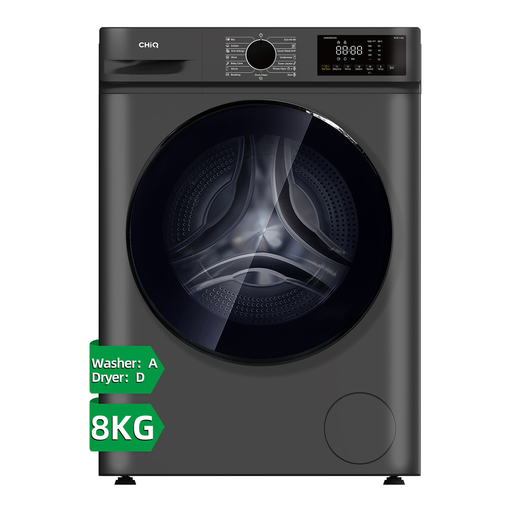 Image unavailable
CHiQ JW85882HG, 8 kg / 5 kg washer-dryer
Worth considering if you want to combine washing and drying in one appliance and can adjust your load to suit the drying cycle.
Listed capacities of 8 kg for washing and 5 kg for drying; spin speed of 1 400 tr/min. An 8 kg wash load is above the maximum drying capacity. Check the installation dimensions in the instructions.
View on Joybuy
 Image unavailable
Hisense WF5I8043BWF, 8 kg washing machine with a 1 400 tr/min spin speed
Worth considering if you use an indoor airer and want a washing machine suited to your usual loads. This appliance does not dry laundry.
Listed capacity of 8 kg and spin speed of 1 400 tr/min. To assess how quickly laundry will dry after washing, also check the model’s spin efficiency class and installation dimensions.
View on Joybuy
 Image unavailable
Electrolux EDH1018CD GentleCare, 8 kg condenser tumble dryer
Worth considering if you have space for a separate tumble dryer for the loads you need to dry regularly.
Listed capacity of 8 kg. Before planning the installation, check the instructions to find out how much space you’ll need and how this model collects or drains condensate.
View on Joybuy
Frequently asked questions
Can a washer-dryer dry a full load straight after washing it?
Not always: its drying capacity is generally lower than its washing capacity, as UFC-Que Choisir points out. Compare the two figures for the model and be prepared to remove some laundry or wash a smaller load if you want to run consecutive cycles.
What should I compare if I’ll use the tumble dryer often?
Compare the capacity, the model’s energy figures and its installation requirements before choosing a technology. Bosch says its heat pump tumble dryers reuse warm air and claims they use less energy than its traditional condenser models. You should still compare the figures for the specific appliances you’re interested in.
Does a condenser tumble dryer need to be connected to a drain?
This depends on the model and the setup described in its instructions. Some appliances have a condensate drainage hose, and dedicated accessories are available. Check whether you can connect the appliance to a drain where you plan to install it, or whether you’ll need to empty a reservoir.
Can you stack any washing machine and tumble dryer?
No. You’ll need a stacking solution that’s compatible with the appliances and meets their installation requirements. For example, Electrolux says one of its kits is suitable for front-loading appliances with a depth of 47 to 60 cm. That range doesn’t guarantee compatibility with other models.
What is the durability index for washing machines in France?
It gives you a score out of 10 and a breakdown of criteria, including repairability and reliability. According to the French Ministry of the Economy, the index replaced the repairability index for eligible front-loading and top-loading washing machines sold in France from 8 April 2025. It does not apply to tumble dryers.


