What should you compare before choosing?
Start by looking at the space you actually have and how much laundry you need to dry. Then compare cycle times and the conditions for using each option.
Washer-dryer
Consider this if: you can’t fit two appliances and can adjust your wash load to suit the drying capacity.
The trade-off: UFC-Que Choisir notes that drying capacity is lower than washing capacity, drying takes a long time, and many models use water during the drying cycle.
Two separate appliances
Consider this if: you have room for a tumble dryer and often need to dry large loads.
The trade-off: you’ll need to transfer the laundry and maintain the tumble dryer. UFC-Que Choisir says heat pump models use less electricity, but generally take longer to dry than the conventional models mentioned in its guide.
Washing machine and clothes airer
Consider this if: you can hang your laundry in a suitable room and would prefer to have a washing machine only.
The trade-off: you’ll need to hang your laundry up and take indoor humidity into account. ADEME recommends a large, well-ventilated room or one with a mechanical ventilation extraction vent.
| Criteria |
What to check |
What matters to me |
| Drying capacity |
For a washer-dryer, compare the washing and drying capacities in kg separately. Check how much laundry can go through a full cycle without removing any items. |
I want to run a wash and drying cycle back to back without having to take some laundry out because the load is too large. |
| Cycle time |
Check the full wash-and-dry cycle time for the model’s reference programme. For a separate tumble dryer, compare the duration of the programme you plan to use. |
When I’m doing several loads in a row, I need to know how long each appliance will be in use. |
| Water and electricity |
Compare the label figures for the same type of cycle, including energy per 100 cycles and water per cycle for washing machines and washer-dryers. According to UFC-Que Choisir, heat pump technology reduces a separate tumble dryer’s electricity use compared with the conventional technologies mentioned in its guide. |
I want to compare the energy and water use for the wash-only or wash-and-dry cycle I’ll actually use, without confusing the two. |
| Indoor humidity |
If you’re using a clothes airer, check the spin efficiency and whether you can dry your laundry in a large, well-ventilated room or one with mechanical ventilation extraction, as ADEME recommends. |
If my laundry dries indoors, I need a room where moisture from the laundry won’t build up. |
| Installation |
Measure the available space and check access and door clearance. If you plan to stack two appliances, check their manufacturers’ instructions before deciding on this set-up. |
I need to be able to install and use the appliances in the space I have, not just squeeze them into the room. |
| Maintenance |
For a separate tumble dryer, check the manual for instructions on the fluff filter and, if the model has an accessible condenser, how to inspect it. Electrolux warns that a blocked condenser can increase energy use and damage the appliance. |
Regular maintenance needs to fit in with the way I use my tumble dryer. |
Which brands and ranges should you consider?
The details below apply to the ranges or models mentioned by their manufacturers. Always check the product information for the model you’re interested in.
AEG
The LWR7G944B washer-dryer is a useful example of the figures to compare before choosing a two-in-one appliance.
- AEG lists a washing capacity of 9 kg, a drying capacity of 5 kg and a cycle time of 6 h 40 for the Eco 40-60 wash-and-dry cycle at full load on this model.
- These figures apply to the LWR7G944B. Check its dimensions and the space needed for installation too.
LG
LG’s French catalogue includes washer-dryers and a WashTower combining a washing machine and tumble dryer in a stacked unit.
- LG lists, among other options, a washer-dryer with a 9/6 kg capacity and a WashTower with a washing capacity of 12 kg and drying capacity of 10 kg. These are different configurations.
- For each model, check the capacity of each function, the cycle time you need and the dimensions rather than assuming these figures apply across the whole range.
Bosch
Bosch’s French range includes separate heat pump tumble dryers, which are worth considering if you have room for a second appliance.
- The Bosch catalogue includes models with capacities of 8 kg and 9 kg.
- Compare capacity, cycle time and energy use for the specific model rather than assuming the figures apply to the whole range.
Joybuy models for two ways to dry your laundry
These models are for adding a separate tumble dryer if you have room, or for washing your laundry before drying it on an indoor clothes airer. Check the installation requirements and cycle information for the model you’re considering.
 Image unavailable
Hotpoint CHD84MWBSEE, 8 kg heat pump tumble dryer
Worth considering if you can install a separate drying appliance alongside your washing machine. The product title lists a capacity of 8 kg and energy class C. Compare the cycle time, energy use for your preferred programme and the dimensions before deciding where to put it.
View on Joybuy
 Image unavailable
Comfee CD08EHP05W-HR, 8 kg heat pump tumble dryer
This separate 8 kg tumble dryer is an option if you have a dedicated space for it. Its stated energy class is D. Check the energy use and cycle time for the programme you’re interested in, as well as the installation dimensions.
View on Joybuy
 Image unavailable
Hisense WF5I8043BWF, 8 kg washing machine, 1 400 tr/min
This washing machine is a good fit if you plan to hang your laundry out to dry after spinning: the product title lists an 8 kg washing capacity and a spin speed of 1 400 tr/min. It doesn’t replace a tumble dryer. For indoor drying, use a well-ventilated room or one with extraction, as ADEME recommends.
View on Joybuy
 Image unavailable
Electrolux EDH1018CD GentleCare, 8 kg condenser tumble dryer
Worth considering if you want to dry your laundry in a separate appliance: the product title lists a capacity of 8 kg and the OptiSense function. If heat pump technology is important to you, check which technology this model uses. Also compare the cycle time and energy use for a programme that suits your loads.
View on Joybuy
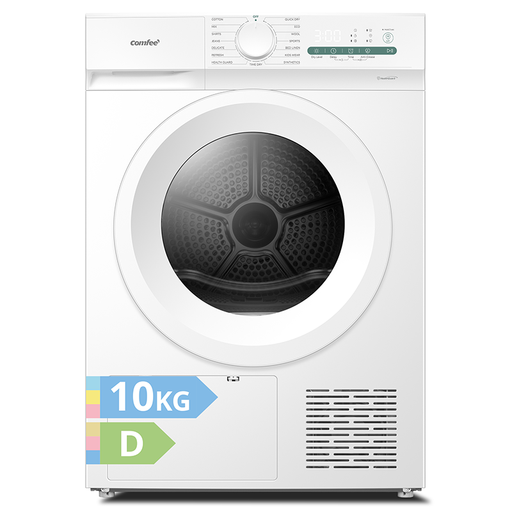 Image unavailable
Comfee CD10EHP05W-HR, heat pump tumble dryer
This separate model is worth considering if you have room to install it. Its descriptions list a capacity of either 8 kg or 10 kg, depending on the source. Confirm the capacity for the CD10EHP05W-HR before planning your loads. Also check its dimensions and the cycle time and energy use for your preferred programme.
View on Joybuy
Frequently asked questions
Can you dry a full load straight away in a washer-dryer?
Yes, as long as the load doesn’t exceed the model’s drying capacity. UFC-Que Choisir points out that this is generally lower than the washing capacity, so you’ll need to take some laundry out before drying a larger load.
Which separate tumble dryer should you consider to reduce electricity use?
A heat pump model is worth considering if you have room for a separate tumble dryer. According to UFC-Que Choisir, this technology uses less electricity than the conventional condenser or vented tumble dryers mentioned in its guide, but generally takes longer to dry. Compare the capacity and figures for the specific model.
What do you need to consider when drying laundry on an indoor clothes airer?
Choose a suitable spin setting and a room where moisture can be extracted. ADEME recommends drying laundry in a large, well-ventilated room or one with a mechanical ventilation extraction vent, preferably with humidity control.
Which figures should you compare for a washer-dryer?
Compare the washing and drying capacities, then check the information for the cycle you plan to use. The European Commission says that the labels for washing machines and washer-dryers in the European Union show, among other details, an A to G rating, energy use per 100 cycles, water per cycle, cycle time and noise. For a washer-dryer, distinguish between the wash-only cycle and the full wash-and-dry cycle.
What maintenance does a heat pump tumble dryer need?
Follow the instructions for your model on cleaning the filter and condenser. For the appliances concerned, Electrolux recommends cleaning the filter after every cycle and checking an accessible condenser at least once a month. Always follow the instructions for your specific model.


