A washer-dryer is best suited to homes with space for just one appliance, provided your usual loads fit within its drying capacity, which is generally lower than its washing capacity. If you have room, two suitably installed appliances are a better choice for frequent or bulky drying loads. A drying rack is another option if drying times and ventilation in your home allow. To decide, compare the actual space required, capacity and full-cycle duration, along with water and energy consumption.
Which option is right for you?
Homes with space and connections for just one appliance
If you can’t install two appliances, a washer-dryer combines washing and drying in one place. However, you’ll need to size your loads according to its drying capacity, not its washing capacity, as UFC-Que Choisir points out.
Homes where laundry is a regular task
If you regularly dry bedding, towels or several loads, start by checking the drying capacity and the full-cycle duration. If your installation allows, it’s also worth considering two separate appliances.
Homes where a drying rack is an option
This avoids installing an electric drying appliance, but it takes up space and time. ADEME highlights the moisture released by laundry drying indoors, so the room and its ventilation matter just as much as the drying rack.
What should you prioritise?
Your choice depends first on what your home can accommodate, then on how much laundry you need to dry and how much space you can leave occupied while it dries.
Washer-dryer
Consider this if: you have space and connections for just one appliance, and your loads fit within the model’s drying capacity.
The trade-off: you may need to remove some laundry before drying a full wash load.
Two appliances suited to your installation
Consider this if: you often dry large loads and have a suitable space, potentially with the appliances stacked.
The trade-off: stacking requires compatible appliances, a stacking kit and a suitable installation; you’ll still need to allow for the space required.
Drying rack
Consider this if: you’re happy to wait and can dry your laundry in a sufficiently well-ventilated room.
The trade-off: damp laundry takes up space and increases indoor humidity, according to ADEME.
| Consideration |
What to check before buying |
Who this matters to |
| Space and installation |
Measure the width, height and depth, delivery access and clearance needed to open the door. Check the connections and, if stacking the appliances, make sure the installation is compatible. |
If there seems to be room for only one appliance, I want to be sure it will fit and work there; around 34% of consumers make this their top priority. |
| Capacity and laundry routine |
Compare the drying capacity, in kg of dry laundry, with your usual loads, then check the duration of the full wash-and-dry cycle. |
If I have several loads to do, waiting for a long cycle to finish or removing laundry before drying makes it harder to plan my day; capacity and cycle times come first for around 33% of consumers. |
| Consumption and maintenance |
For a washer-dryer, check the full-cycle figures: energy use per 100 cycles, water per cycle and cycle duration. Also review the model’s maintenance instructions. |
If I expect to use the dryer regularly, I want to assess the appliance’s full-cycle use and know how to maintain it over time; around 20% of consumers prioritise these considerations. |
| Drying without a machine |
Find a room with enough space and ventilation for a drying rack, or one with suitable air extraction. |
I’d rather do without an electric drying appliance, as long as I can dry laundry without taking up space in a poorly ventilated room; this is the top priority for around 13% of consumers. |
Mistakes to avoid
-
Choosing a washer-dryer based only on its washing capacity
A washer-dryer may wash more laundry than it can dry in the same cycle. If you run a full wash load, you may need to remove some of the laundry before drying.
Compare the full-cycle capacity, given in kg, with your largest loads. The Bosch WNG24402FR and Electrolux EW7IW2856BG specifications illustrate the difference: their manufacturers list capacities of 9/6 kg and 8/5 kg respectively.
-
Assuming the washing figures tell you about drying
The energy label gives separate figures for washing alone and for the full wash-and-dry cycle. UFC-Que Choisir also reports that most of the washer-dryers it tested use a considerable amount of water during drying.
When comparing washer-dryers, check the full-cycle figures on the energy label and product information: energy use per 100 cycles, water per cycle and cycle duration.
-
Assuming indoor drying on a rack has no drawbacks
In a small home, drying laundry takes up space and releases moisture into the indoor air. ADEME highlights the importance of ventilation when drying this way.
Choose a well-ventilated spot or one with suitable air extraction, and make sure you don’t block air inlets or vents.
-
Ordering before checking the space
An alcove that looks wide enough may not be deep enough, or there may not be room to open the door. Stacking appliances or installing them in a bathroom also requires compatibility and safety checks.
Measure the appliance, the route to its intended spot and the clearance it needs. If you’re unsure about the connections or electrical installation, ask a suitably qualified professional to assess your plans.
Brands to compare by model
These examples show different configurations; the specifications apply to the models listed, not to every appliance from each brand.
Bosch
The WNG24402FR washer-dryer and WQG24502FR standalone tumble dryer let you compare two ways to organise your drying.
- Bosch lists a 9 kg washing capacity and a 6 kg full wash-and-dry capacity for the WNG24402FR; the WQG24502FR is a heat pump tumble dryer with a listed capacity of 8 kg.
- Their stated dimensions are 848 × 598 × 590 mm and 842 × 598 × 613 mm respectively. You’ll still need to measure your space and check whether stacking is possible.
Electrolux
The EW7IW2856BG is an example of a washer-dryer to consider if your drying load is smaller than your washing load.
- Electrolux lists a washing capacity of 8 kg and a drying capacity of 5 kg for this model.
- The brand gives a duration of 5 h 55 for the full-load Eco 40-60 wash-and-dry cycle. Check whether that suits your laundry routine.
LG
The F964R76WRST is a washer-dryer to consider if its stated drying capacity of 6 kg suits your loads.
- LG lists a washing capacity of 9 kg, a drying capacity of 6 kg and a 68 L drum for this model.
- A figure for washing alone doesn’t tell you the consumption of the full wash-and-dry cycle. Compare the figures for that cycle specifically.
Samsung
The WD90DG5B15BE combines stated capacities of 9/6 kg with connected features for monitoring energy use.
- Samsung lists a washing capacity of 9 kg, a drying capacity of 6 kg and a depth of 600 mm for this model.
- The brand’s claims about AI Energy mode depend, among other things, on compatible programmes, Wi-Fi and an account. They don’t replace the full-cycle figures on the energy label.
A washer-dryer to consider on Joybuy
This washer-dryer is an option when you need one appliance to handle both washing and drying. Before choosing it for a small home, check its drying capacity and make sure its dimensions suit the space available.
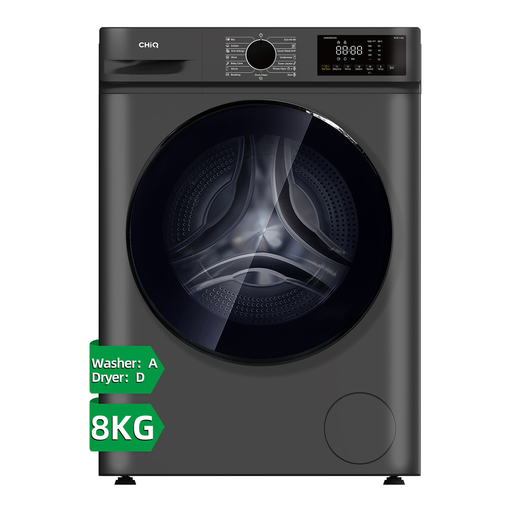 Image unavailable
CHiQ JW85882HG, 8/5 kg washer-dryer
For a space intended for just one appliance, this washer-dryer washes and dries your laundry without the need to install two machines.
Stated capacities: 8 kg for washing and 5 kg for drying. If you want to wash and dry in one go, keep your load within the maximum drying capacity.
The model name mentions a BLDC motor and a spin speed of 1,400 rpm. Before deciding whether it’s right for your home, check its overall dimensions, as well as the duration and consumption of the full cycle.
View on Joybuy
Frequently asked questions
Why can’t a 9/6 kg washer-dryer dry a 9 kg load?
Because 9 kg is the washing capacity and 6 kg is the stated drying capacity for this type of model. The European Commission distinguishes between these capacities. If you want to wash and dry in one go, stick to the full-cycle limit stated in the appliance’s product information.
Can you install a washing machine or tumble dryer anywhere in a bathroom?
No. The position of appliances and sockets must comply with the electrical safety requirements for bathrooms. Promotelec highlights the importance of safety zones. If you’re unsure about a proposed location, ask a qualified professional to check it before you buy.
Is a drying rack enough to dry laundry in a small home?
Yes, if you can make space for one and dry your laundry in a sufficiently well-ventilated room. ADEME points out that indoor drying releases a lot of moisture, so check the ventilation before choosing this as your everyday solution.
Which figures should you compare on a washer-dryer’s energy label?
Compare the full wash-and-dry cycle figures, which are separate from those for washing alone: capacity, energy use per 100 cycles, water per cycle and cycle duration. The information provided by the European Commission helps you distinguish between these two uses; the washing cycle’s energy rating alone doesn’t tell you about drying.


