Who are these options for?

People with room for just one appliance

If you only have one space with the necessary connections and can’t regularly hang your washing out, a washer-dryer means you don’t need to set aside room for a separate tumble dryer. Just check that its drying capacity suits the loads you want to wash and dry without having to intervene.

Households drying several loads a week

Drying capacity and cycle times matter particularly when you’re doing several loads back to back. If you have enough ceiling height and the right installation, it’s also worth considering a stacked pair of appliances with a compatible stacking kit, as UFC-Que Choisir points out.

People who can dry their washing indoors

Air-drying means you don’t need to use an electrical appliance for this stage, but it takes time and requires a suitable room. ADEME highlights the moisture released by washing as it dries indoors, so good ventilation or extraction is essential.

How do the options compare?

Washer-dryer

Worth considering if: you only have room for one appliance and want to run both stages without moving the washing.

Bear in mind: the load for a combined cycle must stay within the drying capacity, which is generally lower than the washing capacity, according to UFC-Que Choisir.

Two stacked appliances

Worth considering if: you regularly dry large loads and have enough headroom.

Bear in mind: you’ll need two appliances, a suitable installation and a compatible stacking kit, as UFC-Que Choisir points out.

Air-drying

Worth considering if: you have the space and time to hang your washing in a well-ventilated room.

Bear in mind: washing releases moisture into the room as it dries, according to ADEME.

Factor What to check What matters to consumers
Space and access Measure the overall dimensions, delivery route and space needed to open the door. Ask for the dimensions of the exact model. In a narrow alcove, I need to be able to install the appliance and open the door without blocking the way; around 29% of consumers prioritise this access.
One cycle, no transfer Compare the washing and drying capacities in kg for a continuous cycle. When I start a wash before going out, I want to come home to dry clothes without having to move them; this is a priority for around 29% of consumers.
Load size and frequency Check the drying capacity and full cycle time. For a stacked pair, check the height and that the kit is compatible. When I do frequent or large loads, I want to avoid running several drying cycles. Around 24% of consumers prioritise having enough capacity to keep up.
Consumption and air-drying Compare water and electricity use, and cycle time for washing and drying. If you use an indoor airer, check that the room is well ventilated. If I can hang my washing out, I want to cut back on electric drying without creating a build-up of damp at home; around 18% of consumers put this balance first.

What pitfalls should you avoid?

  • Assuming the washing capacity is the same as the drying capacity

    On a washer-dryer, the two figures are generally different, according to UFC-Que Choisir. The lower figure limits the load you can wash and then dry without having to intervene.

    Note the model’s washing and drying capacities, for example 9/6 kg, and compare the drying figure with your usual loads.

    If you wash too large a load, you may need to run a second drying cycle or use an airer.

  • Measuring the alcove without allowing for the door

    The depth of the appliance alone doesn’t tell you how much space it takes up in use. For the F852SV50WRS, LG lists a product depth of 475 mm, an overall depth of 535 mm and a depth of 1,015 mm with the door open at 90°. These dimensions don’t apply to other models.

    Also measure the delivery route, connections and space in front of the door, then check the dimensions of the exact model you’ve chosen.

  • Comparing washing figures alone

    Energy use and cycle time for washing alone don’t tell you what to expect from a cycle that includes drying. The label presented by the European Commission distinguishes the information that’s useful when comparing washer-dryers.

    When comparing two specific models, look at the figures for washing and drying, particularly energy and water use and cycle time.

  • Using an indoor airer without considering damp

    ADEME says that clothes drying naturally release a lot of moisture into the indoor air, which is particularly important to bear in mind in a small home.

    Before choosing this option, make sure you have a sufficiently large, well-ventilated room or suitable extraction.

Brands and models to know

LG

LG offers a range of washer-dryers, with dimensions and capacities that vary by model.

  • For the F852SV50WRS, LG lists a capacity of 8.5/5 kg and an overall depth of 535 mm.
  • Check the space in front of this model: LG lists a depth of 1,015 mm with the door open at 90°. Its specifications don’t represent the whole range.

Bosch

The WNG24402FR is an example of a Bosch front-loading model with different capacities for washing and combined wash-and-dry cycles.

  • Bosch lists a washing capacity of 9 kg and a wash-and-dry capacity of 6 kg for the WNG24402FR.
  • Its listed dimensions are 848 × 598 × 590 mm; also check that there’s enough room to open the door in your space.

AEG

AEG offers, among other models, a heat pump washer-dryer and a built-in model, with different dimensions and drying capacities.

  • AEG lists a capacity of 10/6 kg for the heat pump LWR98B166X and 8/4 kg for the built-in LWG88416BI.
  • The LWR98B166X is listed as 636–660 mm deep. For the LWG88416BI, check whether a 4 kg drying capacity will suit your routine.

A washer-dryer on Joybuy

This washer-dryer is for people who want to wash and dry with one appliance. Compare its drying capacity with your usual loads, then check its dimensions before planning the installation.
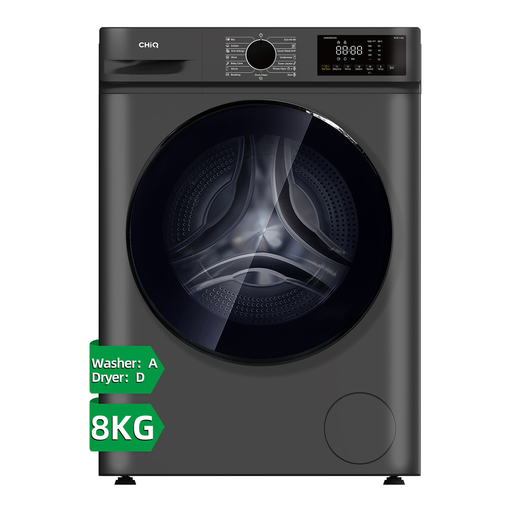
CHiQ JW85882HG washer-dryer, 8 kg washing capacity and 5 kg drying capacity

CHiQ JW85882HG washer-dryer, 8/5 kg

Worth considering if you only have room for one appliance and want to run washing and drying back to back, with loads suited to the drying capacity.

Listed capacities: 8 kg for washing and 5 kg for drying. The product name also mentions a 530 mm drum, a BLDC motor and a spin speed of 1,400 rpm.

Check the overall dimensions and door clearance before buying: the 465 mm width shown in the title doesn’t clearly match the dimensions of 600 × 520 × 847 mm given in the description. Also check the model’s water and electricity use, and its wash-and-dry cycle time.

View on Joybuy

Frequently asked questions

Can you dry the entire load you’ve just washed?

Not if it exceeds the model’s drying capacity. UFC-Que Choisir points out that this is generally lower than the washing capacity. For example, Bosch lists a washing capacity of 9 kg and a combined cycle capacity of 6 kg for the WNG24402FR. To run both stages back to back, keep the load within the drying capacity.

What should you compare on a washer-dryer’s energy label?

Compare the information for washing and drying, rather than looking only at the washing energy rating. The European Commission lists details including the energy rating, energy and water use, and cycle time. Compare like-for-like cycles across the models you’re interested in.

Can an indoor airer replace machine drying?

Yes, if you have the time and a suitable room for drying your washing. ADEME notes that air-drying releases a lot of moisture indoors. In a small home, check that the room is well ventilated or has suitable extraction.

Does a commercial warranty replace the statutory guarantee in France?

No. For goods bought by an individual from a professional seller in France, the statutory guarantee of conformity is compulsory, as economie.gouv.fr points out. Any commercial warranty is separate: check its terms and don’t confuse it with your statutory rights if the goods don’t conform to the contract.