What should you check before choosing?
Washer-dryer
Consider this if: you can only install one appliance and your usual loads are within the model’s drying capacity.
Bear in mind: according to UFC-Que Choisir, a washer-dryer takes longer to dry clothes than a conventional tumble dryer and may also use water.
Two appliances stacked
Consider this if: floor space is limited but there’s enough height to install two compatible appliances.
You’ll need: a stacking kit that’s suitable for your chosen models, plus easy access to the controls, connections and appliances for maintenance.
Washing machine and airer
Consider this if: you can set aside the time and space needed to air-dry clothes.
Keep in mind: according to ADEME, drying clothes indoors releases a lot of moisture, so you’ll need a well-ventilated room or one with mechanical extraction.
Once you’ve chosen your solution, first check the load you need to dry, then look at installation requirements and the features of the cycle you’ll actually use.
| What to consider |
What to check |
How it fits my needs |
| Drying capacity |
For a washer-dryer, compare the washing and drying capacities in kg separately. Check the manual for the maximum load allowed for a wash-and-dry cycle. |
I want to run both stages without taking clothes out: my starting load is limited by the drying capacity, not the washing capacity. UFC-Que Choisir highlights this difference. |
| Space and installation |
Measure the height, width and depth, door opening space and delivery route. For a stacked pair, check that both front-loading appliances and the stacking kit are compatible; for a built-in model, consult the cabinet installation diagram. |
My only floor space can fit one appliance, but the available height will determine whether stacking is an option. I also need to be able to reach the connections and open the doors. |
| Combined cycle |
When comparing two washer-dryers, compare the duration and water and electricity consumption of the wash-and-dry cycle on a like-for-like basis, not just the washing figures. UFC-Que Choisir measures these in its testing protocol. |
If I often use the machine to dry clothes, I want to know how long a full cycle takes and which figures apply specifically to that use. |
| Air-drying |
Allow for a large, well-ventilated room or one with mechanical extraction, in line with ADEME’s recommendations for indoor drying. |
I can manage without machine drying if I have room to hang clothes and can allow for drying time and manage the moisture in the room. |
A few brands to consider
These models show how capacities and formats can vary. Check the exact model, rather than relying on the brand alone.
Bosch
Bosch’s French product pages list the WNA13400FF at 8 kg for washing and 5 kg for a combined cycle, compared with 9 kg and 6 kg for the WNG24402FR. Both are 590 mm deep.
- The separate capacities make it easier to choose a load size for a back-to-back wash-and-dry cycle.
- If you’re stacking appliances with a Bosch kit, check that the models are compatible: a kit’s requirements don’t automatically apply to every appliance.
Haier
Haier lists the freestanding HWD100-B14939 with a 10 kg washing capacity, a 6 kg drying capacity and dimensions of 595 × 688 × 850 mm (width × depth × height).
- The product details distinguish between the load for washing and the load the model can dry.
- Check its 688 mm depth against the available space, access routes and clearance requirements.
Samsung
Samsung lists the WD90DG5B15BEEF with a 9 kg washing capacity and a 6 kg drying capacity, and a depth of 600 mm.
- The separate capacities help you check whether your usual loads are suitable for a combined cycle.
- The 9 kg washing capacity is not the same as the maximum drying load of 6 kg.
Electrolux
Electrolux describes the PerfectCare 800 EW8W3816BI as a built-in model with an 8 kg washing capacity and a 4 kg drying capacity.
- The stated installation type makes this model worth considering for a built-in cabinet project.
- For a back-to-back wash and dry, the load must stay within the 4 kg limit; check the cabinet dimensions against the installation diagram too.
Washer-dryers to consider on Joybuy
These two washer-dryers are options if you’re looking for one appliance to wash and dry clothes. Compare their drying capacity with your usual loads, then check the installation requirements and combined-cycle information for your chosen variant.
 Image unavailable
Samsung WD11DG6B85BEU3 washer-dryer, 11/6 kg
This freestanding model combines washing and drying in one appliance. It has a stated capacity of 11 kg for washing and 6 kg for drying, so limit the load to 6 kg if you want to run both stages without taking clothes out. Before buying, check the dimensions, combined-cycle figures and documentation for this variant.
View on Joybuy
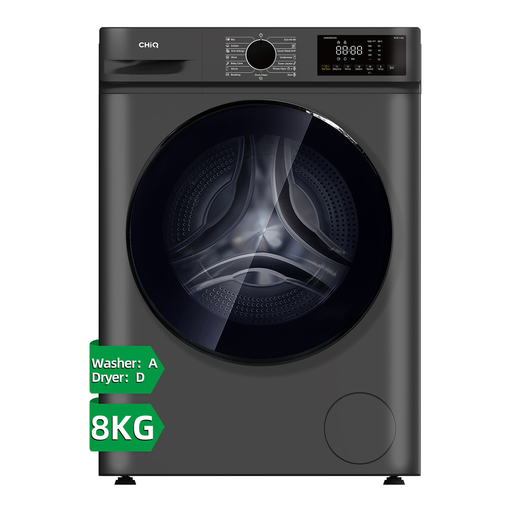 Image unavailable
CHiQ JW85882HG washer-dryer, 8/5 kg
This washer-dryer has a stated washing capacity of 8 kg and a drying capacity of 5 kg, so a full-cycle load must stay within the 5 kg limit. The listed widths of 465 mm and 600 mm don’t match; before choosing it for a narrow space, confirm the dimensions and installation type using the technical specifications and installation diagram. Check the wash-and-dry cycle figures too.
View on Joybuy
Frequently asked questions
Can I wash a full load and start drying straight away?
Only if the load is also within the model’s drying capacity. Bosch, for example, lists the WNG24402FR at 9 kg for washing but 6 kg for a combined cycle. For loads over 6 kg, you’ll need to take some clothes out before drying or split them across several cycles.
What should I measure before ordering a washer-dryer?
Measure the available height, width and depth, the delivery route and the space needed to open the door. Then check the manual for clearance requirements, installation type and connections. UFC-Que Choisir recommends, among other things, a flat, stable floor, a water supply, a drain and a suitable power socket for installing a washing machine.
Can I stack a washing machine and tumble dryer in a narrow space?
Yes, if the height, floor and access allow, and the two front-loading appliances are compatible with a suitable stacking kit. UFC-Que Choisir specifies that the tumble dryer goes above the washing machine, never the other way round. Check the model numbers and manuals before installation.
Can an indoor airer replace machine drying?
It can work if you have the time and a suitable space. ADEME points out that air-drying clothes indoors produces a lot of moisture and recommends a large, well-ventilated room or one fitted with a mechanical ventilation extract vent.
What should I compare on a washer-dryer energy label?
Compare the information that matches how you plan to use the appliance, distinguishing between washing alone and a wash-and-dry cycle. European Regulation 2019/2014 covers energy labelling for these appliances. To assess a back-to-back cycle, also check its duration and water and electricity consumption, which are measured in UFC-Que Choisir’s testing protocol.


