If you can only fit one appliance and want to wash and dry your clothes in one go, without transferring them, a washer-dryer could be the answer — provided your loads fit its drying capacity, which is often lower than its washing capacity, according to UFC-Que Choisir. A washing machine paired with a drying rack is suitable if you have a sufficiently large, well-ventilated room or one with an extractor fan, as recommended by ADEME. If you have room for two appliances, consider that option too when drying capacity and running several loads matter more than floor space.
Who is each option suitable for?
Households with room for just one machine
A washer-dryer combines both functions without taking up floor space with a second appliance. To run consecutive cycles without removing any washing, choose a drying capacity that suits the loads you usually do.
People who don’t want to transfer their washing
A continuous programme saves you transferring clothes between two appliances, but the load allowed for a complete wash-and-dry cycle may be smaller than the washing-only capacity. Check both capacities before relying on this feature.
Households with a suitable room for a drying rack
Air-drying is still an option if you’re happy to wait for your clothes to dry and have a large, well-ventilated room or one with an extractor fan. ADEME highlights the moisture released into the air by laundry drying indoors.
What should you check before choosing?
Washer-dryer
Consider this if : you only have room for one machine and want to run a cycle without transferring your washing.
The trade-off : according to UFC-Que Choisir, drying capacity is lower than washing capacity, and drying takes longer than with a conventional tumble dryer.
Washing machine and drying rack
Consider this if : you can put the drying rack in a large, well-ventilated room or one with an extractor fan.
The trade-off : your laundry takes up space while it dries and releases moisture into your home — a point highlighted by ADEME.
Two separate appliances
Consider this if : you can install two appliances side by side or stacked, and need to get through several loads.
The trade-off : you’ll need to transfer your washing and allow enough space. If stacking the appliances, check which stacking kit the manufacturers recommend.
Once you’ve identified an option that works for your home, compare the amount of laundry it can actually dry, the length of a complete cycle and the installation requirements.
| Factor | What to check | What I need |
|---|
| Drying capacity |
Compare the washing capacity with the capacity for a wash-and-dry cycle, in kg. If you want to run a continuous cycle, use the latter figure: the Bosch WNA144V0FR, Electrolux EW7IW4966BG and LG F164R78BSTA are rated at 9/5 kg, 9/6 kg and 11/6 kg respectively by their manufacturers. |
I want to get my whole load back dry without having to remove some of it after washing. |
| Cycle duration |
Check the duration of the wash-and-dry cycle for the programme and load specified; don’t use the duration of a quick programme as a guide. UFC-Que Choisir notes that drying takes longer than with a conventional tumble dryer. |
If I do several loads in a day, I need to know how long the machine will be occupied. |
| Water and electricity |
On the label for the exact model, check the energy class and consumption figures for washing alone separately from those for a wash-and-dry cycle. Compare figures for the same type of cycle and take the stated capacity into account. |
The energy use of a complete cycle matters more to me than the class shown for washing alone. |
| Space and connections |
Measure the height, width, maximum depth, door clearance and access to the connections. Check the instructions for your chosen model to find out what water supply, drainage and electrical connections it needs. |
The machine needs to fit through to its designated spot, open fully and remain accessible once installed. |
| Room ventilation |
For an indoor drying rack, ADEME recommends a large, well-ventilated room or one with a mechanical ventilation extractor vent. Also consider how much space the rack will take up while your washing dries. |
I can air-dry my washing only if the room is suitable and the rack won’t get in the way of everyday activities. |
What should you watch out for?
-
Choosing based only on washing capacity
A machine rated at 9/5 kg can wash 9 kg, but its stated drying capacity is 5 kg. If you fill the drum based on washing capacity alone, you may have to remove some laundry before drying.
Before choosing a model for continuous wash-and-dry cycles, compare your usual loads with its capacity for a complete cycle.
-
Looking only at the energy rating for washing
Figures for a complete cycle can differ considerably. The EU product information sheet for the Bosch WNA144V0FR gives figures of 0,567 kWh and 46 L for the Eco 40-60 washing cycle, compared with 3,220 kWh and 74 L for the wash-and-dry cycle. These figures apply to this model.
For each model you’re considering, check the energy class, electricity use and water consumption listed specifically for wash-and-dry cycles.
-
Measuring only the available width
A machine that fits the available width may not necessarily be installable, or have enough room for its door to open. Depth, hoses and access to the connections matter too.
Check the full dimensions of the exact model, the delivery route, the door clearance and the space needed for maintenance.
-
Putting a drying rack in a poorly ventilated room
According to ADEME, air-drying laundry releases a lot of moisture into the indoor air. A room where that moisture cannot escape easily isn’t automatically suitable for drying clothes.
Before choosing to dry your washing indoors, make sure you have a large, well-ventilated room or one with a mechanical ventilation extractor.
A few models from well-known brands
These models illustrate the difference between washing and drying capacity. The specifications listed don’t apply to every model in each brand’s range.
Bosch
The freestanding WNA144V0FR is rated for 9 kg of washing and 5 kg for a complete cycle, and measures 848 × 598 × 590 mm, according to Bosch.
- Its EU product information sheet lists a B rating for washing alone and an E rating for wash-and-dry cycles.
- If you wash more than 5 kg, that load can’t be dried in a single complete cycle at the stated capacity.
LG
LG France gives the F164R78BSTA a washing capacity of 11 kg and a drying capacity of 6 kg. It measures 600 × 850 × 565 mm and requires a cold-water supply only.
- Its 11 kg washing capacity makes it easy to identify the washing-only loads to compare with this model.
- The 11 kg figure isn’t the capacity for a drying cycle: LG states a maximum of 6 kg for this function.
Electrolux
The Electrolux EW7IW4966BG is rated for 9 kg of washing and 6 kg of drying. Its French product information sheet lists dimensions of 847 × 597 × 636/658 mm, depending on how depth is measured.
- The product information sheet lists an A rating for washing and a D rating for wash-and-dry cycles.
- When checking whether it will fit, allow for the maximum depth of 658 mm stated by Electrolux, not just the smaller measurement.
A washer-dryer on Joybuy
This option combines washing and drying in one appliance. It’s particularly suited to homes where a second machine would take up too much space. Check that its drying capacity is right for your laundry loads.
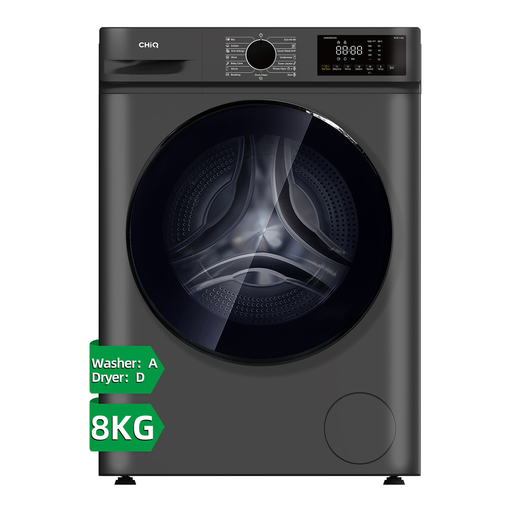 Image unavailable
CHiQ JW85882HG, 8/5 kg washer-dryer, dark grey
This model combines washing and drying in one appliance, with a stated capacity of 8 kg for washing and 5 kg for drying. For a continuous cycle, keep the load within the drying capacity. The stated dimensions — 465 mm wide in one place and 600 × 520 × 847 mm elsewhere — don’t clearly match up, so confirm the full dimensions, including the door when open, before planning the installation. Also check the energy information for the duration and consumption of a complete cycle, and the instructions for the connections required.
View on Joybuy
Frequently asked questions
Can a 9/5 kg washer-dryer wash and then dry 9 kg without any intervention?
No. For a complete cycle, stick to the drying capacity of 5 kg, not the washing capacity of 9 kg. The European Commission distinguishes the rated capacity for a complete cycle from the washing-only capacity, so check the figures for the model you’re considering.
Which part of the energy label should I check for a continuous cycle?
Check the ‘wash and dry’ figures when comparing continuous-cycle use. The European label distinguishes this cycle from washing alone, so compare the energy class, kWh, litres and duration for the use you have in mind. Don’t assume the complete-cycle results based on the washing-only rating.
How can I check the connections for a washer-dryer?
Check the installation instructions for the exact model to find out what water supply, drainage and electrical connections it needs, as well as the clearance required. Requirements can vary by model: for example, LG France states that the F164R78BSTA requires a cold-water supply only.
Is an indoor drying rack suitable for a small, poorly ventilated room?
Don’t choose this option without considering how moisture will escape. ADEME recommends drying laundry in a large, well-ventilated room or one with a mechanical ventilation extractor vent.
Can you install a tumble dryer on top of any washing machine?
No. Check that the two models are compatible and that a suitable stacking kit is available. Bosch instructions allow stacking only with a kit specified by the tumble dryer manufacturer, and rule out stacking when no suitable kit is offered.


