
Livraison le jour même ou le lendemain

Qualité garantie

Débloquez vos offres de bienvenue: Livraison GRATUITE | Jusqu'à -80 % | 30 jours d'essai gratuits à JoyPlus
Téléchargez l'application
A warm duck feather duvet can be a great choice for a bedroom that isn't well heated, an older property, or anyone who tends to feel cold at night. But it's not enough to simply pick a natural filling or a high gram weight. The composition, size and care all play a direct role in everyday comfort.
Before you place an order, take the time to spot the most common pitfalls and compare the features you can actually verify.
Feathers provide more structure and support, while down – which is finer – mainly adds loft. A duvet made up of 90% feathers and 10% down won't feel the same as one filled mostly with down. It will generally be more structured and less airy, though it can still be perfectly suitable for cold nights.
Also check that the product page clearly details the proportions. Marketing terms like "premium", "extra warm" or "luxury" are no substitute for an accurate composition.
The "tog" number is mainly used for synthetic fibre duvets. A 15 tog microfibre duvet is designed to provide significant insulation, but how warm it feels also depends on the filling, the quilting and your bedroom temperature.
For a natural duvet, focus instead on the composition, weight, stated warmth level and baffle-box construction. A very warm duvet can quickly become uncomfortable in a well-heated bedroom.
A duvet that's too narrow lets cold air in at the sides. On the other hand, a very wide model can be heavy and awkward to handle. Before ordering, consider the mattress dimensions, the thickness of your bedding, and each person's habits if you share a bed.
For a duck down duvet, look at the percentage of feathers and down, but also the cover fabric. A cotton cover feels natural and promotes breathability. Where stated, cotton sateen offers a particularly smooth touch.
A natural filling can suit anyone looking for a lightweight yet warm duvet, but comfort depends on the amount of filling and the stated warmth level. In a cold bedroom, a higher feather content will give more structure, while a model with more down will generally be softer and fluffier.
Box-stitch or baffle-box quilting stops the filling from shifting. This reduces the risk of cold spots – areas with less insulation. This detail matters especially for a winter duvet you use every night.
The product page for the Warm duck feather duvet mentions box-stitch quilting, an organic cotton sateen cover and a stated composition of 90% duck feathers and 10% duck down. This information is far more concrete than a simple promise of comfort.
Mentions of OEKO-TEX Standard 100, CertiPUR, Sanitized or ISO 9001 may appear on some product pages. However, they don't all mean the same thing: check the specific certification linked to the product and its exact scope.
When a product page claims a hypoallergenic or anti-dust mite property, treat it as a claim made by the manufacturer or seller, not as a medical guarantee. If you're sensitive, also consider the care instructions, the cover you use and the recommendations on the label.
Measure your mattress and check the exact product dimensions. Terms like "double", "king" or "super king" can mean different sizes depending on the market.
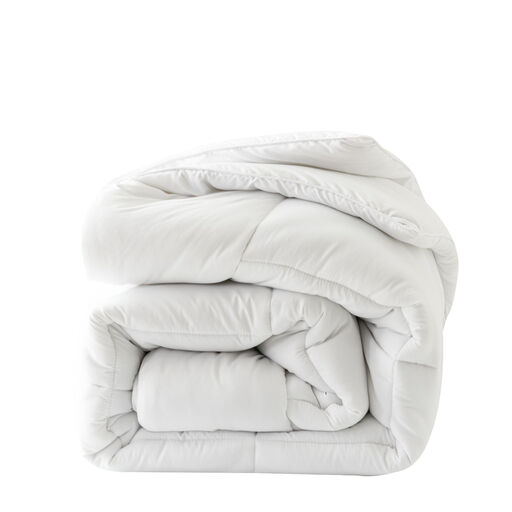
Why this suits this profile: Its double size and stated 15 tog rating make it a good choice for anyone wanting a synthetic winter duvet without moving straight to a duck feather filling.
The product page highlights box-stitch construction and a lightweight design, rather than relying on a vague promise of warmth.
Microfibre filling, 200 x 200 cm size and a stated 15 tog rating.

Why this suits this profile: This natural duvet is aimed at anyone looking for a feather and down filling with a cotton sateen cover.
The stated composition clearly distinguishes the feathers, down, cover and box-stitch quilting.
140 x 200 cm size, stated composition of 90% feathers and 10% down, machine washable up to 40°C according to the product page.
Why this suits this profile: Its size suits a double bed and anyone wanting a more enveloping overhang in a cool bedroom.
The box-stitch quilting helps keep the filling evenly distributed over a large surface, reducing the risk of thin spots.
220 x 240 cm size, stated natural filling and machine washable at 40°C according to the product page.
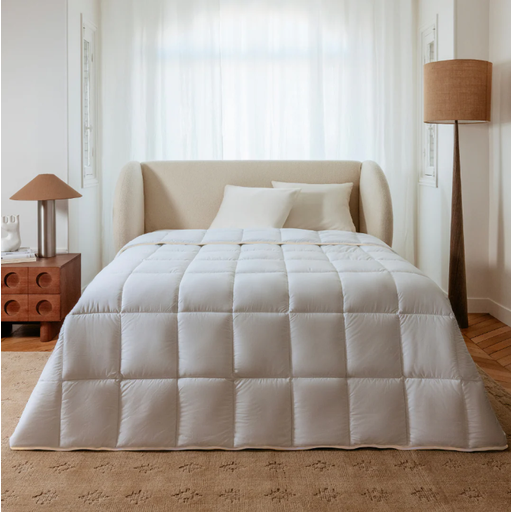
Why this suits this profile: This large all-season duvet can suit a household looking for a versatile natural duvet, rather than one reserved for the coldest nights.
The product page specifies all-season use and box-stitch quilting, rather than just a promise of warmth.
240 x 260 cm size, stated cotton sateen cover and care instructions including a gentle tumble dry.
Always follow the manufacturer's instructions. For models stated as washable, the product pages usually recommend a maximum 40°C wash, a gentle tumble dry or professional cleaning. Avoid storing the duvet while it's still damp, and air it regularly without exposing it to prolonged high humidity.
A duvet cover protects the outer fabric and means you can wash it less often. How long the duvet lasts then depends on the quality of the materials, how often you use it, how you wash it and the storage conditions. A persistent loss of loft, filling that shifts, or a damaged cover are all signs that a replacement may be needed.
It can, especially if it's stated as suitable for winter and has a sufficiently insulating composition. However, check the warmth level, weight and size: the feel can vary noticeably from one model to another.
An all-season duvet is designed for versatile use, whereas a very warm duvet is aimed at cold nights. In a well-heated bedroom, the versatile model will often be easier to adapt to the temperature.
Choose a washable cover, use a protective duvet cover and follow the care instructions. When a product page mentions an anti-dust mite or hypoallergenic property, check the certification and the associated conditions rather than taking the claim as a health guarantee.