
Livraison le jour même ou le lendemain

Qualité garantie

Débloquez vos offres de bienvenue: Livraison GRATUITE | Jusqu'à -80 % | 30 jours d'essai gratuits à JoyPlus
Téléchargez l'application
A wall-mounted coat rack frees up floor space, brings order to the entryway and provides a clearly visible place for coats, bags, hats and towels. However, some models focus more on appearance than everyday practicality and quickly reveal their limitations. Before placing an order, it is therefore worth checking the mounting system, actual capacity and material quality.
A wall-mounted coat rack with five hooks may appear spacious enough. However, everything depends on their design: some are single hooks, while others are double. A 5-hook coat rack fitted with double hooks can therefore hold considerably more accessories than a model with five simple hanging points.
The spacing between the hooks also matters. Thick coats and bulky bags can quickly overlap when the available width is limited.
The phrase “easy installation” does not mean that the same fixings will work for plasterboard, brick or concrete. Wall plugs must be suitable for both the wall material and the weight being suspended. An underspecified fixing can pull out of the wall, even when used with a wall hook made from a robust material.
Screws and wall plugs are not always included. Check the product specifications before buying, then choose fixings suitable for your wall.
A vintage, rustic or modern coat rack should naturally complement your décor. But aesthetics cannot replace practical considerations. A board that is too short, hooks positioned too closely together or fragile finishes can make storing coats on the wall inconvenient in everyday use.
In a busy family entryway, prioritise a stable structure, rounded hooks and sufficient width. In a bathroom or kitchen, a moisture-resistant finish is another valuable advantage.
Wood adds warmth and works particularly well for a wooden coat rack in a Scandinavian, natural or vintage style. However, pine, MDF and solid wood offer different characteristics. MDF generally provides a smooth surface and low weight, while solid wood is valued for its natural appearance and visual presence.
For metal components, look for a finish described as corrosion-resistant or protected with a coating. Varnished aluminium models can work well in several rooms, provided you observe the maximum load specified by the manufacturer.
A 6-hook coat rack is well suited to families or spaces shared by several people. Double wall hooks allow two items to be hung in the same place, but check that their arrangement remains practical when garments are bulky.
Hooks with a lip or groove hold hats, scarves and small bags more securely. Rounded ends also help reduce the risk of snagging fabrics.
Measure the available width before choosing an entryway coat rack. A length of 60 to 64 cm can work well above a low cabinet or in a hallway. A set of separate hooks is easier to adapt to an irregular layout.
Maximum load figures should be viewed in context. The stated values generally apply when the product is installed with suitable fixings. For the Kapanou models featured below, the specifications state a capacity of up to 11 lb per double hook—approximately 5 kg—or 66 lb for certain six-hook coat racks—approximately 30 kg. These figures do not remove the need to choose wall plugs suited to the type of wall.
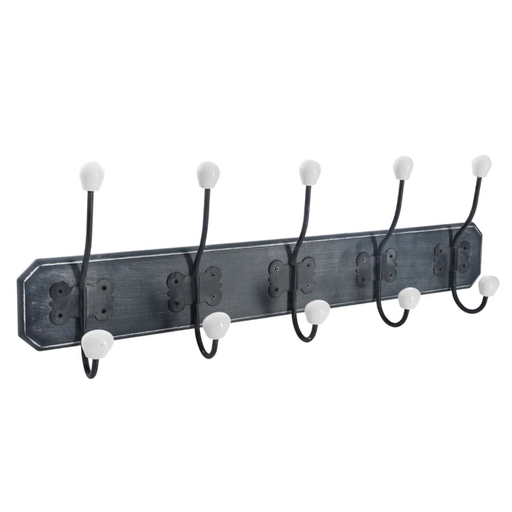
Why this model suits this profile: Measuring 60 x 9 x 20 cm and featuring an MDF panel, it helps organise an entryway or hallway without taking up the space of a bulky piece of furniture.
The product specifications state that it is equipped with five double metal hooks, rather than a simple row of hanging points.
A distressed retro design, ceramic knobs and an E1 MDF panel described as FSC-certified. The wall fixings should be selected according to the wall material.
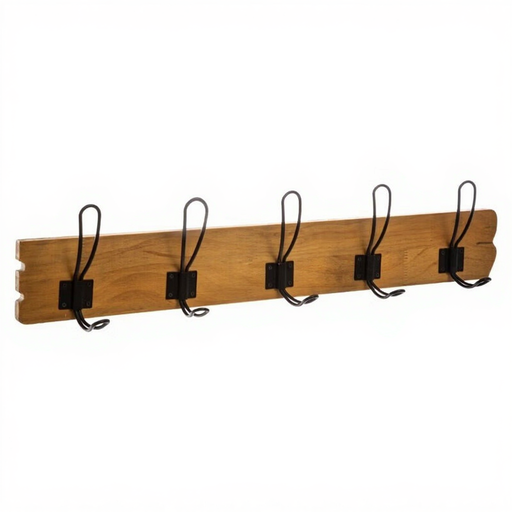
Why this model suits this profile: Its pine frame and cast-iron hooks pair naturally with rustic or traditional décor.
Its dimensions of 63.6 x 14 x 9.5 cm mean you should check the available depth before installation, especially in a narrow passageway.
Five double hooks for coats, jackets, bags and scarves, with a pine and cast-iron structure as stated in the product specifications.

Why this model suits this profile: Its six hooks are well suited to a family entryway, utility room or shared space used by several people.
The specifications state a total capacity of 66 lb—approximately 30 kg—provided it is installed correctly and the stated limits are observed.
Solid rubberwood described as FSC-certified, aluminium-alloy hooks and a finish advertised as resistant to water and rust.
In an entryway, install the coat rack at a height that is accessible to both adults and children without obstructing the door. In a hallway, measure its depth to maintain comfortable passage. A wall hook can also be installed behind a door, in a bedroom or near a shoe cabinet.
In the bathroom, towels and bathrobes need hooks with enough space between them. In the kitchen, a decorative wall hook can hold tea towels or lightweight utensils. For uneven walls, some Kapanou models include a grey rubber backing pad designed to protect the surface and compensate for minor irregularities.
Explore a regularly updated selection of coat racks and wall hooks to compare formats, materials, styles and hook counts.
Use wall plugs specifically designed for plasterboard and locate the studs when the load is substantial. For several heavy coats, fixing directly into a stud or adding suitable reinforcement reduces the risk of the coat rack shifting. Check the tightness after installation and periodically thereafter.
For two people, four or five hooks may be sufficient, depending on how many bags and jackets need to be hung. A family, or a home that regularly welcomes guests, will generally be better served by a 6-hook coat rack. Double hooks increase practical capacity, but the available space and the load supported by each hook remain decisive factors.
Dust it with a soft, dry cloth, or a slightly damp one if permitted by the product specifications. Avoid abrasive cleaners and solvents, which may damage the varnish, patina or paint. Also check the screws and mounting points, particularly if the coat rack is used every day.