
Livraison le jour même ou le lendemain

Qualité garantie

Débloquez vos offres de bienvenue: Livraison GRATUITE | Jusqu'à -80 % | 30 jours d'essai gratuits à JoyPlus
Téléchargez l'application
Far more than just a light source, a well-chosen wall sconce can transform a room and become a centrepiece of your decor. The problem? The market is saturated with models whose attractive designs often hide deal-breaking flaws in practice. Before falling for a pretty picture, it's crucial to know the few pitfalls that can turn a promising purchase into a real headache.
As the head of product selection at Joybuy, my role is to help you see things more clearly. Let's forget the marketing jargon and focus on what really matters: the practical details that make all the difference in your daily life.
The 3 Pitfalls to Avoid When Buying a Wall Sconce:
To make the right choice, focus on these few technical points. They are far more revealing than any marketing claim.
The Ingress Protection (IP) rating is a European standard that classifies an electrical device's level of resistance to the intrusion of solid objects (dust) and liquids (water). It consists of two digits: the first for solids, the second for liquids.
This is the criterion that will determine the simplicity (or complexity) of your project.
The material doesn't just influence the style; it plays a key role in how light is diffused.
Rather than an endless list, here are a few models that meet specific needs while sidestepping the pitfalls we've just discussed.
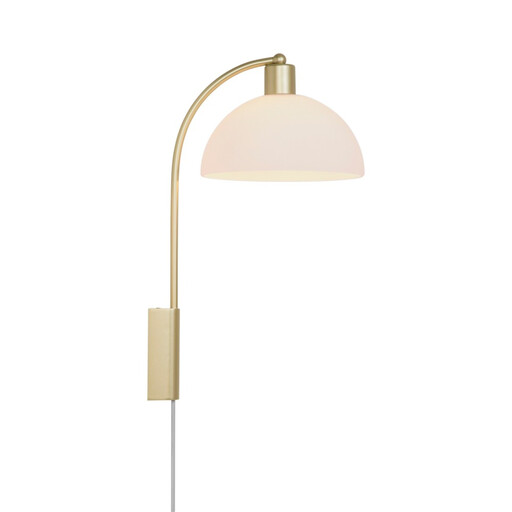
Why we love it: With its rounded shade and airy structure, the Ellen sconce is the epitome of Scandinavian minimalism. Perfect near a sofa or as a wall-mounted bedside lamp, it creates pleasant ambient lighting and a generous halo of light.
Delivered with a 150 cm cable and an integrated switch, it bypasses the complex installation trap. Its glass globe is designed for soft light, perfectly meeting the need for ambient lighting.
Its timeless design provides a gentle visual presence and quality diffused light, a signature of the Scandinavian style.
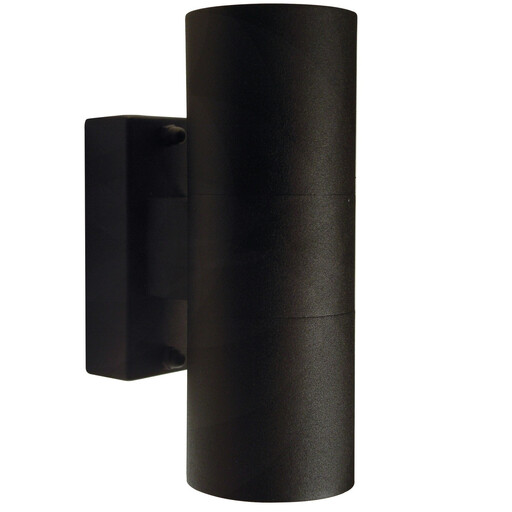
Why we love it: For lighting an entrance, a garage, or a facade, robustness and safety are paramount. This black metal model is built for the outdoors and provides functional dual-beam lighting (up and down).
Its IP54 rating is clearly stated, guaranteeing its resistance to dust and water splashes. It's a safe choice that avoids the pitfall of an unsuitable protection rating. The technical sheet specifies the need for grounding (Class 1), thus informing the buyer of the technical prerequisites.
The dual lighting (up and down) creates a decorative light effect on the facade, while also ensuring effective and welcoming pathway illumination.
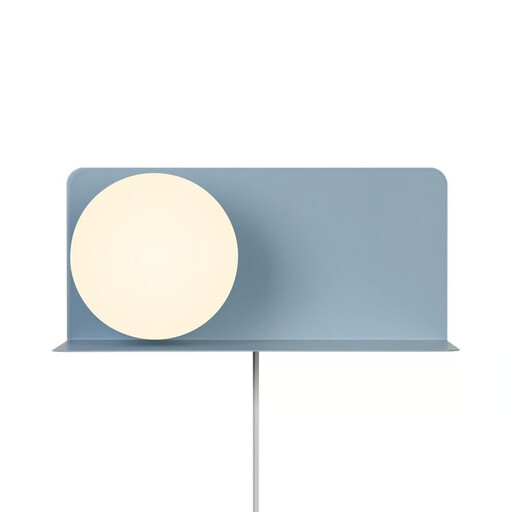
Why we love it: Much more than just a lamp, this model includes a small shelf. Ideal in an entryway for your keys, or in a child's room as a night light and a spot for their bedtime storybook. Its design is as clever as it is functional.
Equipped with a cable and switch, its installation is a breeze. The opal glass globe was chosen for its diffuse and non-harsh light, perfect for a bedroom, thus avoiding the trap of overly bright lighting.
Its dual function as a lamp and shelf makes it a 2-in-1 solution that optimises space with style and ingenuity.
We have curated a complete selection of products that meet our quality criteria and current safety standards.
It all depends on the type of LED. For a sconce with an integrated LED (non-replaceable), manufacturers generally state a lifespan of 20,000 to 25,000 hours, which is over 15 years with a few hours of use per day. For sconces with standard sockets (E27, E14, GU10), the lifespan will depend on the bulb you choose. The advantage? You can easily replace it when the time comes.
The simplest solution is to opt for a wall sconce with a switch and power cable. These models, like the Ellen sconce from our selection, can be mounted on the wall wherever you like and simply plugged into a power outlet. This is the most accessible method and requires no electrical skills.
No, absolutely not. For obvious safety reasons, a bathroom is divided into several regulated "zones." In areas near a water source (sink, shower, bathtub) that are likely to get splashed, it is mandatory to install a fixture certified IP44 at a minimum. Some models are specifically designed for this use. Using a standard sconce (IP20) is not only dangerous but also non-compliant with the NF C 15-100 standard.