
Livraison le jour même ou le lendemain

Qualité garantie

Débloquez vos offres de bienvenue: Livraison GRATUITE | Jusqu'à -80 % | 30 jours d'essai gratuits à JoyPlus
Téléchargez l'application
A well-organised hallway often starts with a wall-mounted coat rack suited to the available space. However, some purchases can prove disappointing in everyday use: too few hooks, unsuitable wall fixings or furniture that turns out to be more cumbersome than expected. Before choosing a wall hook, a few simple checks can help you avoid unpleasant surprises and unnecessary expense.
A coat rack with hooks may seem practical on paper. However, six hooks may not be enough if the rail is narrow or clothes overlap. Remember to check:
A 6-hook coat rack is suitable for many uses, but you should also consider the bulk of winter coats, bags and scarves.
The stated load capacity only applies when the installation is carried out correctly. On plasterboard, brick or concrete walls, wall plugs and screws must be chosen differently. An unsuitable wall fixing can pull away, even with a sturdy wooden coat rack.
For a permanent installation, identify the type of wall and use suitable wall plugs. If drilling is forbidden or simply undesirable, an adhesive hook with no drilling may do the job, but only on a smooth, clean, dry surface that is compatible with the adhesive.
A hallway unit with a coat rack often provides more storage, but its dimensions must be compared with those of the corridor. Measure the available width, the space needed for movement and the clearance required to open drawers or doors.
A set with a shoe bench can be particularly practical in a family hallway, provided it leaves a sufficiently comfortable passageway.
Measure the wall where the hallway coat rack will be installed, then allow some extra space for hanging coats. In a narrow corridor, a shallow wall hook or over-door hooks can free up floor space.
For a complete unit, always check all three dimensions: width, depth and height. For example, the first set shown below measures 100 × 35 × 180 cm. This information is far more useful than a carefully staged product photo: it lets you compare the product with the actual dimensions of your hallway.
The maximum load should be treated as a limit not to be exceeded, rather than the amount recommended for everyday use. Distribute heavy items between several hooks and avoid hanging a fully loaded bag from a single hook.
For adhesive models, the load capacity depends largely on the surface, temperature and application time. The TAILI model states 2.6 lb per hook, equivalent to approximately 1.18 kg. It is therefore better suited to small items, towels, accessories and lightweight clothing than to several thick coats.
Wood adds a warm touch, while metal and stainless steel are easy to clean, particularly in a kitchen or bathroom. Rounded edges also reduce the risk of snagging fabrics.
Simple, regular maintenance is generally all that is needed: wipe with a soft, slightly damp cloth, dry promptly and avoid abrasive products. On a wall-mounted model, also check the screws and anchor points periodically.
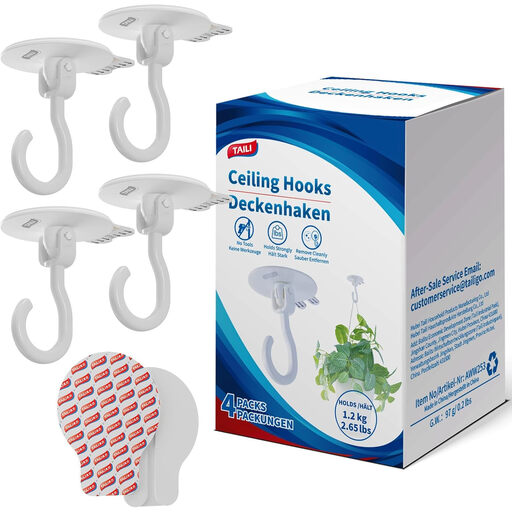
Why this choice suits this profile : A tool-free solution, ideal for tenants or for quickly adding storage in a bathroom, kitchen or small hallway.
The product details specify compatible surfaces and a maximum load of 2.6 lb per hook. This helps prevent you from placing too much weight on it.
No-drill installation, 360° rotation and fixing designed for smooth surfaces.
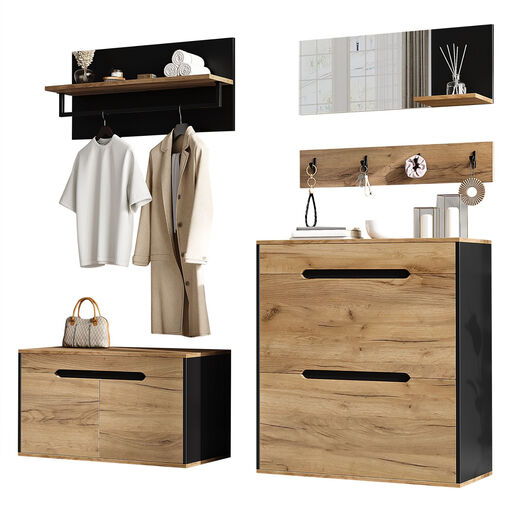
Why this choice suits this profile : This set is designed for households looking for a coordinated arrangement with a mirror, drawer, hat shelf, four hooks and two shoe compartments.
Its stated dimensions make it possible to assess how much space it will take up before buying, while the separate storage areas prevent belongings from piling up on the floor.
Integrated mirror, four hooks, drawer and two shoe compartments.
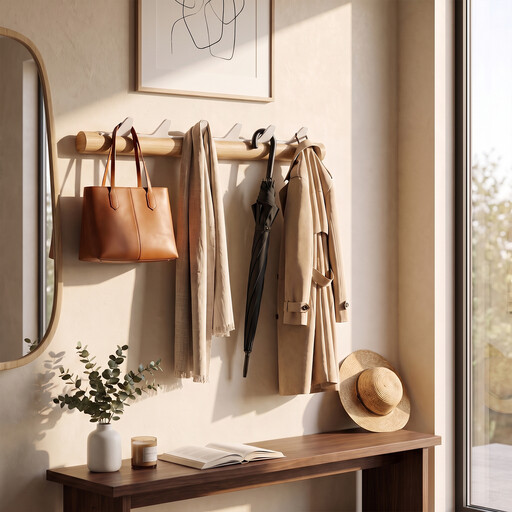
Why this choice suits this profile : This wooden coat rack can be used in a hallway, bedroom, bathroom or kitchen that requires several hanging points.
The product details mention fixing with screws and wall plugs, as well as a maximum load of 66 lb. The wall support must therefore be selected and installed carefully.
Six hooks, FSC-certified rubber rod according to the product details, rounded edges and varnished finish.
We have put together a complete, real-time updated selection of products that meet these demanding selection criteria and European safety standards.
For a standard wall-mounted model:
For adhesive hooks, clean the surface, dry it thoroughly and follow the application time specified in the instructions. Avoid wallpaper, textured walls, cracked surfaces and areas exposed to high heat. Stainless steel over-door hooks are another no-drill solution, provided you check the door thickness and make sure it closes fully.
A height of around 1.60 m is generally suitable for adults, but a family installation can include a few lower hooks. The key is to ensure that neither the doors nor movement through the hallway is obstructed.
Its lifespan depends on the material, the load it supports, the quality of the fixing and the level of humidity. A correctly screwed-in and well-maintained model can remain functional for many years. Adhesive solutions are more sensitive to the surface, temperature and suspended weight.
Yes, with an adhesive hook or over-door hooks. This solution is mainly suitable for lightweight items and smooth surfaces. For several heavy coats, a screwed fixing with suitable wall plugs is generally preferable.