
Livraison le jour même ou le lendemain

Qualité garantie

Débloquez vos offres de bienvenue: Livraison GRATUITE | Jusqu'à -80 % | 30 jours d'essai gratuits à JoyPlus
Téléchargez l'application
A wall-mounted coat rack seems deceptively simple. Yet, who hasn't cursed at a stylish model that gets ripped from the wall after a few months, or proves incapable of holding more than two winter coats? Choosing the right wall hook means finding the perfect balance between aesthetics, practicality, and durability. Before you commit to a purchase, it's best to know the common pitfalls to ensure you're investing in a solution that will truly optimize your entryway.
As a Product Expert at Joybuy, my mission is to help you see clearly and make the right choice, steering you away from misleading marketing claims.
An attractive design can hide flaws that only become apparent with use. Here are the three most common problems that turn a bargain into a real headache.
To avoid these disappointments, here are the three key points to check for a truly durable and functional purchase.
Robustness is the name of the game. There are two figures to watch closely:
Be aware that this theoretical capacity is only valid if the wall mounting is flawless. The secret? Choose anchors perfectly suited to your wall type (drywall, hollow brick, concrete...). Never hesitate to discard the included hardware and replace it with high-quality models (like Molly-type expansion anchors for drywall, for example). Good to know: an individual screw-in hook often distributes the load better than a single large backplate.
The longevity of your coat rack depends directly on the quality of its materials.
A good coat rack must be practical for daily use. Check the spacing between hooks: a minimum of 10 to 12?cm (4 to 4.7 inches) is recommended to hang winter coats without them becoming a jumbled mess. The shape of the wall hook also plays a role. Models with double prongs or a rounded head (the classic ball on vintage hooks) hold clothing better and prevent stretching the collars.
To illustrate this advice, here is a selection of models that meet specific needs while avoiding the classic pitfalls.
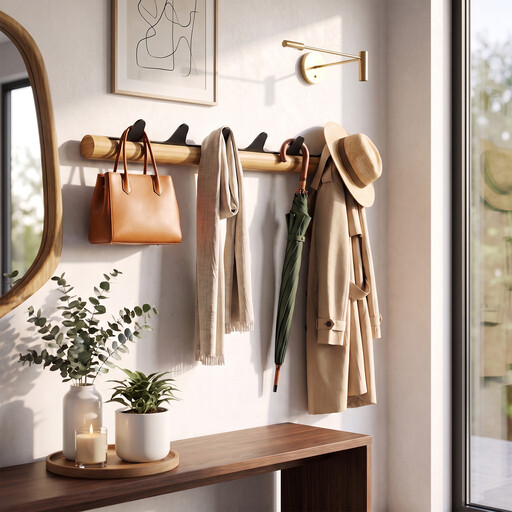
Why we chose it: Designed for busy entryways, it effortlessly holds coats, school bags, and purses for the whole family thanks to its sturdiness and six well-designed hooks. Perfect as a family entryway coat rack.
It sidesteps the cheap materials trap with its FSC-certified solid rubberwood bar and robust aluminum alloy hooks, which are built to last.
Generous load capacity (up to 30 kg / 66 lbs) and materials that are resistant to water and rust.
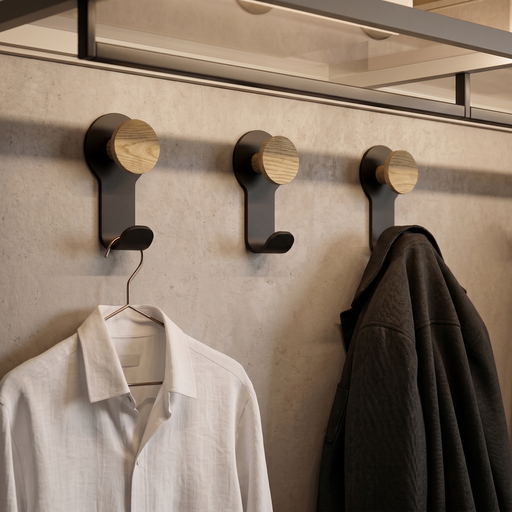
Why we chose it: Perfect for those who want to create their own storage wall. These individual hooks can be arranged freely to fit your space and style, while offering a practical dual-hook design.
It avoids the "ergonomics sacrificed for design" trap. Its dual-hook design (one wood, one metal) optimizes storage, while the individual mounting of each screw-in hook ensures rock-solid stability.
Maximum installation flexibility and an award-winning design (Muse Design Award). Each hook supports up to 5 kg (11 lbs).
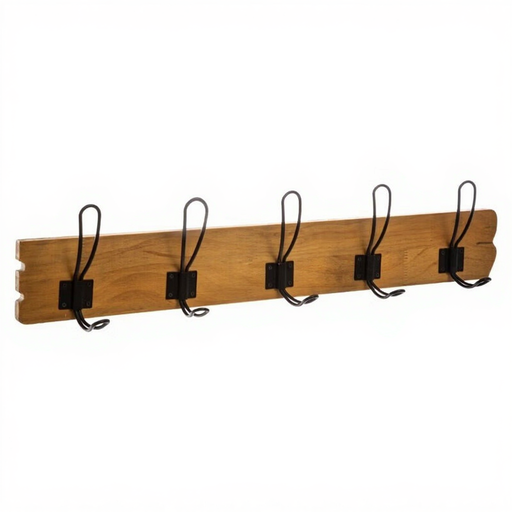
Why we chose it: Its understated design and successful pairing of pine wood and cast iron give it a timeless rustic charm. Perfect for entryways or hallways where every inch counts, without compromising on sturdiness.
Its cast iron hooks, far sturdier than cheap alloys, eliminate any risk of bending. Its simple, time-tested design is a guarantee of everyday functionality.
Authentic style and durable materials. Its double hooks are very practical for hanging both a coat and an accessory.
1. What kind of wall anchor should I use to mount a coat rack? It all depends on your wall type. For drywall (plasterboard), expansion anchors (like Molly bolts) are essential. For a solid wall (concrete, cinder block), universal or hammer-in anchors will work. Finally, for a hollow wall (brick), opt for toggle bolts or even a chemical anchor for the heaviest loads.
2. What is the ideal height to install a wall-mounted coat rack? Generally, it should be installed between 1.70?m and 1.75?m (about 5'7" to 5'9") from the floor. This is the perfect height for adults to reach easily and for long coats not to drag on the ground. For children, feel free to add a lower row of hooks around 1.10?m (about 3'7").
3. How can I prevent clothes from slipping off designer hooks? Choose models where the tip is curved upwards, or that end in a ball or disc. This small detail, typical of vintage hook designs, makes all the difference! If you've already bought a slippery model, small, transparent anti-slip pads can discreetly save the day.