
Livraison le jour même ou le lendemain

Qualité garantie

Débloquez vos offres de bienvenue: Livraison GRATUITE | Jusqu'à -80 % | 30 jours d'essai gratuits à JoyPlus
Téléchargez l'application
A wall-mounted A4 document organiser helps free up desk space, but not every model suits every purpose. Incoming post, invoices, client files, papers to mark or creative supplies each need their own tailored organisation system.
Before you buy, three common pitfalls keep cropping up:
A4 paper measures 21 × 29.7 cm, but a wall-mounted document sorter needs enough margin to accommodate plastic pockets, folders or pre-punched sheets. Be sure to check:
An A4 file organiser with a label holder plate also lets you spot categories like "To do", "To archive" or "To pass on" at a glance. This feature is especially handy in a reception area, classroom or home office.
A metal document holder with a powder-coated finish can work well for regular use, provided you look after it properly and keep it away from excessive moisture. This finish is generally easy to clean with a soft, dry cloth.
Melamine panel models, on the other hand, offer a useful top surface for placing a printer or a few supplies. The right choice depends on the weight it needs to bear, how you like to organise your documents and the space you have available – rather than just a promise of durability.
For a wall-mounted mail sorter, start by identifying what kind of wall you have: solid wall, brick, concrete, hollow partition or door. The screws supplied aren't always accompanied by wall plugs suited to your wall. Remember to distribute documents evenly and not to exceed the capacity stated in the instructions.
If your files need to move around regularly, a mobile filing cabinet on castors might be a better fit. It takes up more floor space, but avoids drilling into the wall and can also double as a side table or equipment stand.
The models below cater to different requirements. The features listed are taken from the information published on each product page.
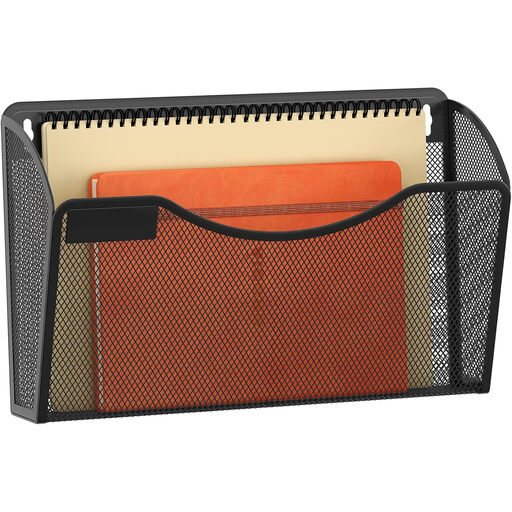
Why this suits this profile: This single compartment is ideal for an entrance hall, a small desk or a home office where you simply want to keep post and current documents within easy reach.
Its minimalist design stops you buying an oversized set when you only need to manage documents in progress.
35 cm wide, 9 cm deep, label holder plate and can be fixed to the wall or a door.
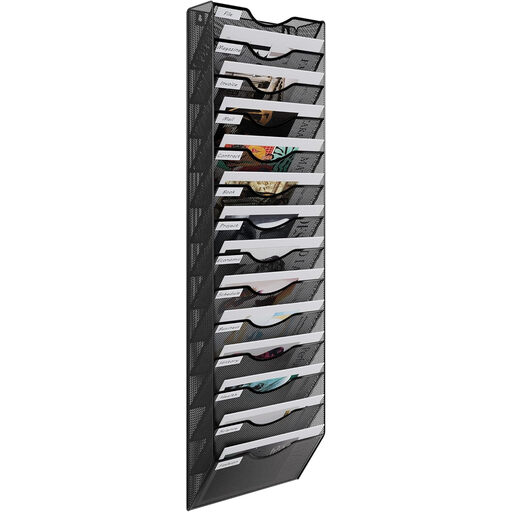
Why this suits this profile: With its 14 tiers, this model is aimed at professionals, teachers and administrative departments who need to separate numerous categories without cluttering their desk with accessories.
Each compartment keeps files separate, while the labels stop you wasting time hunting for the right document.
Vertical steel structure with powder-coated finish, 112 cm high and stated internal width of 31.5 cm per tier.
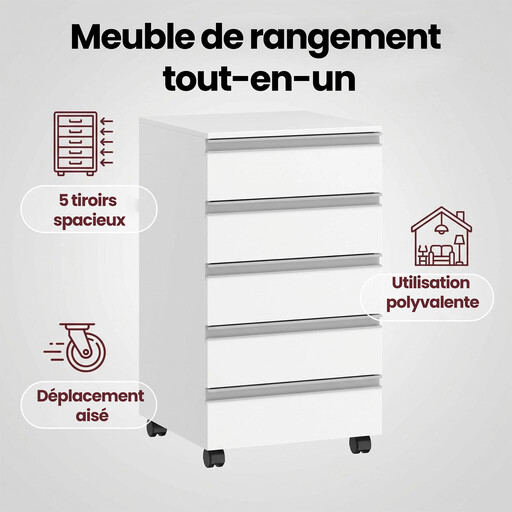
Why this suits this profile: This mobile filing cabinet on castors is designed for workshops, creative studios and offices where files, tools or supplies are frequently moved around.
It requires no wall fixing and its five drawers let you separate documents or accessories of different sizes.
Dimensions 40.5 × 40.5 × 65.5 cm, 360-degree swivel castors and stated total load capacity up to 50 kg.
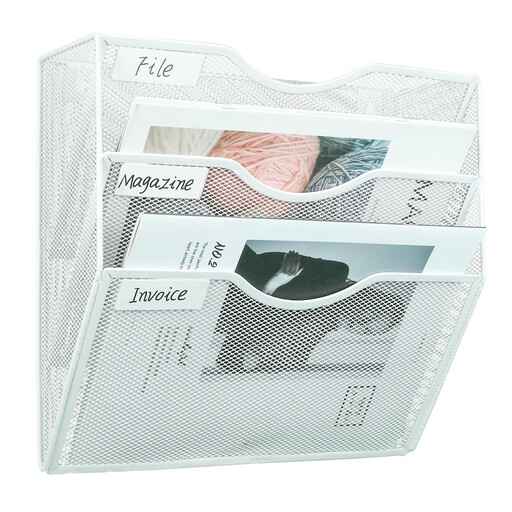
Why this suits this profile: Its three tiers offer a good balance between step-by-step filing and a compact footprint, especially in a shared workspace or a small room.
The label holder plates make categories visible, while the wall-mounted installation keeps your desk surface clear.
Three compartments, 32.5 cm wide, 10.5 cm deep, said to require no assembly and screws included.
We've put together a comprehensive, real-time updated list of products that fully meet these strict selection criteria and European safety regulations.
To ensure a wall-mounted A4 document holder stays stable, first choose a spot that's easy to reach but far enough away from walkways to avoid knocks. Use a spirit level to align the brackets properly and select wall plugs according to your wall type. On a hollow partition wall, a specialist fixing is essential.
Then organise your documents using a simple system:
A wall-mounted magazine rack can hold magazines or large-format documents, while a desktop organiser placed on your work surface is better for sheets you consult several times a day. Avoid filling compartments to the brim and regularly sort through documents you no longer need.
Use wall plugs designed for plasterboard and check the total weight of the holder once it's full. If you need to store several heavy files, try to locate a metal stud behind the partition or opt for a floor-standing unit.
There's no universal lifespan – it all depends on how often you use it, the weight it carries and the environment. Gentle cleaning, regularly checking the fixings and protecting it from damp will help reduce wear. Inspect the screws, weld points and condition of the finish from time to time.
It's more practical when documents or supplies need to move between several workstations. Wall storage frees up more desk space but stays fixed and depends on the strength of the wall. The choice really comes down to how often you need to move things around and how much space you have.