
Livraison le jour même ou le lendemain

Qualité garantie

Débloquez vos offres de bienvenue: Livraison GRATUITE | Jusqu'à -80 % | 30 jours d'essai gratuits à JoyPlus
Téléchargez l'application
A cluttered hallway, keys that are impossible to find, or towels that never dry properly can quickly make daily life more complicated. Wall hooks help you save space while organising an entrance hall, bedroom, kitchen, bathroom, garage or balcony. But you need to choose the right model.
Some marketing claims deserve a closer look. A fixing advertised as "no-drill" won't necessarily be compatible with a textured wall. The maximum weight load also depends on the surface, the quality of the installation and the type of item being hung. As for a decorative wall hook, it may lack depth or have edges that could snag clothing.
Here are the points to check before you buy, along with a selection of models suited to different uses.
Adhesive hooks and no-drill hooks appeal to tenants because they avoid making holes in walls. However, they require a clean, dry and perfectly smooth surface. Wallpaper, render, porous walls, flaking paint or dusty surfaces can significantly reduce their grip.
A self-adhesive fixing is best suited to keys, small accessories, tea towels and lightweight items. For a thick coat, a heavy bag or a tool, it's usually better to opt for a screw-fixed hook.
The weight stated on the packaging applies to very specific conditions. It can vary depending on the type of wall surface, the quality of the adhesive, the waiting time after installation and how the weight is distributed. A wall-mounted coat hook installed on a hollow partition wall will not perform like a hook screwed into a solid wall with the right wall plugs.
Always leave a safety margin and never exceed the stated capacity. For heavy or fragile items, also avoid placing them above a bed or a walkway.
A metal wall hook or a wall-mounted coat rack can perfectly complement your décor. However, the number of hooks, their spacing and their depth matter just as much. A model that is too compact may cause jackets to overlap. Conversely, a large coat rack can prove too bulky for a narrow hallway.
Stainless steel resists moisture better than untreated metal. It is therefore well suited to towel hooks in a bathroom. Aluminium is lightweight and can be used for everyday wall mounting. Wood combined with metal adds a more decorative touch but requires appropriate care.
In a kitchen or garage, choose a surface that is easy to clean. For a hallway, check that the corners are rounded and that the hooks won't snag scarves or delicate fabrics.
Measure the width of the wall before ordering. A wall-mounted key holder with four or five hooks is usually enough for a couple or a small family. A modular set, on the other hand, allows you to space the hanging points freely. For family organisation, double hooks let you hang several accessories without multiplying the number of fixing points on the wall.
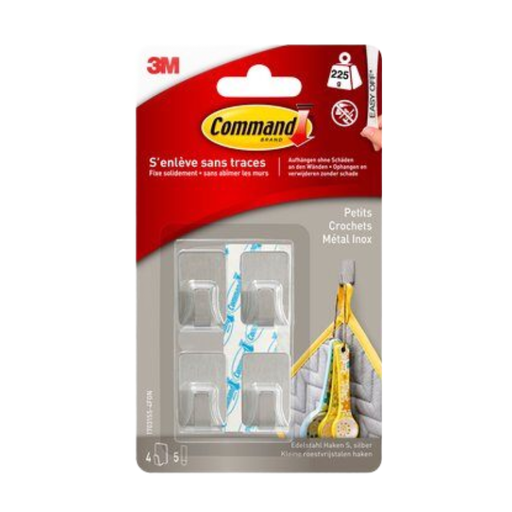
Why this choice suits this profile: This pack of four small hooks is ideal for organising a hallway, kitchen or bathroom when the items to hang are lightweight.
The product page states a maximum load of 0.5 lb, approximately 225 g per hook. This clarity prevents accidentally using them for coats or heavy bags.
Polished stainless steel, four hooks and five adhesive strips included. Compatibility is stated as limited to smooth indoor surfaces.
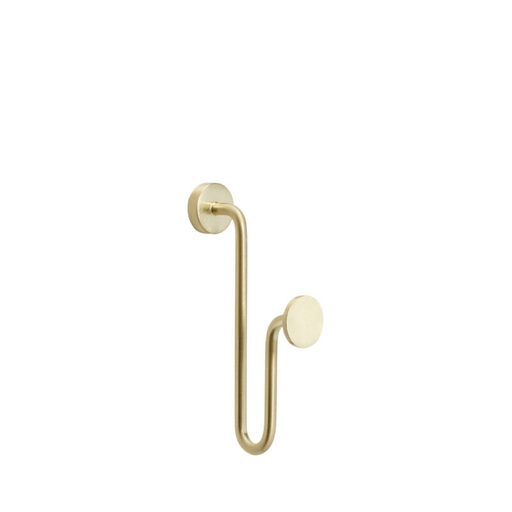
Why this choice suits this profile: Its brass look and compact size blend easily into a well-considered décor, particularly in a hallway, bedroom or kitchen.
Its dimensions of 7 × 2.5 × 13 cm allow you to assess its exact size before installation, rather than relying solely on the photo.
Iron structure with brass finish and a swivelling hook. For cleaning, a soft, dry cloth is sufficient.
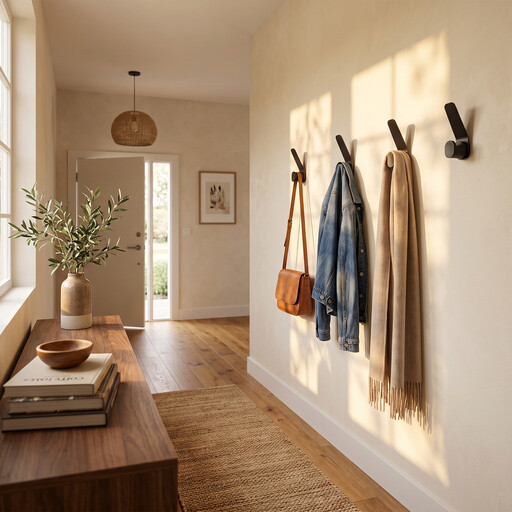
Why this choice suits this profile: With eight double hooks, this model is ideal for a family, utility room or space where coats, bags, hats and towels are regularly hung.
Fixing is done with screws and appropriate wall plugs. The product page states up to 11 lb per hook, approximately 5 kg, provided the installation is carried out correctly.
Aluminium described as rust-resistant, grooved double hook and a back plate designed to protect the wall.

Why this choice suits this profile: This iron wall-mounted key holder is designed for those who want to keep their keys together while adding a decorative touch to the hallway or corridor.
Its stated dimensions of 10.2 inches, approximately 26 cm, allow you to anticipate the space needed and check that the fixing is suitable for the chosen wall.
Four metal hooks and a key-shaped silhouette adorned with the decorative inscription "Welcome Home", for storing keys and small items.
We have curated a comprehensive, real-time updated list of products that meet these exacting criteria as well as European safety standards.
Before installing a wall-mounted coat rack, clean the surface thoroughly and let it dry. For an adhesive model, press firmly for the stated duration, then wait the recommended time before hanging anything on it. For a screw-fixed hook, use wall plugs suitable for the wall material and check the tightness regularly.
Dust the coat hooks with a soft cloth. In a damp room, avoid abrasive products and keep an eye out for any signs of oxidation. If a hook comes loose, immediately remove the hanging item and replace the fixing rather than putting it back without checking it.
An adhesive hook is suitable for lightweight items, provided the surface is smooth, clean and dry. Check the maximum weight load and any restrictions stated by the manufacturer. On a textured, porous or wallpapered wall, a mechanical fixing will often be more reliable.
It all depends on the weight hung, humidity, temperature, the surface and the quality of the installation. There is therefore no universal lifespan. Inspect the adhesive regularly and do not reuse a strip that is starting to peel off.
Yes, provided the material and finish are designed for humid environments. Stainless steel and certain treated metals can be suitable, whereas an unprotected product may deteriorate quickly. Also check that the adhesive fixing is compatible with tiles and limit the weight hung.