
Same-day & Next-day Delivery

Quality Guaranteed

Unlock Your Welcome Offers: FREE Delivery | Up to 80% OFF | Free 30-day JoyPlus trial
Download the APP
In a narrow hallway, a sparsely equipped bathroom or a cluttered bedroom, wall hooks can quickly free up space. However, not every model is suitable for every surface or every item. A wall-mounted coat rack fixed in the wrong place may come unstuck, a hook that is too lightweight could bend, and an adhesive hook may leave a mark if it is not installed correctly.
Before you buy, it is therefore worth looking beyond the design and promises of “damage-free” fixing.
The maximum capacity shown generally applies under specific conditions: a suitable surface, correct installation and a stationary load. A full bag, a thick coat or several damp towels place more strain on the fixing than a simple lightweight accessory.
For sturdy wall hooks, check the maximum load supported by each hook, not just the capacity for the set. Also allow a safety margin, particularly if the hook is in a high-traffic area.
Drill-free adhesive hooks are very convenient for renters, but they do not automatically work on every wall. Textured, dusty, porous, wallpapered or freshly painted surfaces can compromise adhesion.
Smooth tiles, glass or completely dry paint are generally more suitable, subject to the manufacturer's instructions. In a bathroom, you must also take humidity, condensation and splashes into account.
Drill-free wall hooks avoid holes, but they must be removed using the recommended method. Pulling a strip towards you may take some paint with it. You generally need to pull the tab slowly in the direction indicated, parallel to the wall.
On plasterboard, a fixing designed specifically for this type of surface is often more suitable than a simple adhesive, particularly for heavy items.
Start by identifying the surface:
For keys, tea towels or small accessories, a low-capacity hook may be sufficient. For coat and towel hooks, choose a model that is deep enough to prevent items from slipping off.
A double hook increases storage capacity in the same area, but check the available space and the total supported load. Rounded edges are preferable to prevent clothes from catching.
Screw-in hooks provide a durable fixing, provided you use the right wall plugs and do not overtighten them. Adhesive models can be installed more quickly, but fitting them requires a minimum of care:
For home wall storage, this approach helps you avoid unsuitable purchases and choose each hook according to the room.
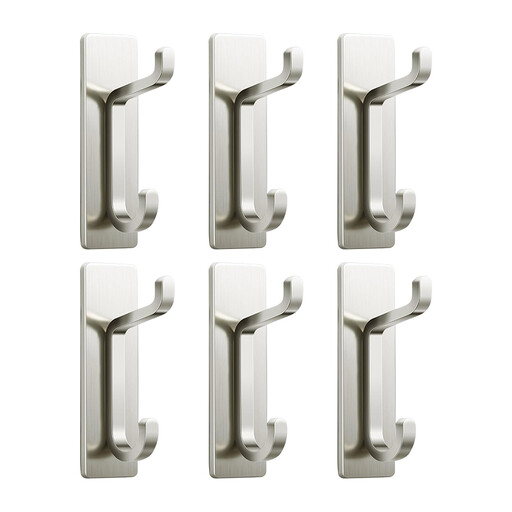
Why this product suits this profile : This pack of six stainless-steel hooks is a simple way to organise a hallway, kitchen or bathroom, without a drill or screwdriver.
The pack lets you distribute items rather than overload a single fixing. Drill-free installation limits the need for alterations in a rented property, provided you use it on the recommended surface.
Pack of 6, stainless-steel construction and drill-free installation as stated by the manufacturer.
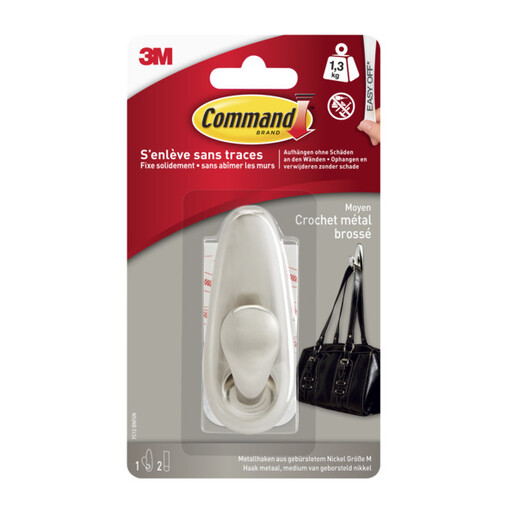
Why this product suits this profile : Its brushed-nickel finish fits easily into a hallway or bathroom where the hook plays a full part in the décor.
The stated 1.3 kg load capacity means you should not choose it for an especially heavy coat. The manufacturer also states that it can be installed without tools and removed without leaving holes on compatible surfaces.
Brushed-nickel metal, stated maximum load capacity of 1.3 kg and replaceable adhesive strips.
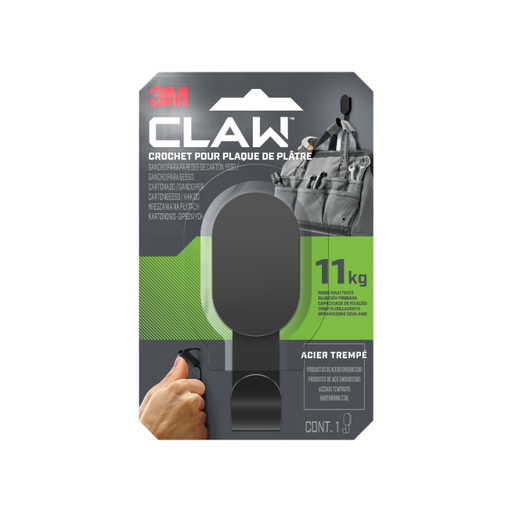
Why this product suits this profile : This hook is aimed at anyone who wants to hang a relatively heavy item on plasterboard, without relying on a simple adhesive solution.
It does not rely on an adhesive strip that could fail to adhere to an uneven surface. However, the 11 kg limit is absolute, as is following the installation instructions.
Hardened-steel claws, tool-free press-fit installation as stated and a maximum capacity of up to 11 kg on plasterboard.
We have compiled a complete, real-time updated list of products that fully meet these strict selection criteria and European safety regulations.
The surface must be clean, dry and compatible with the adhesive. Press firmly on the hook for the stated length of time, then wait before hanging an item on it. Do not install an adhesive hook on wallpaper, a textured wall or recently applied paint without checking the instructions first.
Yes, provided you choose the system according to the load. For a lightweight item, a suitable fixing may be sufficient. For a frame, mirror or heavy bag, it is better to consider hooks specifically designed for plasterboard, such as models with metal claws. The stated load capacity never replaces correct installation.
There is no universal timeframe: how well it holds depends on the surface, humidity, temperature, load and quality of installation. Inspect the hook regularly, particularly in a bathroom. If the adhesive starts to lift or the surface deteriorates, remove the whole fixing and replace it before adding a new load.