
Livraison le jour même ou le lendemain

Qualité garantie

Débloquez vos offres de bienvenue: Livraison GRATUITE | Jusqu'à -80 % | 30 jours d'essai gratuits à JoyPlus
Téléchargez l'application
A wall hook can easily free up space in a hallway, bathroom or bedroom. But a rushed purchase can also leave you with a hook that comes loose, damaged paint or a fitting unable to hold a damp coat. To avoid unpleasant surprises, it is better to consider the type of wall, the load it can support and the installation method, rather than focusing on design alone.
The capacity shown on the packaging does not necessarily apply to every surface. A robust wall hook installed on a plasterboard partition will not perform in the same way as a hook fixed into concrete. The hold also depends on the type of wall plugs used, the spacing between the screws and the way the item is hung.
A heavy bag pulling forwards puts more strain on the fitting than a light towel resting against the wall. You should therefore leave a margin between the weight of the items to be hung and the stated maximum load.
A drill-free wall hook can be perfectly suitable for smooth tiles, glass or metal. However, matt paint, a porous wall, wallpaper or uneven tiles may compromise adhesion. Suction-cup models follow the same rule: they require a smooth, clean, dry and non-porous surface.
The words ‘damage-free’ do not remove the need to follow the manufacturer’s recommendations. A poorly positioned suction cup or adhesive applied to a dusty surface can quickly lose its holding power.
A decorative wall hook with protruding edges can catch on clothing. Two hooks placed too close together make it harder to remove coats. In a narrow hallway, a very deep hook may even obstruct movement.
Check the edges, depth, space between the hooks and whether a protective coating is included. These details matter just as much as the colour or style.
A drill-free fixing is useful for renters, but it is not automatically suitable for heavy items. For a thick coat, a full bag or several towels, a well-chosen mechanical fixing will generally provide a more reliable hold.
Start by listing the items you want to hang: keys, tea towels, hats, towels, bags and coats do not put the same demands on the fitting. A towel hook can remain compact, while a coat hook needs to accommodate a bulky, and sometimes damp, garment.
When several hooks are mounted on a rail, check whether the stated load applies to the whole rail or to each individual hook. For a screw-fixed fitting, choose wall plugs compatible with the wall material and check the tightness regularly.
Aluminium, steel and certain plastics meet different needs. In a damp room, choose a surface that is resistant to water and oxidation. In a hallway, rounded edges reduce the risk of catching on fabrics.
A wall hook or wall-mounted coat rack fitted with a rear pad can help prevent marks and compensate for minor irregularities. For maintenance, a soft, slightly damp cloth is generally sufficient. Avoid abrasive products, which may damage the finish.

Why this choice suits this profile : This pack is aimed at anyone who wants to organise a bathroom or kitchen without a drill, with repositionable hooks for compatible surfaces.
The product details specify the compatible surfaces and exclude porous, painted or uneven walls. This helps prevent installation on an unsuitable surface.
Drill-free installation, a 360° rotatable hook and a stated load of up to 11 pounds, or approximately 5 kg, on a smooth, non-porous surface.
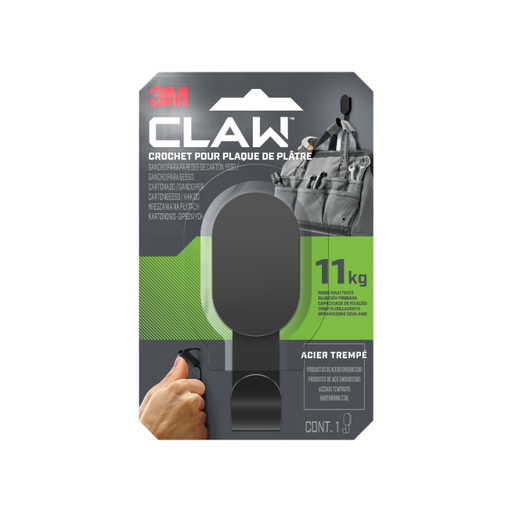
Why this choice suits this profile : This model is designed for people living in homes with plasterboard partitions who want quick, tool-free installation for relatively heavy items.
The product details clearly distinguish plasterboard partitions from other wall types and state a maximum load of 11 kg. It remains essential to respect this limit and check the condition of the surface.
Hardened steel claws, installation by simply pressing with your thumb, and no screws or nails, according to the manufacturer’s instructions.
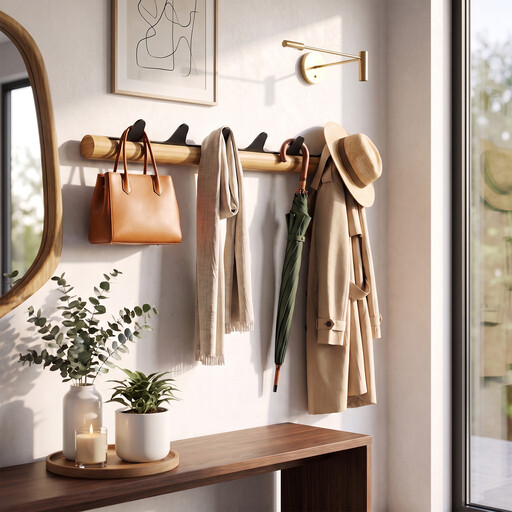
Why this choice suits this profile : This solid rubber and aluminium rail is ideal for a family hallway where coats, bags and hats need to remain easily accessible.
The instructions provide details of the screw-and-wall-plug fixing, allowing you to adapt the anchors to the type of wall. This is more reliable than choosing an adhesive without checking the surface.
Six hooks, FSC-certified solid wood mentioned in the product details, rounded edges and a stated capacity of up to 66 pounds, or approximately 30 kg, provided it is installed correctly.
We have selected a comprehensive, regularly updated range of products that meet these demanding criteria while also taking European safety regulations into account.
A suction-cup hook is suitable for glass, metal and smooth tiles, provided it is installed on a clean, dry and non-porous surface. On a plasterboard partition, a claw model such as the 3M CLAW offers another tool-free solution. However, make sure you respect the maximum load and installation instructions.
It depends on the type of adhesive, the weight being hung, humidity, temperature and the nature of the surface. Clean the surface in accordance with the manufacturer’s recommendations, allow the adhesive to stabilise for the specified time and do not exceed the stated load. In a bathroom, regular checks are advisable.
Not necessarily, but a screw-fixed fitting or one specifically designed for plasterboard will generally be better suited to a substantial load. Before drilling, identify the type of wall and choose compatible wall plugs. For renters, a drill-free solution may be suitable for a lightweight coat, provided the manufacturer approves its use on the surface in question.