
Livraison le jour même ou le lendemain

Qualité garantie

Débloquez vos offres de bienvenue: Livraison GRATUITE | Jusqu'à -80 % | 30 jours d'essai gratuits à JoyPlus
Téléchargez l'application
A wall hook? A trivial purchase, you might think. Yet, appearances can be deceiving. The wrong choice can quickly lead to damaged walls, belongings on the floor, and a daily hassle. Before you commit, it's best to understand the common pitfalls that turn this handy storage solution into a real headache.
Here are the 3 most frequent mistakes to avoid:
To avoid falling for these traps, looks aren't enough. Let's dive into the technical criteria that truly make a difference in day-to-day use.
To find the model that will provide long-term satisfaction, focus on three essential points: the mounting system, the materials, and the design of the hook itself.
This is the fateful question, which depends as much on the nature of your wall as it does on your lease agreement.
The choice of material is not just a matter of taste: it directly determines the strength and lifespan of your hook.
The weight capacity stated by the manufacturer should be taken with a grain of salt. A screw-in mount will always support more weight than an adhesive mount of the same size. For heavy items, don't play with fire: choose a screw-in model.
It's the make-or-break detail, yet it's often overlooked. Good design must be practical before it's pretty. Favour models with:
After scrutinising dozens of models, here is our selection of products that avoid the common pitfalls and meet our demanding criteria.
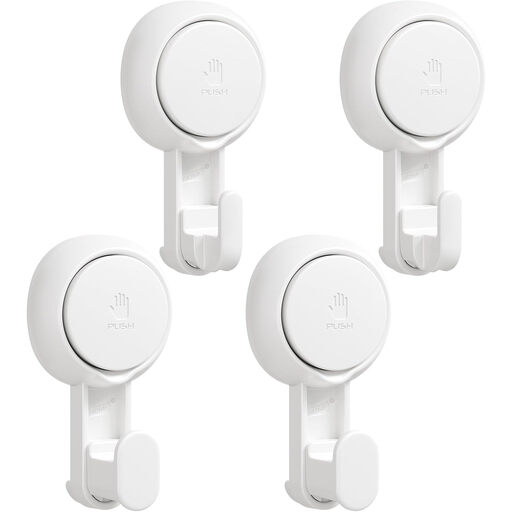
Why we chose it: The sensible choice for anyone who can't (or won't) bring out the drill. This hook installs in seconds on smooth surfaces (tile, glass) and can be moved without leaving a trace. Perfect for the bathroom or kitchen.
It bypasses the problem of unreliable adhesives with a powerful vacuum suction system, designed to withstand water and humidity where classic adhesives fail.
Tool-free installation and repositionable at will. The 360° rotating hook offers great flexibility. Supports up to 5 kg (11 lbs) on a suitable surface.
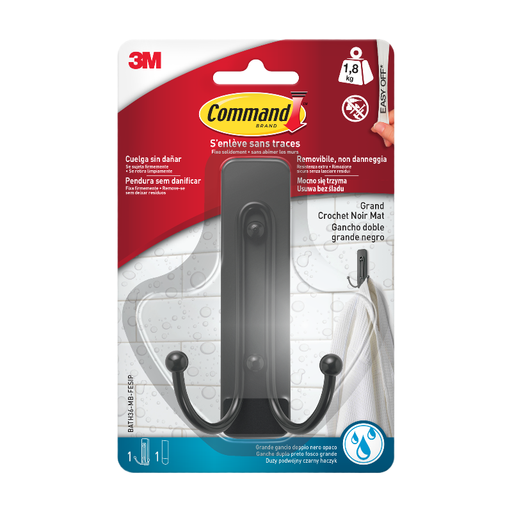
Why we chose it: Its natural habitat: wet areas. This adhesive hook uses technology that allows it to hold firmly even inside the shower, perfect for hanging towels, robes, or loofahs.
It directly tackles the problem of adhesive failing in humidity. Its strips are specially formulated to resist water, providing a reliable hold where others fail.
Damage-free installation and clean removal. The double-hook design maximises storage. According to 3M, its hold is superior to suction cups in wet environments.
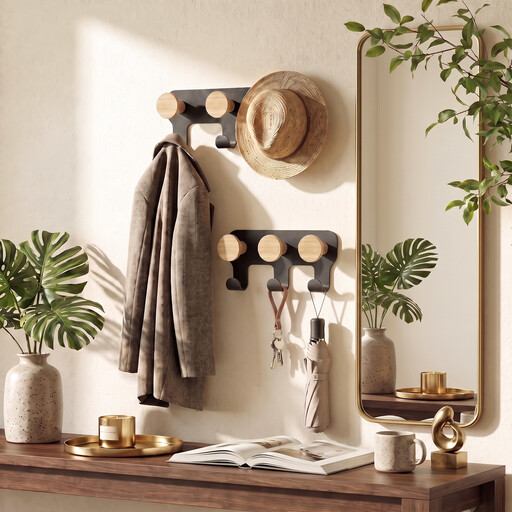
Why we chose it: The perfect balance of aesthetics and strength. The combination of aluminium and FSC-certified wood creates an object that is both decorative and highly functional, perfect for an entryway or bedroom.
It never sacrifices function for form. The edges are rounded to prevent damage to clothing, and the screw-in mount ensures the 5 kg (11 lbs) per hook weight capacity is realistic and reliable.
Dual-hook design (wood + metal) for maximum versatility. Quality materials (aluminium, FSC wood). Award-winning minimalist design (Muse Design Award, French Design Award).
Explore our full collection of products that have passed our tests and meet our quality and safety standards.
To install a no-drill hook, you have two main options. The first is an adhesive hook, which uses a powerful sticky strip. The secret is a perfectly clean and dry surface, and a little patience to respect the recommended curing time. The second is a suction hook, which works by creating a vacuum. This technique works wonders on very smooth surfaces like tile, glass, or metal.
The range is huge from one model to another, varying from less than 500g (1 lb) to over 5 kg (11 lbs). It is therefore imperative to consult the manufacturer's technical sheet. This capacity is generally valid under optimal conditions (smooth, clean, dry surface). For a bathroom adhesive hook, performance in a humid environment is the most important criterion. Don't take the advertised weight at face value, especially with valuable items.
For a bathroom, resistance to humidity is the non-negotiable criterion. Bet on materials that don't rust, such as stainless steel, treated aluminium, high-quality plastic, or brass. For mounting, screws remain the safest bet. If you don't want to drill, look for "wet-area" adhesive systems or new-generation suction hooks.