
Livraison le jour même ou le lendemain

Qualité garantie

Débloquez vos offres de bienvenue: Livraison GRATUITE | Jusqu'à -80 % | 30 jours d'essai gratuits à JoyPlus
Téléchargez l'application
A hook that rips out of the wall, an adhesive that gives way under the weight of a single towel, or a coat rack that rusts in the bathroom… These everyday scenes are unfortunately all too common. They turn a storage solution that was meant to be practical into a real headache. Choosing a wall hook might seem trivial, but the market is flooded with products making tempting promises that often disappoint over time.
To avoid disappointment and wasted money, here are the most common pitfalls to watch out for?:
This guide is here to help you decode the spec sheets and choose a storage solution that will truly meet your needs, both today and in the future.
You don't need to be a DIY expert to make the right choice. Just focus on three essential points that determine the effectiveness and lifespan of your hook.
This is the number one criterion. It directly depends on what you plan to hang and the nature of your wall.
The material doesn't just define the style; it also determines your hook's ability to stand the test of time and its environment.
Never blindly trust marketing claims. The advertised load capacity is a maximum value obtained in a lab under perfect conditions.
Here are a few options that meet specific needs, taking our durability and functionality criteria into account.
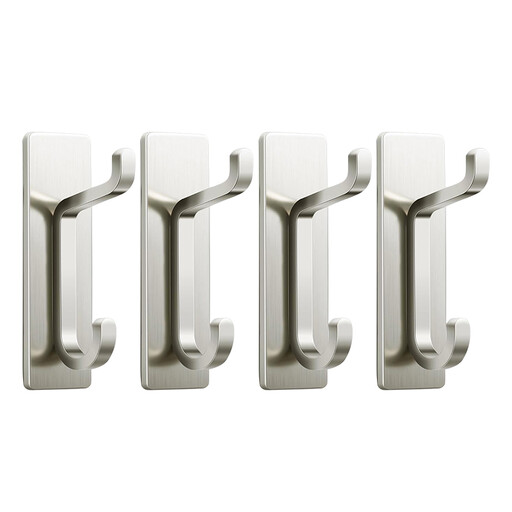
Why we love it: This is the smart, hassle-free solution for those who can't (or don't want to) drill. Perfect for organising a kitchen, bathroom, or laundry room by hanging dish towels, light towels, and small utensils.
It stands out from unreliable generic adhesives with a formula designed specifically for smooth surfaces (tile, glass), with clear instructions that guarantee maximum adhesion.
A damage-free and completely reversible installation. Its metal construction gives it much better durability than a simple plastic hook.
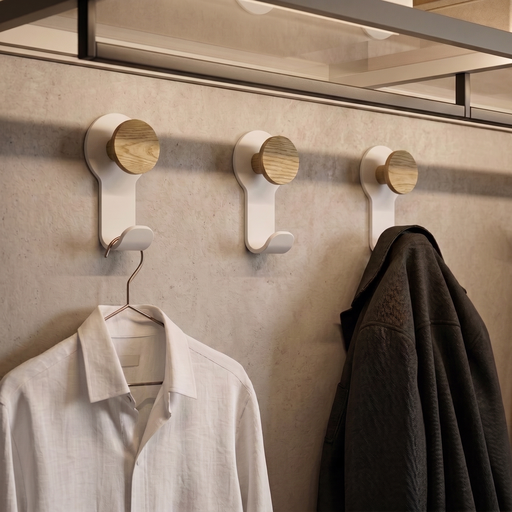
Why we love it: Sold in a set of 8, these individual screw-in hooks offer complete freedom to create a custom wall arrangement. We love the wood/metal combination for its rustic-modern touch, and the double-hook design that doubles the storage space.
No more low-end materials. Here, the use of FSC-certified wood and a protected aluminium alloy is a true mark of quality and durability.
Complete modularity to adapt to any wall. The double hook is ultra-practical for hanging a coat and a scarf, for example.
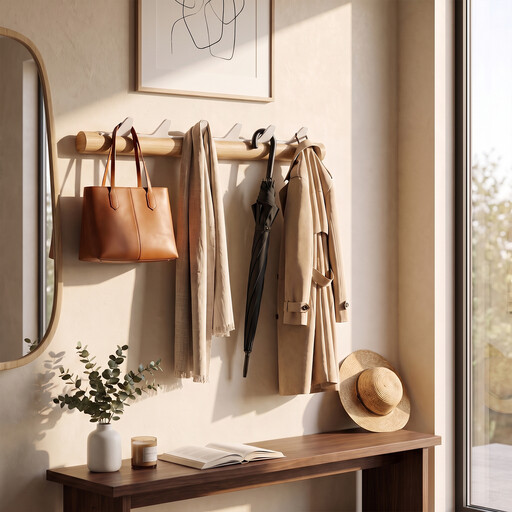
Why we love it: This is the all-in-one solution designed for entryways where clutter quickly takes over. With its solid wood plank and 6 sturdy metal hooks, this coat rack is built to handle the weight of coats, backpacks, and school bags for the whole family.
It tackles the problem of unrealistic load capacities head-on. Its single-piece structure is designed for a solid wall mount and optimal weight distribution.
Its extra-large load capacity (up to 30 kg advertised, if installed correctly) and quality materials (solid wood and aluminium) guarantee exceptional durability.
Discover our full selection of products that meet our quality and durability criteria.
The gap is huge. A good no-drill adhesive hook will typically support between 1 and 3 kg (2-7 lbs), which is perfect for a towel, a dishcloth, or a set of keys. In contrast, a wall hook properly secured with the right screws and anchors can handle 5 to over 15 kg (11-33+ lbs) without breaking a sweat, depending on the model and the wall's strength. For a wall-mounted coat rack intended for heavy loads, screw-in fastening isn't an option: it's a necessity.
To avoid making a hole (if you're a renter, for example), the best option is a high-quality adhesive hook, following the installation instructions to the letter. If you need to hang something heavier, screwing it in is unavoidable. You must use anchors specifically designed for drywall (like Molly bolts), which expand behind the wallboard to distribute the load and ensure a rock-solid installation.
Yes, but on one condition: the wood must be protected from moisture. A raw wooden hook will literally "drink" the humidity, risking swelling, moulding, or staining. For a bathroom hook, choose woods that are naturally water-resistant, like teak or bamboo. Otherwise, make sure the wood has been treated with a waterproof finish (marine varnish, protective oil). The good news is that most quality wooden hooks today are already treated for versatile use.