
Livraison le jour même ou le lendemain

Qualité garantie

Débloquez vos offres de bienvenue: Livraison GRATUITE | Jusqu'à -80 % | 30 jours d'essai gratuits à JoyPlus
Téléchargez l'application
A blank wall is a blank canvas, a promise of style and personality. Yet, finding the perfect wall decor often turns into a headache. Between flattering online photos and vague descriptions, it's easy to make a mistake. The object that caught your eye turns out to be a disappointment once unboxed: ill-suited for your space, of poor quality, or simply not living up to your expectations.
Before you buy, let's review the most common mistakes. Knowing these pitfalls is the best way to make a choice you won't regret.
To avoid these unpleasant surprises, a few checkpoints are essential. They will help you objectively evaluate each product and make an informed choice for your living room wall decor or any other room.
The material defines not only the look of your decoration but also its longevity.
Before you even browse the options, measure the wall space you want to adorn. The decorator's trick? Follow the rule of two-thirds: the object or composition should occupy about two-thirds of the width of the furniture it hangs above (sofa, sideboard, console table).
Also, consider the orientation. An elongated piece can sometimes be hung vertically or horizontally, offering more flexibility to fit your wall. Don't hesitate to simulate the object's template on your wall with masking tape. It's the best way to get a real feel for the final look.
Weight is a non-negotiable factor. A decorative piece under 500g will be fine with a simple nail, but a metal piece over 1.5 kg will require a solid mounting, appropriate for your wall type (plasterboard, brick, concrete).
Always check if the mounting hardware is included. Most of the time, it isn't, as it needs to be specific to your wall. Thinking about this detail will save you a last-minute trip to the hardware store.
To move from theory to practice, here are a few gems that suit different styles, all while meeting the criteria we've just discussed.
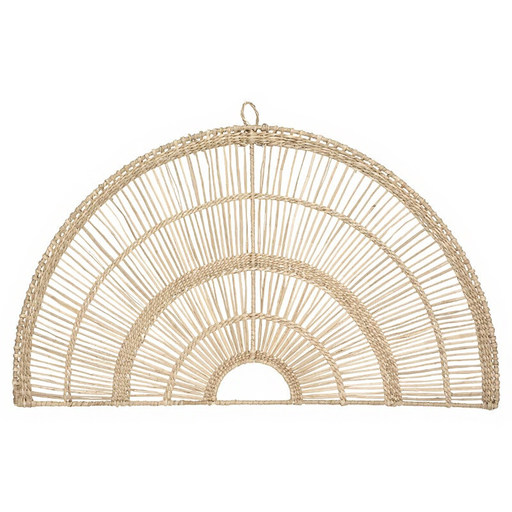
Why we love it : Perfect for infusing an organic, artisanal touch into your home. Its half-sun shape and natural material instantly warm up a room.
Its solid metal structure ensures it holds its shape, while the seagrass is purely decorative. Its dimensions (60 x 35 cm) are clearly stated to avoid any surprises.
Very lightweight (260 g), it can be easily installed on almost any wall without requiring complex mounting hardware.
Why we love it : Perfect for dressing up a wall above a sideboard or in an entryway. Its abstract design is a strong statement piece that draws the eye without overwhelming the decor.
Made from cast iron, it offers genuine robustness and a high-quality feel. Its elongated shape can be hung horizontally or vertically, allowing it to adapt to the available space.
Its versatile installation (portrait or landscape) allows it to be adapted to different layouts, whether in a narrow hallway or on a wide living room wall.
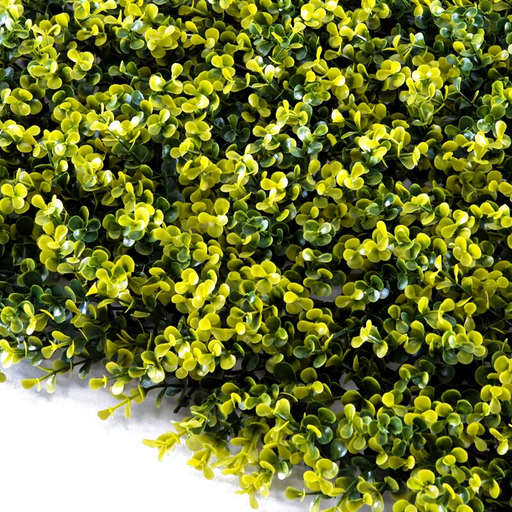
Why we love it : To create a lush green corner indoors or out, with no watering or light constraints. Perfect for a balcony, a terrace, or for creating a green wall in a living room.
The polyethylene material is UV-treated, which prevents it from fading in the sun. The modular panel system (0.5 x 1 m) allows you to cover the desired area precisely, avoiding any dimension issues.
Completely modular and interlocking, it adapts to projects of all sizes, from a small balcony privacy screen to a large decorative green wall.
Discover our full selection of wall decor that checks all the boxes : style, quality, and the latest trends.
The golden rule: aim for a piece or a composition that takes up about two-thirds of the width of the furniture it hangs above (a sofa, for example). If you're hanging it on an empty wall, make sure it's neither too small (it would look lost) nor too large (it would overwhelm the room). Always leave a "breathing" space of at least 15 to 20?cm on each side.
For objects over 2?kg on a plasterboard wall, using specific anchors is essential. Hollow-wall anchors (like Molly bolts) are a reliable option. They expand behind the plasterboard for a solid hold. Always check the maximum weight supported by the anchor, indicated on the packaging. If in doubt about a very heavy object, seeking professional advice is recommended.
To create a "gallery wall," choose a common thread. This could be a colour palette, a type of material (for example, a mix of wood wall decor and black frames), or a theme (nature, abstract, photographs). Before drilling, arrange the items on the floor to visualise the layout. Start by placing the largest piece in the centre or slightly off-centre, then build your composition around it.