A no-prep breakfast on your own
You want a chocolate and hazelnut portion that’s already wrapped and ready to eat, without taking out a jar or making toast. Nutella describes B-ready as an individually wrapped wafer.


For a no-prep breakfast on your own, choose an individually wrapped wafer if you want to eat a ready-made portion straight away. Nutella B-ready fits the bill, but it isn’t a spread you can spread on bread. If you want to top your own bread or pancakes, a jar is a better choice. Compare the recipe and the amount you plan to serve.
You want a chocolate and hazelnut portion that’s already wrapped and ready to eat, without taking out a jar or making toast. Nutella describes B-ready as an individually wrapped wafer.
You’d rather choose how much to spread on bread, pancakes or waffles. The Jardin Bio étic spreads featured by Auchan and E.Leclerc come in jars.
You want to compare the sugars, ingredients and allergens in the product you’re considering. When comparing products in different categories, look at the values per 100 g as well as the amount you’ll actually eat.
First decide whether you want a ready-to-eat snack or a spread to serve: each format is designed for a different purpose. For comparing recipes, the DGCCRF notes that the prepacked foods concerned must carry a nutrition declaration.
Choose this if: you want a wrapped portion to eat without bread or spreading.
Bear in mind: Nutella B-ready is a filled wafer, not a portion of spread on its own.
Choose this if: you want to spread the amount you like on something to eat.
Bear in mind: you’ll need something to spread it on and will need to serve a portion; the jars featured here aren’t individually wrapped sachets.
| Criteria | What to check | Who is it for? |
|---|---|---|
| Individual portions | Check the product name, individual packaging and weight per piece. | I want to open a portion and eat it without making toast. This format is the top priority for around 40% of consumers. |
| Nutrition information | Compare sugars per 100 g, then check the amount per piece or the portion you’ll serve. | When choosing between a wafer and a jar, I want to compare the values with what I’ll actually eat. Nutrition comes first for around 40% of consumers. |
| Ingredients and allergens | Read the ingredients list and allergen information for the exact variant. | If I need to avoid an ingredient or am looking for a particular recipe, the ingredients decide what I choose; they’re the top priority for around 20% of consumers. |
Nutella B-ready is ready to eat: its chocolate and hazelnut filling is enclosed in a wafer. You can’t control how much filling you spread on toast.
Choose according to how you want to eat breakfast: open a snack or spread something on your food.
The Nutri-Score may not appear on the product. For the prepacked foods concerned, the nutrition declaration described by the DGCCRF lets you check the values per 100 g.
Compare sugars per 100 g in particular, then consider the portion you’ll eat.
The Jardin Bio étic products featured by Auchan are spreads in jars, even when their recipes highlight other features.
If individual packaging is essential, check the packaging details for the exact product.
Ingredients and precautionary ‘may contain’ statements vary between products. For B-ready, Nutella lists hazelnuts, milk, soya, wheat and barley among the ingredients.
If you have an allergy or avoid certain foods, check the label on the variant you’re buying, including any ‘may contain’ statements.
With B-ready, Nutella offers a chocolate and hazelnut wafer in an individual wrapper, rather than a spread in a jar.
The products featured by Auchan are chocolate and hazelnut spreads in jars, so compare the exact recipes.
The product featured by E.Leclerc is a 1 kg jar of spread, intended to be served rather than eaten as an individually wrapped snack.
These products are for anyone choosing a ready-to-eat snack for breakfast on their own. The Nutella B-ready wafer and Kinder Happy Hippo Hazelnut biscuit are two different products; neither replaces a jar if you want a spread to put on bread.
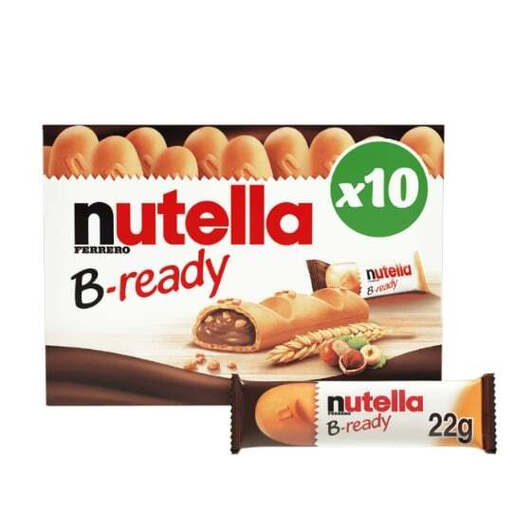 Image unavailable
For enjoying a chocolate and hazelnut wafer without making toast. Nutella sells B-ready in individual wrappers; this pack contains 10 pieces of 22 g each.
This is a filled wafer, not a spread. If you have an allergy, check the ingredients and any ‘may contain’ statements on the packaging.
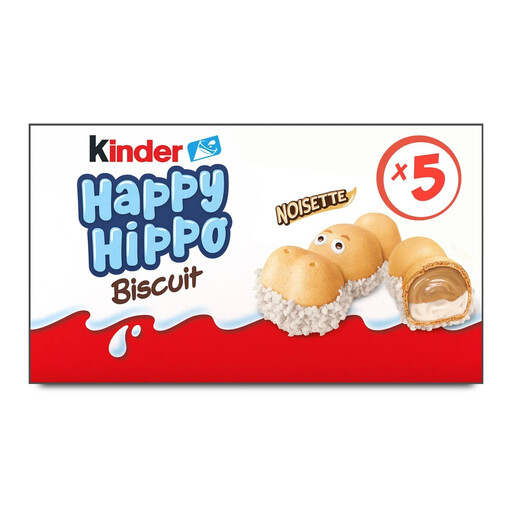 Image unavailable
Choose this biscuit to eat straight away rather than a spread that needs serving. The T5 format is a 103 g pack.
This biscuit is neither a spread nor a Nutella B-ready wafer. Check its ingredients list and nutrition information if you’re comparing it with those other products.
Compare the nutrition information per 100 g, then consider how much you’ll actually eat. Nutella gives the weight of a B-ready piece as 22 g and its sugar content as 10,4 g per piece. With a jar, the amount depends on how much you spread. Also bear in mind that a wafer has a cereal-based outer layer, so the two products are eaten differently.
Read the nutrition declaration for the product you’re considering. The DGCCRF says this must appear on the packaging of the prepacked foods concerned. It lets you compare sugars and fats per 100 g, among other things. Then check the size of the portion you plan to eat.