Choose an individually wrapped filled wafer if you want a portion that’s ready to take with you. Choose a spread in a jar if you can prepare your snack and measure out the amount yourself. Before exercise, the format alone isn’t enough to decide: consider the timing, how well you tolerate it, and the sugars, fats and allergens listed for the portion you’ll eat.
Who are these formats for?
Short on time before a session
You want a portable snack that’s already portioned and needs no preparation. Nutella France says that each B-ready wafer is individually wrapped. You just need to choose when to eat it, based on what works for you before exercise.
Mindful of how you tolerate food before exercise
You’d rather avoid trying a new food or having a large snack just before a competition. The IRBMS recommends a light, low-fat pre-competition meal around 2 h 30 to 3 h before the start. It doesn’t set a universal time for eating a wafer.
Prefer to choose how much spread to use
You want to choose what to spread it on and how much to use, rather than opening a ready-to-eat portion. When comparing jars, use the values given per 100 g to work out what they mean for the amount you plan to eat.
What should you look for before buying?
Individually wrapped filled wafer
Choose this if: you want a portion that’s ready to eat and easy to take with you, without a jar or utensils.
Bear in mind: the portion size is fixed, but convenience alone doesn’t tell you whether it’s right for you before exercise.
Spread in a jar
Choose this if: you can prepare your snack and want to decide how much spread to use and what to put it on.
Bear in mind: you’ll need to measure out the spread and have something to put it on. The values per 100 g don’t directly describe your portion.
| What to consider |
What to check |
Who is it for? |
| Portion and portability |
Check the weight of each piece and whether each one is individually wrapped. |
If I’m heading straight to my session, I want to take a portion with me without having to prepare it. Around 50% of consumers prioritise this kind of convenience. |
| Time before exercise |
Check the fat content per portion and consider how long you have before your session. |
When exercise is coming up, I’d rather stick to an amount and a food I know I tolerate. Around 30% of consumers put feeling comfortable before exercise first. |
| Ingredients and portion size |
Compare the sugars and fats per portion, along with the ingredients and allergens for the exact product. |
When making a snack, I want to choose how much I use and know what’s in the product. Around 20% of consumers prioritise control over portion size and ingredients. |
Common misconceptions to avoid
-
Assuming “individually wrapped” means “suitable for sport”
Nutella France says that one B-ready wafer contains 10,4 g of sugars and 5,9 g of fat. The individual wrapping tells you about the portion and how easy it is to carry, not whether it’s suitable just before your session.
Check the values per piece. If you’re thinking of eating one before exercise, try it during a regular training session rather than for the first time on competition day.
-
Applying the “soda tax” to a spread
The contribution described by BOFiP-Impôts applies to non-alcoholic drinks containing added sugars. It isn’t a useful way to compare a spread with a filled wafer.
For these products, compare the amount you’ll eat and the nutritional information for that portion instead.
-
Assuming Nutri-Score is compulsory
Santé publique France says that displaying Nutri-Score is voluntary. If it appears on the packaging, it can help you interpret the nutrition information, but it doesn’t replace the ingredients and allergen list.
Use it to compare similar products when it’s available, then check the portion you’re interested in.
-
Judging the sugar content from a claim on the jar
Auchan Bio’s product information for its cocoa and hazelnut spread lists 55 g of sugars and 31 g of fat per 100 g. A claim such as “organic” doesn’t tell you the nutritional values for the amount you spread.
Check the values per 100 g, then consider how much you’ll actually use.
Brands and ranges to know
Nutella
Nutella France describes Nutella B-ready as a filled wafer sold in individual portions, making it different from a spread sold in a jar.
- Nutella France says each 22 g wafer is individually wrapped and has nutrition information listed per piece.
- One wafer contains 10,4 g of sugars and 5,9 g of fat. The recipe includes hazelnuts, milk, soya, wheat and barley.
Carrefour Classic’ / Carrefour Bio
These ranges of spreads in jars let you choose how much to use and what to spread it on.
- Carrefour France’s catalogue includes spreads under these brands.
- A jar doesn’t define the amount in each snack. Check the nutrition information for the product you choose and measure out your portion.
Auchan Bio / Auchan Pasta Cao
These ranges are among the spreads in jars listed by Auchan France.
- Auchan Bio’s product information describes a 400 g jar of cocoa and hazelnut spread, with no individual sachets.
- This Auchan Bio product lists 55 g of sugars and 31 g of fat per 100 g. Consider how much you’ll actually spread rather than relying on the range name alone.
An individually wrapped wafer on Joybuy
This chocolate and hazelnut filled wafer is an option if you want a portion that’s ready to take with you, rather than a spread in a jar that you can measure out yourself.
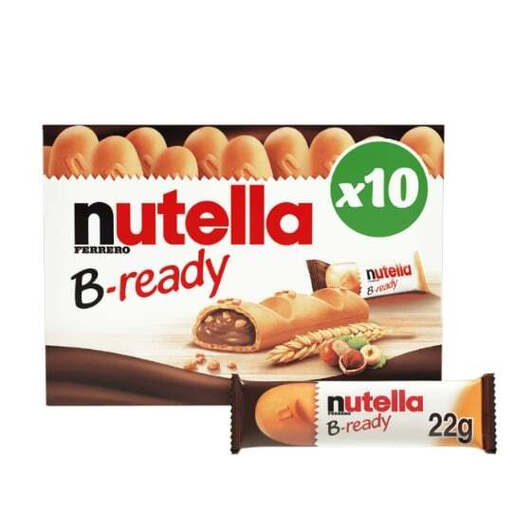 Image unavailable
Nutella B-ready, 10 wafers of 22 g
For a snack you can take with you without any preparation, this pack contains 10 filled wafers, individually wrapped.
Nutella France says that one 22 g wafer contains 10,4 g of sugars and 5,9 g of fat. The recipe includes hazelnuts, milk, soya, wheat and barley.
A ready-to-eat portion doesn’t guarantee that the wafer will suit you just before exercise. Consider the timing and how well you tolerate it.
View on Joybuy
Frequently asked questions
Does the “soda tax” apply to chocolate and hazelnut spread?
No. The contribution on drinks described by BOFiP-Impôts applies to non-alcoholic drinks containing added sugars, not to a spread or a solid wafer.
Does a wafer or jar have to display Nutri-Score?
No. Santé publique France says that producers can choose whether to display Nutri-Score. If it’s shown, use it alongside the nutrition information, portion size and ingredients.
Is a filled wafer suitable just before a competition?
That depends in part on how long you have before the start and how well you tolerate the food. The IRBMS recommends a light, low-fat pre-competition meal around 2 h 30 to 3 h before exercise. This guidance applies to a meal, not to a set time for eating a wafer.
Which allergens should you check in a filled wafer?
Check the ingredients list for the exact product, as recipes can vary. Nutella France lists hazelnuts, milk, soya, wheat and barley among the ingredients in B-ready.


