
Livraison le jour même ou le lendemain

Qualité garantie

Débloquez vos offres de bienvenue: Livraison GRATUITE | Jusqu'à -80 % | 30 jours d'essai gratuits à JoyPlus
Téléchargez l'application
Upgrading to LED lighting is an excellent way to modernise your car and improve visibility. However, the process can quickly turn into a headache if an error message appears on your dashboard right after installation. This is a common problem on recent vehicles, whose on-board diagnostics (OBD) system doesn't always play well with these newcomers.
This guide gets straight to the point: helping you choose the right error-free W5W LED bulb. We'll break down the key technical points for a successful purchase, with no nasty surprises.
Before you dive in, here are the crucial points to check to ensure the compatibility and performance of your future bulbs.
The Canbus (Controller Area Network bus) is like your car's electronic brain. It monitors everything, including the power consumption of the bulbs. An original halogen bulb draws a certain amount of current. An LED, being much more efficient, consumes far less. To the Canbus, this low consumption is an anomaly: it thinks the bulb has blown and triggers a warning on the dashboard.
The solution? An error-free W5W LED bulb. It integrates a resistor or circuit that mimics the power consumption of a conventional bulb. The on-board computer is "fooled," won't know the difference, and no error message will appear. This is THE essential criterion for most vehicles produced since the 2000s.
W5W, T10, 501, 168, 194… It's easy to get lost. Don't worry: all these references actually refer to the same type of base. This is the small, all-glass bulb with no metal parts (a wedge base), with a 10 mm diameter, that is extremely common in our cars.
You can find it almost everywhere:
To be sure of the physical compatibility, a quick look at your vehicle's manual is all it takes. If it mentions any of these references, you're good to go.
Colour temperature, measured in Kelvins (K), determines the shade of the light. A classic halogen bulb emits a yellowish light, around 3200 K. For a modern look and better contrast perception, a xenon white effect between 6000 K and 6500 K is preferred.
Brightness, expressed in lumens (lm), measures the amount of light emitted. A good LED shines much brighter than a halogen, while consuming far less power. Rest assured, all the bulbs in our selection operate on a standard 12V voltage, compatible with almost the entire car parc.
We have selected a few models for you that have proven their worth, both for their Canbus compatibility and their performance.
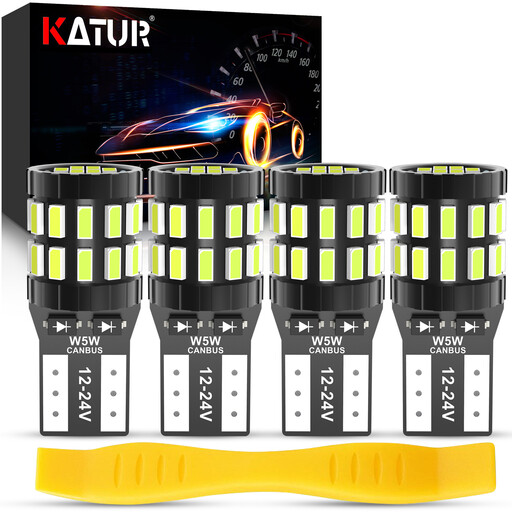
What sets it apart: Its very distinctive ice blue colour, perfect for adding a touch of customisation to the interior or sidelights. Its design with 30 LED chips (3014 type) ensures a uniform 360° light distribution.
Key features:
Who is it for? For those who want to stand out with an original colour, without sacrificing the peace of mind of an error-free installation.
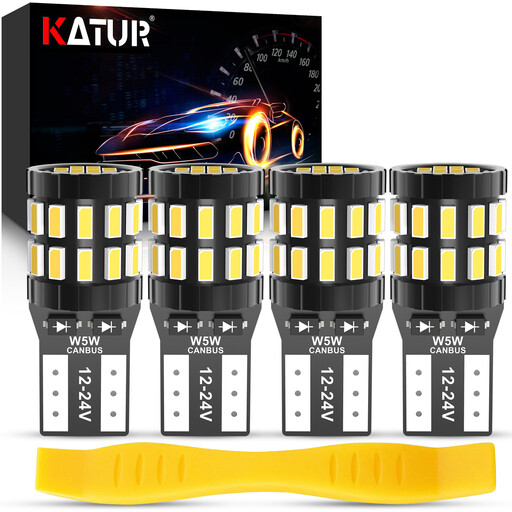
What sets it apart: This is the reliable choice for intense and pure 6000K xenon white lighting. It gives any vehicle a real modern facelift. Using the same architecture as the blue version, it combines performance and elegance.
Key features:
Who is it for? For anyone who wants a radical increase in brightness and a modern white finish, whether for the dome light, sidelights, or number plate.
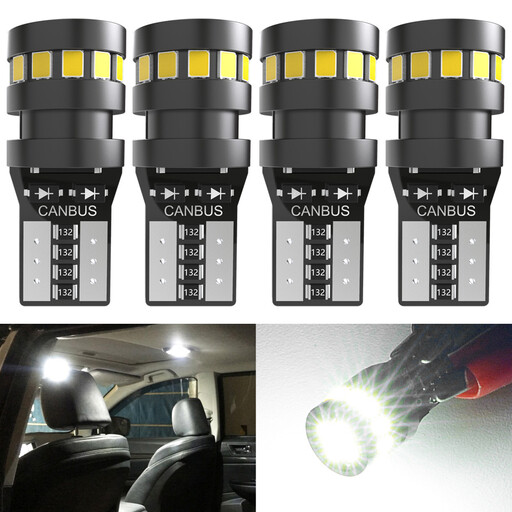
What sets it apart: OUSHI focuses on an excellent performance-to-efficiency ratio. The brand claims a brightness 300% greater than halogen. Its all-aluminium body is designed to dissipate heat as quickly as possible.
Key features:
Who is it for? A reliable and versatile solution for equipping multiple locations (number plate, interior, sidelights) with high-performance, energy-efficient, cool white LED lighting.
The world of automotive LED lighting is vast, and every vehicle has its own specific requirements. If W5W bulbs aren't what you need, or if you're looking for models for your headlights, indicators, or daytime running lights, feel free to explore our catalogue.
Discover our full range of 12V LED bulbs
1. Is an error-free W5W LED bulb truly compatible with 100% of vehicles? Almost! In the vast majority of cases, yes. However, a few very recent vehicles or certain brands (often German) have such a sensitive Canbus system that it may still detect an anomaly. For these stubborn cases, adding an external resistor (a decoder) becomes the solution.
2. What's the difference between a W5W and a T10 bulb? From a practical standpoint, none. The two terms are interchangeable. For a bit of background, T10 refers to the shape of the bulb (Tubular, 10 mm in diameter) and W5W is the official standard for a 5-watt glass bulb. But when you're buying, they are the same thing.
3. Is installation complicated? No, it's a breeze. Replacing a T10 LED bulb is a "plug-and-play" operation: you remove the old one and clip in the new one. The only precaution: turn off the ignition and wait for the original bulb to cool down before handling it. If in doubt, your car's manual is your best friend.