
Livraison le jour même ou le lendemain

Qualité garantie

Débloquez vos offres de bienvenue: Livraison GRATUITE | Jusqu'à -80 % | 30 jours d'essai gratuits à JoyPlus
Téléchargez l'application
For a parent, peace of mind is priceless. A video baby monitor has become the ideal solution for keeping an eye on your child. The problem? The market is saturated with models making sometimes misleading marketing claims, and it's easy to get lost. Between security arguments, endless spec sheets, and wide price ranges, the risk of buyer's remorse is very real.
This guide is here to help you see things more clearly. We'll break down the 3 most common pitfalls and give you the keys to choosing a device that will truly meet your needs, whether it's for watching over a newborn, monitoring your pet, or looking after an elderly relative.
Marketing often highlights features that aren't necessarily useful in daily life. Here are the points to watch out for.
To ensure you make the right choice, focus on the few parameters that determine your device's day-to-day effectiveness.
Rather than an endless list, here is our curated selection, with options that cater to specific user profiles.
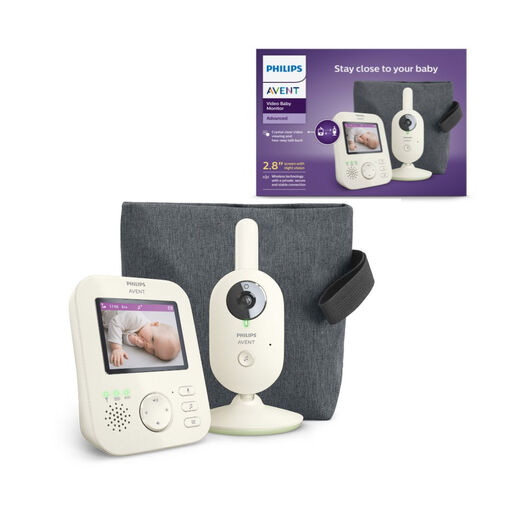
Why it's the right choice: Perfect for parents who don't want to take any risks with the internet. This model operates on a closed circuit, with no app or Wi-Fi, guaranteeing a 100% private connection and immediate, out-of-the-box use.
It bypasses Wi-Fi and its risks by using a proprietary connection technology (2.4 GHz FHSS) that pairs only the camera and its monitor.
Private and reliable connection; ECO mode for up to 12 hours of battery life; incredibly simple setup and use.
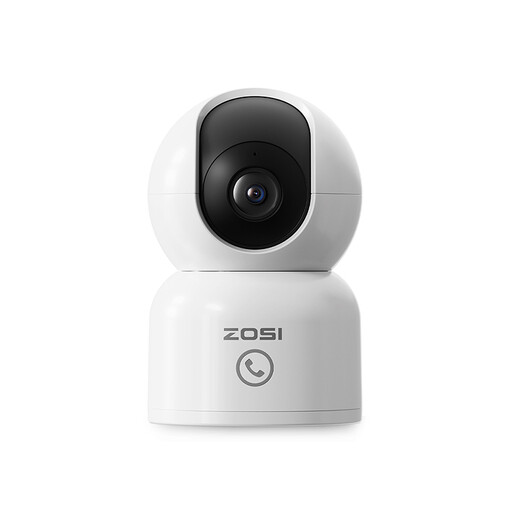
Why it's the right choice: Perfect for those who want a do-it-all device. It serves as a baby monitor today and can be repurposed as a pet camera or indoor security camera tomorrow. Access via the app is a real plus for checking in from the office.
This model focuses on the essentials and avoids the trap of useless gadgets: a 360° view with motion tracking and a very decent 1080p resolution, all at an affordable price point.
360° panoramic view with motion tracking; remote access via app; two-way audio and effective night vision.
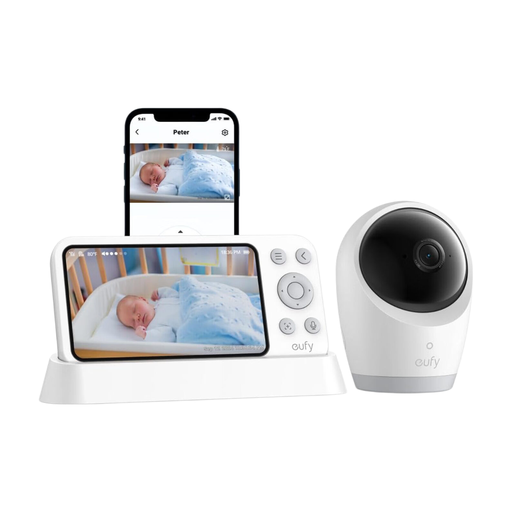
Why it's the right choice: For parents who want the best of the best. The 4K resolution allows for highly precise zooming, while the hybrid mode (Wi-Fi and local) and the portable, battery-powered camera offer maximum flexibility.
It tackles the battery life pitfall head-on with a robust 5000 mAh battery and a portable camera. Its hybrid mode allows you to switch to a local connection to reassure the most security-conscious users.
Hybrid connectivity (Wi-Fi/local); portable, battery-powered camera; 4K resolution for ultra-detailed zoom; large 5-inch screen.
We have compiled a complete selection of products that meet our quality criteria and current safety standards.
What is the real-world range of a video baby monitor? The range advertised by manufacturers (often up to 300 metres) is always measured in an "open field," meaning with no obstacles. In a house with concrete walls or across multiple floors, expect it to be significantly reduced. For a non-Wi-Fi model, you can realistically count on 30 to 50 metres. For a Wi-Fi model, it all depends on the quality of your network's coverage.
Does a Wi-Fi video baby monitor use a lot of mobile data? When you view the video feed from home via your own Wi-Fi, it has no impact on your mobile plan. Your 4G/5G data is only used when you access the camera remotely (from the office, for example). To control your data and cloud usage, look for models that offer local storage on an SD card.
Can you use a standard security camera as a baby monitor? Absolutely, and it's an increasingly popular solution. Many indoor security cameras offer similar functions (night vision, two-way audio, motion detection). However, dedicated baby monitors retain specific advantages: a temperature sensor, built-in lullabies, a VOX mode that is more sensitive to crying, and, most importantly, a local, non-Wi-Fi connection, which many parents consider more secure.