What should you look for?
First, check whether you can actually use an external air vent. Then compare energy use and cycle duration, and choose a capacity that suits your laundry.
Heat pump
Worth considering: for regular drying without an external duct, especially if keeping electricity use down is a priority.
Bear in mind: cycles are generally longer than those of the other types described by UFC-Que Choisir.
Standard condenser
Worth considering: if you don’t have an external vent and drying time matters more to you.
Bear in mind: it generally uses more energy than a heat-pump model, according to UFC-Que Choisir.
Vented
Worth considering: only if you have access to an external opening or suitable ventilation duct.
Bear in mind: it needs a connection to expel moist air outside and generally uses more energy than a heat-pump model, according to UFC-Que Choisir.
| Factor |
What to check |
What matters to shoppers |
| Installation |
Check whether you can access an external opening or duct, then measure the space and check how the appliance collects condensed water. |
If my home has no external vent, I need to rule out a vented installation that the room can’t accommodate. Around 31% of consumers put this installation requirement first. |
| Energy use |
Compare the stated energy use per 100 cycles and the duration of the Eco programme across models with a suitable capacity. |
If I dry several loads each week, I want to use less electricity, even if I have to wait longer for a cycle to finish. This is the top priority for around 31% of consumers. |
| Cycle duration |
Check how long the Eco programme takes, and the load and fabric limits for quick programmes. |
When I have several loads to get through, I want to know how long it will take to get a load ready to use. Speed comes before other factors for around 19% of consumers. |
| Capacity and fit |
Match the capacity in kg to your usual loads. Measure the space with the door open, and compare the stated noise level. |
In a small space or with lots of laundry, I need to be able to load and use the appliance without running extra cycles. Capacity and fit are the top priority for around 19% of consumers. |
Brands to compare
The details below apply to specific models. Check the specifications of the one you’re considering rather than assuming they apply to the whole brand.
Bosch
The French range includes 8 and 9 kg heat-pump tumble dryers, which are useful for comparing capacity, noise and condensate management.
- Bosch Electroménager France lists the WQG2450SFR as having a 9 kg capacity, a noise level of 64 dB(A), a self-cleaning condenser and a water drain hose.
- The WTH83V01FF is listed with an 8 kg capacity and a noise level of 65 dB(A), but without a water drain hose or self-cleaning condenser. These features vary by model.
Beko
Beko also offers a vented model, which is only worth considering if your home can accommodate the external air vent this technology requires.
- Beko France lists the DA8013PA as an 8 kg vented tumble dryer with a stated noise level of 67 dB(A).
- Its product sheet gives it a G energy rating. This applies to the DA8013PA, not to all Beko tumble dryers.
Miele
The French range includes 8 and 9 kg heat-pump models, with differences in condensation features and cycle duration.
- Miele France says the 8 kg TSA523WP has a water tank and an integrated condensate drain kit.
- Miele lists an Eco programme duration of 231 minutes for the 9 kg TQ 1000 WP. Check this if you need to dry several loads in a row.
Tumble dryers available on Joybuy
These condenser models, several of them heat-pump dryers, are suitable for drying clothes indoors without an external air duct. Compare each model against the space you have, your laundry loads and the cycle duration that works for you.
 Image unavailable
Hotpoint CHD84MWBSEE — 8 kg, class C
This 8 kg heat-pump tumble dryer is worth considering if you dry clothes regularly and don’t have an external air vent.
The product title gives it a C energy rating. To compare it with other models for everyday use, check the Eco programme duration, energy use per 100 cycles and appliance dimensions.
View on Joybuy
 Image unavailable
Comfee CD08EHP05W-HR — 8 kg, class D
This 8 kg heat-pump model could be a good option for regular drying without an external duct.
The product title gives it a D energy rating. If a quick programme is one of the reasons you’re considering it, check the load and fabrics it’s designed for in the instructions. Also compare the Eco programme duration and the space it takes up.
View on Joybuy
 Image unavailable
Electrolux EDH1018CD GentleCare — 8 kg
This 8 kg condenser tumble dryer could work in a home without an external air duct.
If you plan to use it often, compare its cycle duration and energy-use figures with those of heat-pump models. Measure the space you have and check the clearance required in the instructions.
View on Joybuy
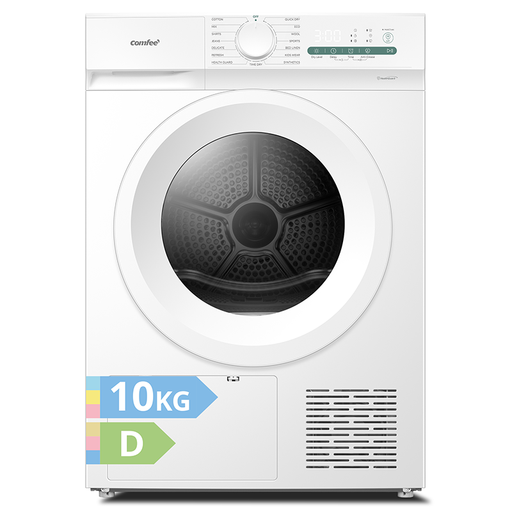 Image unavailable
Comfee CD10EHP05W-HR — heat pump
This heat-pump model is worth considering for drying clothes indoors without an external air vent.
Check its capacity before choosing it for your usual loads: the product title gives 10 kg, while another description says 8 kg. Also check the Eco programme duration and dimensions.
View on Joybuy
Frequently asked questions
Can you install a tumble dryer without an external opening?
Yes. A condenser tumble dryer, including a heat-pump model, doesn’t need an air duct to the outside. UFC-Que Choisir says a vented model, however, needs an external opening or access to a ventilation duct. Also follow the location and installation instructions for the model you choose.
Does a condenser tumble dryer need to be connected to a water drain?
Not necessarily. Condensed water can collect in a tank, while some models can be connected directly to a drain. Bosch Electroménager France lists a water drain hose for the WQG2450SFR, but not for the WTH83V01FF. Check the product details and instructions for the exact model.
How do you compare the energy use and cycle duration of two models?
Look at the energy use per 100 cycles, the Eco programme duration and the capacity that suits your loads. An energy rating on its own doesn’t tell you how long your clothes will be in the dryer. Check the conditions for quick cycles too if you plan to use them.
Is a heat-pump dryer a good choice if I need to dry clothes quickly?
It’s most worth considering if energy use matters and you’ll be drying clothes regularly. UFC-Que Choisir says heat-pump cycles are generally longer than those of standard dryers. If you need to get through several loads, compare the duration of programmes suited to your laundry. A vented model still needs a suitable external air vent.
What if I still dry some clothes on an airer indoors?
For clothes drying naturally on an airer, ADEME recommends using a large, well-ventilated room or one with a mechanical ventilation (VMC) extraction vent, preferably humidity-sensitive. This advice is for air-drying clothes. For a tumble dryer, follow the installation instructions for your appliance.


