Households that often dry large loads
You need a capacity that suits the amount of laundry you usually do, and want to compare energy use if you run the dryer regularly.


If you don’t have an external vent, choose a condenser dryer rather than a vented tumble dryer. Go for a heat pump model if you dry clothes often and want to keep energy use down, or a standard condenser dryer if shorter cycles matter more. If you only have room for one appliance, consider a washer-dryer and check its drying capacity, which is separate from its washing capacity. In every case, follow the model’s instructions for ventilation and installation.
You need a capacity that suits the amount of laundry you usually do, and want to compare energy use if you run the dryer regularly.
A washer-dryer combines both functions in one appliance, but its drying capacity may be lower than its washing capacity, as the Electrolux EW7IW4966BG illustrates.
If you dry clothes less often and want to compare cycle times, look at the programmes available on standard condenser dryers, as well as their stated energy use.
For a home without an external vent, start by considering the space available and the amount of laundry you need to dry. Then compare energy use and programme times for the models you’re considering.
Consider this: if you dry clothes frequently and energy use is an important factor in your choice.
The trade-off: according to Que Choisir’s guide, cycles are generally longer than with a standard condenser dryer.
Consider this: if drying time matters more and you only use the dryer occasionally.
The trade-off: Que Choisir reports that these models generally use more energy than heat pump models. Compare the specifications for the individual appliances you’re considering.
Consider this: if you only have room for one appliance to wash and dry your clothes.
The trade-off: the drying capacity may be lower than the washing capacity. Electrolux lists capacities of 6 and 9 kg respectively for its EW7IW4966BG.
| Factor | What to check | What matters to you |
|---|---|---|
| Regular use | Energy use for a comparable programme and the drying capacity. | If I dry several loads each week, the electricity used for each cycle matters when I’m choosing a model. Around 36% of consumers make this their top priority. |
| Amount of laundry | Drying capacity in kg and the appliance’s dimensions for the space available. | I want to avoid having to split a typical household load across several drying cycles. This is the top priority for around 29% of consumers. |
| Space available | Dimensions, access to the appliance, and separate washing and drying capacities. | If I only have room for one appliance, combining washing and drying matters more than drying a large load all at once. Around 21% of consumers prioritise this. |
| Cycle times | The programme time for the load you expect to dry and its corresponding energy use. | If I need my laundry ready sooner, I’d rather check the actual programme times, even if energy use may be higher. Around 14% of consumers make this their top priority. |
A condenser dryer doesn’t need to vent air outside. However, you still need to meet the requirements for installing the appliance. Bosch’s instructions, for example, call for a well-ventilated room and an unobstructed ventilation opening.
Measure the space and check the instructions for the exact model to find out about clearances, ventilation and the required connection.
The Electrolux EW7IW4966BG has a stated washing capacity of 9 kg, compared with 6 kg for drying. So a full 9 kg wash load can’t all be dried at once at its maximum capacity.
Compare the drying capacity in kg with your usual loads, and check the specifications for combined cycles.
Splitting a load across several cycles means more drying to plan.
A short programme doesn’t tell you everything about energy use or the amount of laundry it can handle. Que Choisir outlines the trade-offs between cycle time and energy use for standard condenser and heat pump dryers.
For suitable loads and programmes, compare the cycle time and energy use listed for the specific models you’re considering.
Condenser drying means managing the collected water and following the appliance’s cleaning instructions. Direct water drainage is only possible if the model and installation allow it.
Before choosing, check the instructions for emptying the tank, cleaning the filters and any requirements for a water connection.
The WQG13500FR is an example of a heat pump tumble dryer to consider for larger loads.
The FFTBCM118XBFR provides a comparison point for a standard condenser dryer.
The EW7IW4966BG washer-dryer shows why a combined appliance can be a good option when you only have room for one.
These standard condenser and heat pump models are worth considering if you’re looking for a tumble dryer without an external vent. Compare their capacity and energy information, then check the installation and water management requirements for the model you choose.
 Image unavailable
Worth considering if you’re looking for a condenser dryer with a stated capacity of 8 kg and no external vent.
The product name mentions OptiSense and a propane refrigerant. Check the instructions for ventilation and clearance requirements, as well as how to drain the water.
 Image unavailable
Compare this model if you dry loads of up to its stated 8 kg capacity and want to consider a heat pump option without an external vent.
The product name lists an energy rating of C. Check the instructions for dimensions, ventilation and the requirements for any direct water connection.
 Image unavailable
Worth considering if you want to dry clothes without an external vent and need a stated capacity of 8 kg.
The product name lists an energy rating of D and mentions refresh and UV lighting functions, but doesn’t establish how they affect your laundry. Check the instructions for dimensions, ventilation and water management.
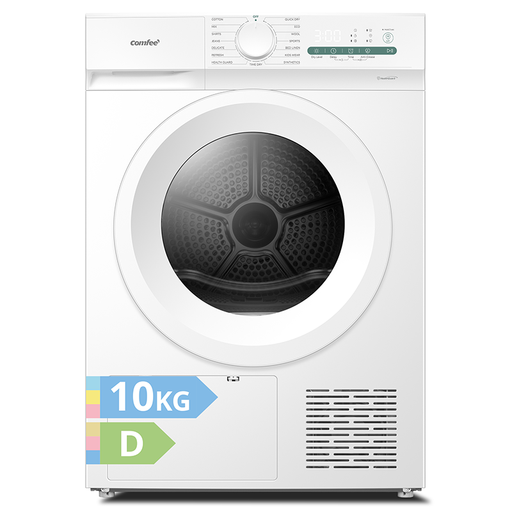 Image unavailable
Worth considering as a heat pump tumble dryer without an external vent, provided its capacity suits your loads.
The title lists 10 kg, while one description gives a capacity of 8 kg. Confirm the drying capacity of this variant before you choose. The product name lists an energy rating of D; also check the instructions for installation and water management.
Yes. A condenser tumble dryer, including a heat pump model, doesn’t need an external vent, unlike a vented model, as Que Choisir explains. You still need to follow the dimensions and installation instructions for the model you choose.
Yes. Not having an external vent doesn’t remove the need to follow the appliance’s ventilation requirements. Bosch’s instructions call for a well-ventilated room and an unobstructed ventilation opening. Check the instructions for the model you plan to install.
Start with its drying capacity if you want to dry your laundry in the same appliance. Electrolux lists a washing capacity of 9 kg but a drying capacity of 6 kg for the EW7IW4966BG, so a full-capacity wash load will need to be split for drying.
Compare the energy information for the exact models using equivalent cycles and loads, rather than figures based on different conditions. The European Commission says you can use the EPREL database to check information for products covered by energy labelling.
The legal guarantee of conformity applies to new goods bought from a professional seller in France. The French Ministry of the Economy states that the guarantee lasts for two years. Any additional commercial guarantee is separate.