Tenants or homeowners without an external outlet
You want a drying solution without installing a duct or using an external opening. The first distinction is therefore between condenser appliances, including heat pump models, and vented dryers.


Without an opening or duct to the outside, rule out vented tumble dryers: a condenser model, with or without a heat pump, can work without an external connection. A heat pump is particularly suitable for frequent drying if you are happy to accept longer cycles; a washer-dryer is most useful when only one space is available, provided you take its drying capacity and connections into account.
You want a drying solution without installing a duct or using an external opening. The first distinction is therefore between condenser appliances, including heat pump models, and vented dryers.
You need a capacity that matches your washing machine and want to keep an eye on electricity consumption during repeated use. In particular, compare the heat pump, Eco programme duration, kWh per 100 cycles, noise level and how condensed water is handled.
You cannot install a separate washing machine and tumble dryer. A washer-dryer can meet this need if you accept a lower drying capacity than washing capacity and have the necessary connections.
Consider it: if you need a tumble dryer without an external duct and prefer a generally quicker cycle.
Bear in mind: resistance-heated appliances use more energy than heat pump models, and condensed water must either be emptied or drained, depending on the model.
Choose it: for regular drying in a flat without an external vent, when the cycle length fits your routine.
Check: the Eco duration, capacity, kWh per 100 cycles, noise level and how the model handles condensed water.
Choose it: when only one space and one appliance are possible, or for occasionally drying small loads.
Accept that: the drying load is often smaller than the washing load, and complete cycles can be long.
| Priority | What to check | Your needs |
|---|---|---|
| Installation without a duct | Choose a condenser or heat pump appliance. Check the ventilation required in the instructions and the intended installation space. | I want to dry laundry in a room without a duct or opening to the outside. |
| Energy consumption and duration | Compare kWh per 100 Eco cycles, Eco duration, capacity and noise level using the same generation of energy label. Since 1 July 2025, the energy label for tumble dryers has used an A to G scale, according to GIFAM and the applicable European regulation. | I dry laundry frequently and want to balance electricity consumption against programme duration. |
| Capacity and footprint | Measure the height, width and depth, door clearance and delivery route. For a washer-dryer, check the drying capacity, which is separate from the washing capacity. | My available space is limited and I want to avoid splitting my laundry loads too often before drying. |
| Condensed water and stacking | Check whether there is a compatible tank or drain hose. For a stacked installation, choose only a kit explicitly compatible with both appliances. | I want to know whether I will need to empty a tank and whether stacking is suitable for my installation. |
A condenser appliance avoids the need for an external duct, but available space, ventilation, the power socket, stability, door opening and condensed-water management remain essential considerations.
Read the French instructions for the exact model before ordering and check the installation requirements, electrical connection, alignment and any possible water drainage arrangements.
An appliance advertised as 10/6 kg or 8/6 kg can only dry 6 kg at a time. A full washing load may therefore require you to remove some of the laundry or run a second drying cycle.
Base your choice on drying capacity and how often you do large loads, not just on the stated washing capacity.
Since July 2025, the A to G scale and its indicators have changed. An old A+++ rating cannot be compared directly with a letter on the new label.
Compare kWh per 100 Eco cycles, Eco duration, capacity and noise level between appliances displaying the same generation of energy label.
An unapproved stacked installation may be unstable, particularly when the appliances differ in manufacturer, depth or dimensions.
Use a stacking kit explicitly compatible with both product references rather than relying on a similar width.
The stacking kit is a separate accessory, and compatibility depends on the selected product references.
An example of a freestanding heat pump tumble dryer range for households looking for a large capacity. The WQG2450SFR is listed with a 9 kg capacity and dimensions of 842 × 598 × 613 mm.
Offers separate heat pump tumble dryers and washer-dryers. The EW9W1165RC illustrates a space-saving solution with a 10 kg washing capacity and 6 kg drying capacity.
Offers freestanding washer-dryers, including some models with a reduced depth. The FFWDB864349BVEE is listed with an 8 kg washing capacity, 6 kg drying capacity and a depth of 57 cm including the door.
Offers 8 or 9 kg heat pump tumble dryers and, depending on the model, options for stacking or integrated condensed-water drainage.
This selection brings together condenser tumble dryers, including heat pump models, as well as a washer-dryer for flats without an external duct.
 Image unavailable
A heat pump option for loads of up to 8 kg in a home without an external duct.
Listed specifications include an 8 kg capacity, C energy rating and direct connection for the drain hose.
Check the French instructions for the dimensions, ventilation, door clearance, drainage accessories and any stacking installation.
 Image unavailable
Suitable when one appliance needs to handle both washing and drying in a single space.
Listed specifications include an 11 kg washing capacity, 6 kg drying capacity and dimensions of 60 × 85 × 60 cm.
The stated wash-and-dry cycle lasts 7 h 32 min; confirm the water inlet, drainage, socket and ventilation space before installation.
 Image unavailable
An 8 kg condenser tumble dryer for installation without a connection to the outside.
Listed specifications include dimensions of 60 × 65 × 85 cm, a reversible door and a water collection tank.
Check the French instructions for clearances, ventilation and whether direct water drainage is possible.
 Image unavailable
A heat pump solution listed for everyday loads without an external duct.
Listed specifications include an 8 kg capacity, D energy rating, three drying levels and a double-layer filter.
Check the dimensions, door clearance, ventilation, condensed-water management and stacking compatibility in the instructions.
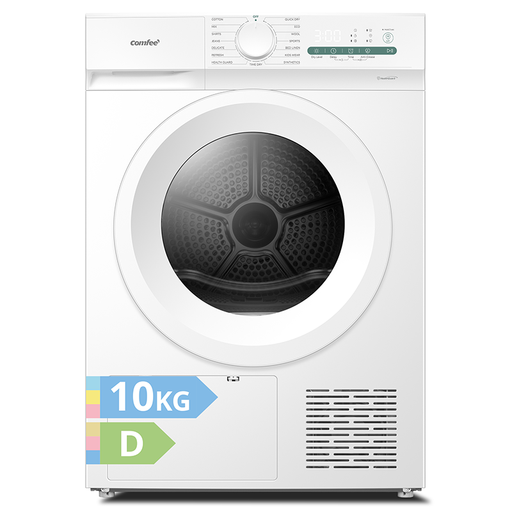 Image unavailable
A heat pump tumble dryer for a flat without an external duct.
Listed specifications include a D energy rating, three drying levels, a double-layer filter and a refresh programme.
The capacity is stated as 10 kg in the title but 8 kg in another description: confirm the specifications for the exact SKU, along with the dimensions and condensed-water management.
Yes. Condenser tumble dryers, with or without a heat pump, do not need a connection to the outside, unlike vented models. However, follow the ventilation and positioning requirements in the French instructions for your chosen model.
Do not assume that a water inlet is required. Instead, check how the model handles water extracted from the laundry: a condensation tank, drain hose or both, depending on the product reference and supplied accessories.
Measure the height, width, closed-appliance depth, door clearance, delivery route and the space required for connections. Dimensions and door clearance vary by model.
Yes, but only with a suitable stacking kit compatible with both appliances. The Bosch WQG2451SFR instructions specifically state that the appliance must not be stacked without the manufacturer's appropriate connection kit.
The first figure indicates the washing capacity and the second indicates the drying capacity. For example, a 10/6 kg model can wash 10 kg of laundry but dry only 6 kg at a time, so a full load may need to be divided before drying.